
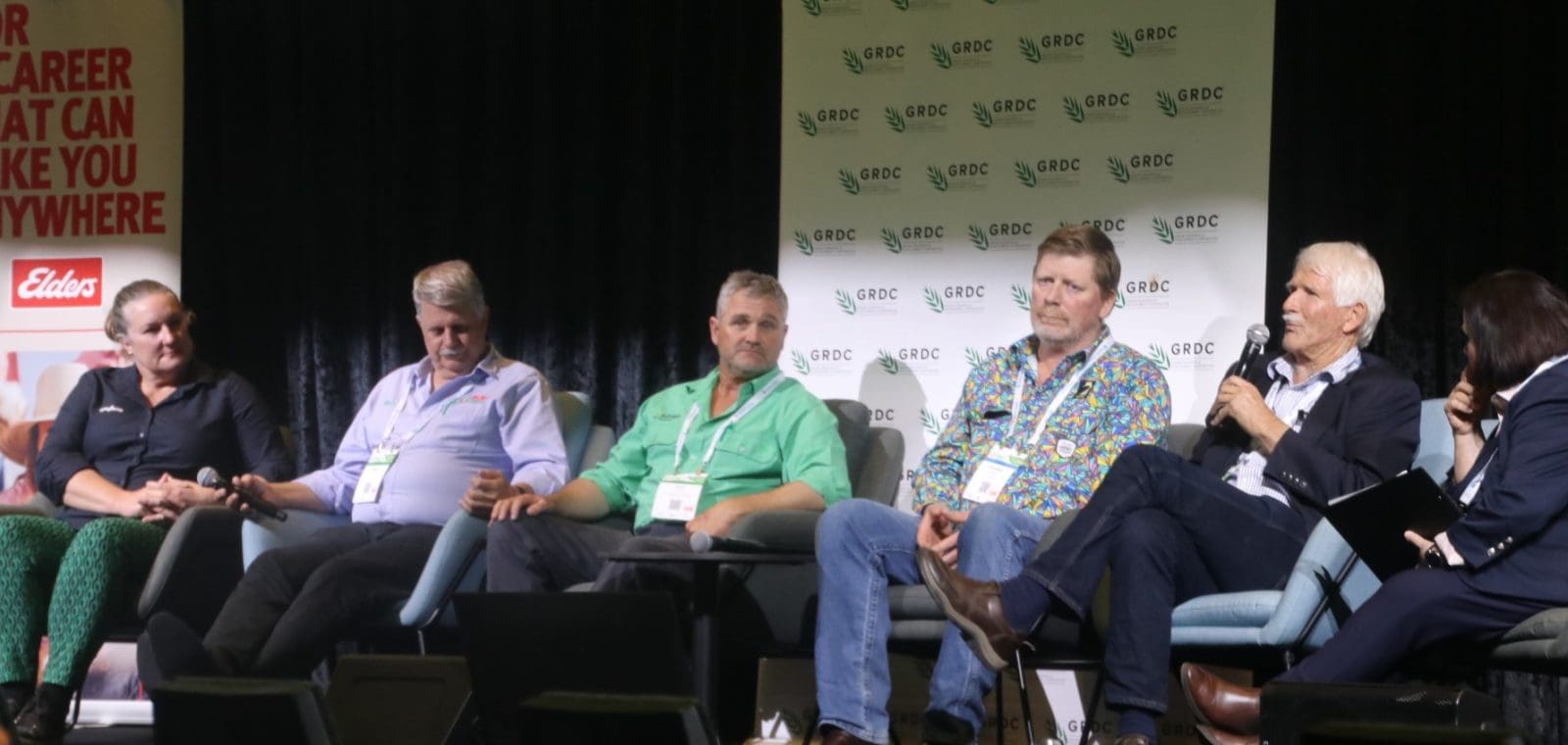
Syngenta technical manager herbicides Sarah Wilson, ICAN consultant Mark Congreve, Nutrien Ag Solution agronomist Ross Pomroy, AgForce grains president Brendan Taylor, and B&W Rural director Peter Birch.
REGULATORY shortcomings and knowledge gaps in the oversight of agricultural chemicals are causing delays and confusion in bringing new products to market, the Australian Summer Grains Conference has heard.
These issues are being compounded by growing herbicide resistance and the need to find new products, technology and management techniques to combats pests and weeds without traditional chemicals.
A panel at the event held last week at the Gold Coast, and entitled Future of Chemistry in Ag, featured insights from Syngenta technical manager herbicides Sarah Wilson, AgForce grains president and Warra grower Brendan Taylor, Nutrien Ag Solutions Dalby agronomist Ross Pomroy, ICAN consultant Mark Congreve and B&W Rural director Peter Birch, Moree.
As a developer and marketer of agricultural chemicals, Ms Wilson said the regulatory system, led by the Australian Pesticide and Veterinary Medicines Authority, had been a major roadblock for industry.
She said when lodging applications and submissions, Syngenta had encountered difficulties due to decision-makers lack of on-farm knowledge.
“The registration process…is becoming increasingly difficult to negotiate,” Ms Wilson said.
“[Regulators] aren’t necessarily trained in agriculture, so with our submissions, we’re at the point now where we have to explain the crop.”
Ms Wilson said they had a situation where Syngenta offered to “show them some things because they have a lack of understanding” and took representatives to view some products for cotton.
“They got out of the car and wandered off into the sorghum.
“There’s a real lack of understanding and I think there’s many, many reasons for that.
“They’re going through a whole different turmoil at the moment with the APVMA.
“Good will come of it, but in the meantime…everyone has had registrations held up and [it has] cost us time and money.”
Ms Wilson said this was slowing the path to market.
“The fact is that our product registrations today cost between $450 and $550 million per molecule and it takes between 13 and 15 years.
“We are at the point when the APVMA have held us up for two years on a key product registration because they didn’t understand the pest.
“The clock is ticking for us to try and actually get our money back and reinvest in new products.
“There’s a complete lack of understanding and a lack of accountability as well.”
She said this situation was more concerning when it came to the evaluation of relatively new technologies, such as green-on-brown and green-on-green camera-based spraying.
“They don’t know how to deal with these.”
Ms Wilson said there was uncertainty around the application process for these technologies with the regulator commenting that “we don’t know”, when several of these are already registered.
As a member of the grains industry for more than 40 years, Mr Birch said he had seen the benefits of industry collaboration with the APVMA.
He said industry body CropLife had some success organising on-farm tours with APVMA representatives in the past.
“A few years ago, CropLife actually organised the tours and the APVMA agreed to going out to…farms to actually start to learn,” Mr Birch said.
“I think it was a really good process, and we probably should revisit that because…there’s very little knowledge in the APVMA in actually what happens on the ground and why it happens and what the implications are.”
Paraquat review
Panelists discussed the potential outcomes of an ongoing APVMA review on the use of paraquat and diquat.
Mr Congreve said there was potential for the regulator to keep its initial view, further restrict usage, or broaden usage.
“I think it’s too early to tell,” Mr Congreve said.
“They could go further, and we could lose paraquat altogether.”
He said all options “were still on the table” and it was impossible to tell what was “the most likely winner at this stage”.
He said any changes to paraquat usage would “make it harder that’s for sure and…potentially more expensive” but that “generally every time we have a problem we find a solution”.
Mr Taylor said there was potential for this decision to impact the efficacy of other agricultural chemicals.
He said this would include impacting products, such as RoundUp, which were used as part of a double-knock method, and that would possibly need to be used in greater volumes, therefore increasing the likelihood of resistance.
“If we lose one product, it might exacerbate or speed up the removal of two other products through resistance,” Mr Taylor said.
Non-chemical solutions
With the potential restriction of the use of Ag chemicals and the longer term reality around herbicide resistance, panelists discussed potential innovative solutions.
Mr Pomroy said using crop rotation alongside biologicals could go part-way to solving these issues.
“If we can use the biologicals to improvement out crop production, to improve biomass, to compete more with our weeds to have a healthier plant to compete against fungal diseases, compete against insect damage,” Mr Pomroy said.
Mr Taylor suggested that developing genetically-modified crops could also contribute to a future without the current chemical line up.
“If you look at the GM side in cotton, it has revolutionized growing cotton from an insect management point of view.
“Maybe GM is the next step we need to be going in in other grains from a potentially user point of view and from an insect management point of view.”
Despite these major challenges, Mr Birch and Ms Wilson said they were optimistic that the grains industry could find innovative ways to solve them.
Mr Birch said he was “very confident they will keep coming up with the answers”.
“Australian agronomists, growers, people in agriculture, whatever your role might be, you are renowned across the world for being the most innovative,” Ms Wilson said.
“Whatever the decision might be we will find a way to make it work.”
Grain Central: Get our free news straight to your inbox – Click here
How the hell have we come to a situation where the APVMA don’t have any agricultural knowledge. They need to start learning and fast otherwise we are on a hiding to nowhere. Maybe a formal agricultural teaching strategy needs to be applied to those involved in making these decisions.