
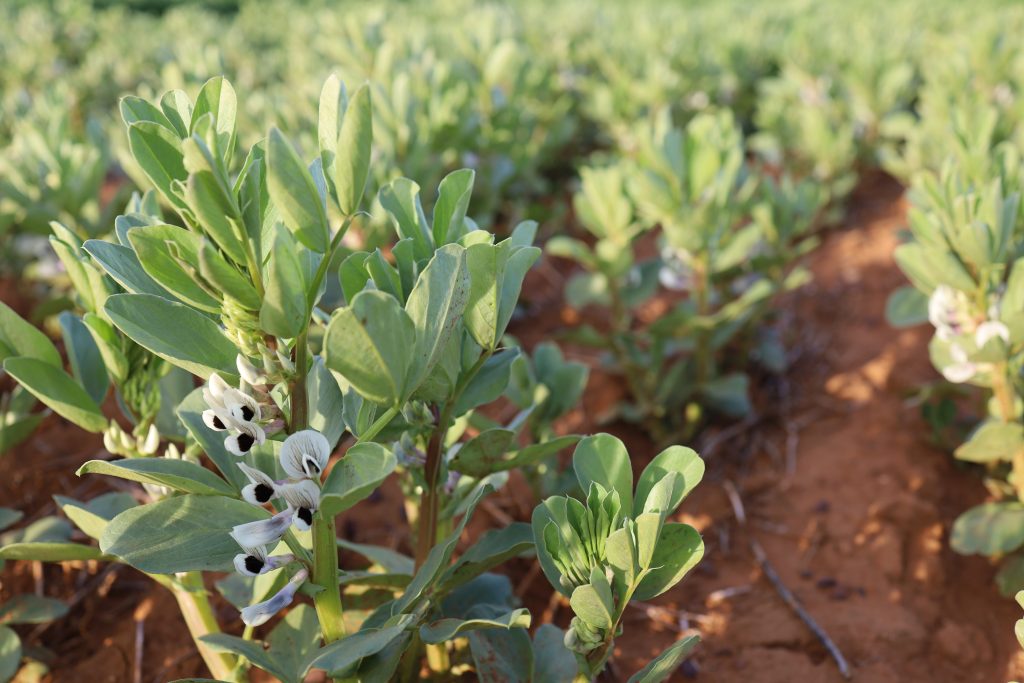
A faba bean trial site in Warne, Victoria.
DETAILS of a national Faba Bean Breeding Program to provide improved higher-yielding varieties of faba beans with better disease resistance, quality traits and adaptation across Australian growing regions have been announced by the Grains Research and Development Corporation.
Australia is the world’s largest exporter of faba beans, supplying around one-third of global trade, with key markets including Egypt, the Middle East, North Africa and South-east Asia.
The 2.5 year program has a total value of $9.5 million, and is a co-investment of GRDC, InterGrain and the Adelaide University.
The program will be led by InterGrain., which is jointly owned GRDC and the Western Australian Goverment.
GRDC manager genetic technologies Camilla Hill said the program marked a significant step forward for the Australian faba bean industry, and builds on more than a decade of investment in faba bean breeding.
“The new national Faba Bean Breeding Program brings together world-class expertise and a refreshed delivery model to accelerate the development of faba bean varieties that will meet grower needs into the future,” Dr Hill said.
“Its focus is on improving yield, disease resistance, adaptation and quality traits, so growers have access to faba bean varieties that perform reliably across existing production regions and as the crop continues to expand into new areas.”
Dr Hill said the program followed GRDC’s previous investment in faba bean breeding through Pulse Breeding Australia, University of Sydney and Adelaide University, which since 2011 had underpinned steady improvements in variety performance and market suitability.
“This investment builds on a solid history of GRDC investment in faba beans and reflects confidence in the crop’s long-term role within Australian farming systems.
“The renewed approach allows us to target specific regional and market requirements more effectively, while ensuring breeding outcomes translate quickly into on-farm benefits for growers.
“One aspect of the project will focus on delivery of the breeding program and associated intellectual property, while the second aspect will address variety release and commercialisation.”
Dr Hill said the program aimed to strengthen the profitability and sustainability of faba bean production, with long-term targets focused on lifting production, supporting export growth and meeting rising domestic demand for plant-based protein.
“We see strong opportunities for faba beans to play an even greater role in Australian crop rotations, delivering both financial and soil health benefits while supporting diversification at a whole-of-farm level.”
InterGrain chief executive officer Tresslyn Walmsley said the company was in a great position to deliver new varieties for growers.
“This renewed national breeding effort is about giving growers more choice and confidence – delivering higher-yielding faba bean varieties with stronger disease resistance and quality traits,” Ms Walmsley said.
“With InterGrain’s national breeding platform and deep connections across Australia’s growing regions, we’re well placed to ensure these improvements are developed, tested and delivered where growers need them most.”
Dean of Adelaide University’s School of Agriculture, Food and Wine Jason Able, said this was “an exciting era” for faba bean breeding in Australia.
“With the rich history and continued legacy of plant breeding education, research and variety development at Adelaide University’s Waite campus, combined with InterGrain’s proven variety success across several commodities, the faba bean varieties of tomorrow developed through this partnership will value-add significantly across the industry,” Professor Able said.
“For an industry that is worth more than $300 million in Australian exports annually, this partnership will further contribute to the profitability of Australian growers already growing faba and provide new opportunities for those growers yet to evaluate faba as part of their rotation.”
Faba beans are an increasingly important crop for Australian growers, offering a valuable rotation option alongside cereals through nitrogen fixation, improved soil health and weed and disease break benefits.
As a cool-season legume, faba beans also provide growers with flexibility in challenging seasons and access to premium markets.
Australian faba bean production has expanded significantly over the past decade, underpinned by strong export demand and growing interest from the domestic food and feed sectors.
The new Faba Bean Breeding Program is designed to support this growth by delivering varieties with improved yield potential, disease resistance and seed quality, while ensuring adaptation across Victoria, South Australia, northern New South Wales, southern Queensland and Western Australia, where interest in expanding production is increasing.
By aligning breeding investment with clear market signals and regional production needs, GRDC and its partners aim to secure the long-term resilience of the Australian faba bean industry and maximise returns for growers.
Source: GRDC
The successful faba bean improvement program operated by Uni of Sydney from PBI at Narrabri for the last 12 years has been terminated. Can a successful faba bean program for NW NSW be conducted from a site 1500Km away? NW NSW is in a sub-tropical zone, while Adelaide is in a temperate Mediterranean environment.