
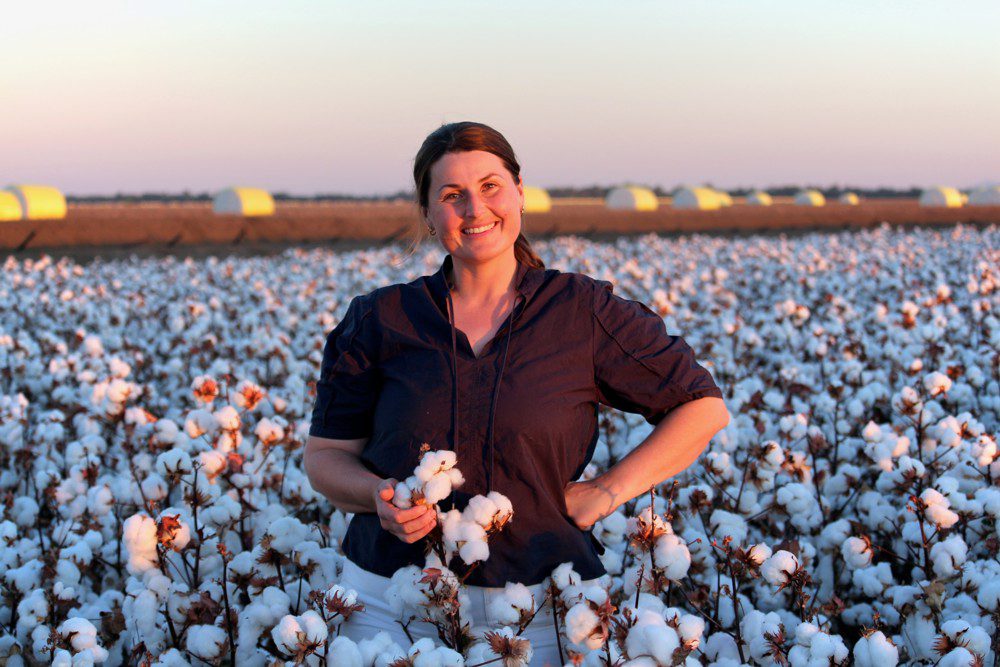
INTEGRATING semi-irrigated cotton into farming systems could help growers build resilience as water availability declines because of climate variability and government buybacks, according to 2025 Nuffield Scholar Kate Lumber.
The Moree-based Poole Ag Consulting agronomist presented her findings to a packed room at last week’s Australian Cotton Conference.
Her Nuffield report, Making Every Drop Count, was released a week earlier to coincide with the event.
The study comes amid low water allocations in many New South Wales valleys, driven by poor rainfall and the Federal Government’s Murray-Darling Basin buyback policy.
Ms Lumber said that the industry was “really good at growing cotton when water isn’t limited” but “we find it a lot harder to transition to systems that perform when we don’t”.
“It’s about building adaptable systems that take advantage of the hand that they’re dealt,” Ms Lumber said.
She argued that there was a “fit for semi-irrigated cotton to meet that challenge”.
At the start of the season, growers face the key decision of how many hectares to plant.
“It’s made earliest with the least information and it’s the hardest decision to walk back from, and the way I see it comes down to three main questions: how much water is confirmed; how secure is that position, and what’s your tolerance to risk?”
During times of reduced allocation, Ms Lumber said growers typically switch to minimise area to keep a “fully irrigated approach, protecting yield potential and giving relative return certainty on every hectare zone”.
“You then move into moderate deficit where you’re spreading the same amount of water across more hectares at a planned deficit.
“We then have a hybrid split which is dividing the farm into a priority one area at full water and a priority two area deliberately deficit irrigated, and a round up area which is planning to an expected water position and accepting the risk of buying water to finish or accepting an early cut-out.”
She said none of these approaches was “inherently right”, but the research supported a hybrid model in an environment of reduced water availability.
“In a water-limited environment, the metric that matters is return per megalitre, not return per hectare.
“No single strategy wins season on season and my research throughout my Nuffield project supports transitioning to a hybrid model as water availability declines.
“Most confirmed water is allocated to a fully irrigated priority one area and a smaller semi-irrigated deficit priority two area is grown alongside it.
“What that gives you is a contained downside, genuine upside if conditions improve, and a farm position to respond as the season progresses.”
Ms Lumber said she had figures behind this judgment but underlined that they were “illustrative, not prescriptive” and available in her report.
“The real value is running the same comparison at your own cost of production and achievable yields.”
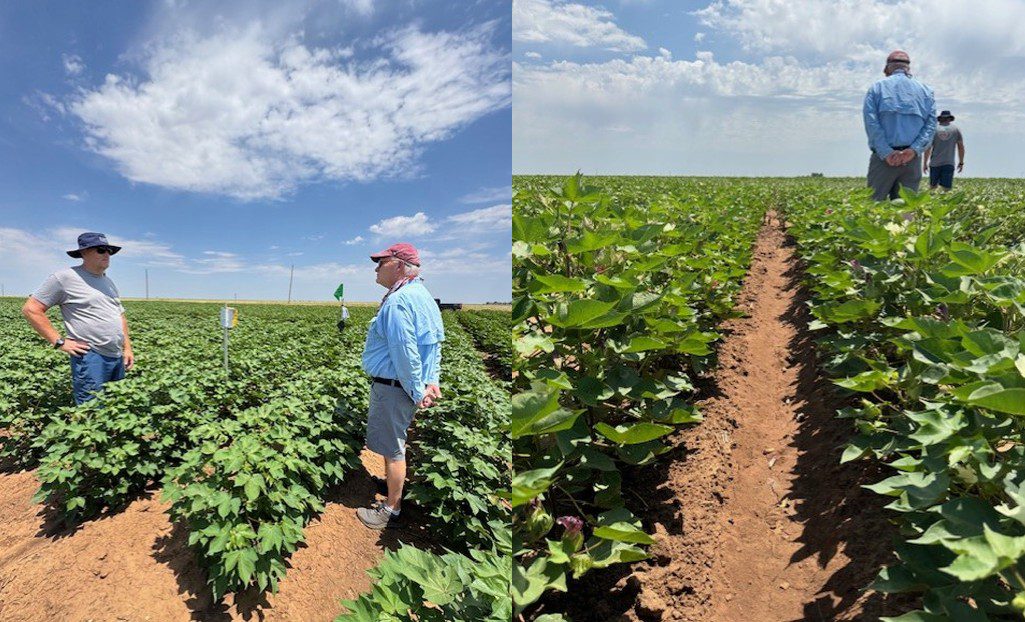
In the field looking at monitoring technologies and deficit irrigation under pivots and drip tape on her Nuffiled visit to the US which included Lubbock,Texas. Source: Kate Lumber
Flexible farming systems
Ms Lumber said a hybrid model offered flexibility that maximised returns for an operation.
She said this would require a shift in mindset for some growers.
“Too often we try to make the crop fit our expectations instead of making decisions to fit the crop and for the season.
“The most resilient growers continually ask: ‘given the water I have today, what’s the best crop I can grow and confidently finish?’”
She said that this was “genuine adaptive management”.
“Flexible farming systems outperform fixed production systems under uncertainty.
“The best businesses don’t have one production system; they have options and flexibility.
“When allocations fall, they don’t simply shrink, they reconfigure and that’s why semi-irrigated cotton shouldn’t be viewed as a reduced version of irrigation, but as a production system that allows businesses to scale to opportunity.
“Resilience isn’t having more water; to me it’s about having more options.”
Better decision-making
Ms Lumber said her research ultimately found that the success of resilient semi-irrigated cotton came down to efficient and effective decision-making.
“Across Australia, Brazil and the United States, the biggest differences between businesses weren’t explained by rainfall or infrastructure; they’re explained by the quality of decisions.
“Water creates opportunity and good decisions determine how much value you can create from those opportunities.”
She pointed to decision-making around new technology as a key factor separating average farming operations from top-tier operations.
“I visited farms with extraordinary technology and farms achieving outstanding results with surprisingly simple systems.
“The difference was never technology, it was whether it changed a decision.
“The real investment isn’t in hardware or software, it’s building the confidence to use technology wisely and making better decisions every day.”
Ms Lumber said a trusted relationship between growers and advisers was also important to making effective decisions.
“In semi-irrigated systems, the limiting factor is rarely technical; it’s mostly human.
“I see trusted relationships between growers, agronomists and advisors as a key to this.
“The psychology of change where barriers to adoption are rarely about access to information, but about the conditions which people act on.
“A disciplined risk assessment and knowing the true cost of production well enough to act with confidence and proactive versus reactive management and the discipline to act ahead of a decision window rather than in response to it.”
Ms Lumber presented at a session titled: Water: Maximising The Returns From Your Irrigation Asset.
To read her full Nuffield report click here.
Grain Central: Get our free news straight to your inbox – Click here
HAVE YOUR SAY