
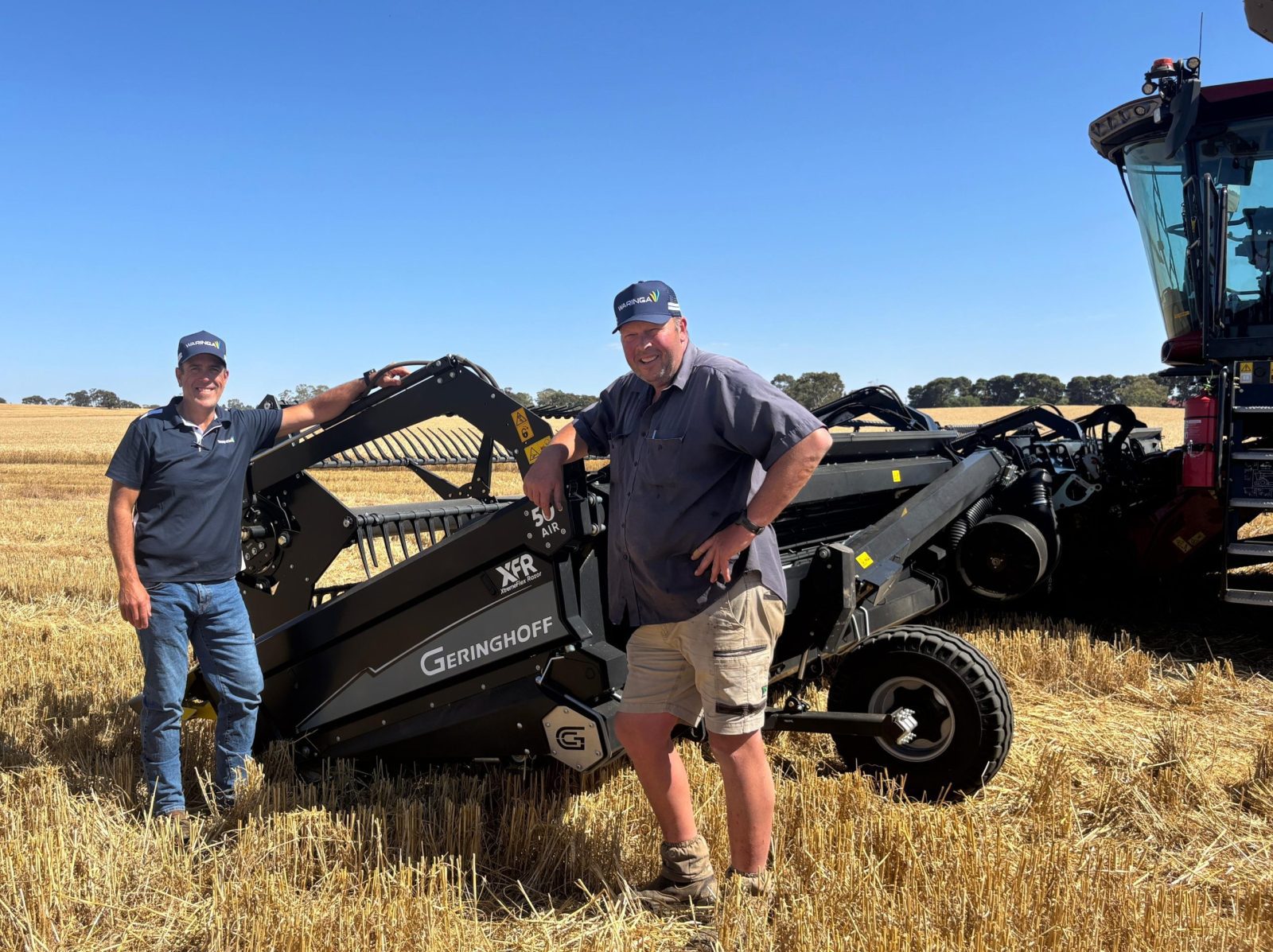
Waringa Distribution’s Gavin Branson (left) and farm manager Philip Barr during a pause in harvesting with Geringhoff’s latest 15.2m draper front fixed to a Case IH AF10 header and operating in SA’s Mid North. Photo: Waringa
FARM manager Philip Barr doesn’t mind being the “guinea pig” for new equipment and, after operating the largest header front of its type in Australia at harvest, he is pleased to share that it achieved all targets.
Mr Barr manages several properties from Mallala to Riverton in the Mid North region of South Australia for Adelaide lawyer Peter Moloney.
The farms grow wheat, barley, lentils, canola, and faba beans over about 1820ha, and also look to fatten trade lambs on bean stubbles.
Mr Barr said they were previously using a John Deere S790 harvester with a 12m MacDon FD140 front; however, after its spring launch at the Yorke Peninsula Field Days at Paskeville, they took delivery of the only 15.2m Geringhoff flexible draper front available in Australia, partnered with a new Case IH AF10 header.
Through national distributor Waringa Distribution, Geringhoff fronts measuring 9.15-13.7m across were made available to suit all crops and header brands throughout the country last season, with the new 15.2m model only recently released in North America.
Three-sectioned frames with the Geringhoff fronts act independently, allowing them to adjust from one end to the other by close to 1.2m.
Flexible cutterbars add another 150mm for total adjustment of around 1.3m, making them the most flexible fronts in Australia.
The 15.2m front at the Moloney properties offers full flexibility, with both a rigid and flexible cutterbar, and it includes Geringhoff’s fully integrated air system, which operates directly behind the knife to guide crop on to the belt and ensure maximum reduction in harvest losses.
The diameter and speed of the centre feed drum auger with the latest front also have been increased to allow combine harvesters to run at maximum capacity.
Geringhoff fronts already feature the widest centre section with floating, mechanical drive intake auger to feed in high-yielding and bulky crops.
“We couldn’t get the capacity out of the John Deere; we could only get 35 tonnes per hour with wheat, and we want to be getting 50-60t/hr,” Mr Barr said.
“We are now doing that easy with the machines we have got now.”
Mr Barr said they conducted significant research to assist their decision on a header front and, in this case, it was a little strange not to “kick the tyres” prior to purchasing.
Ideal for lentils
Local machinery dealer Ramsey Bros offered the Geringhoff fronts and after sourcing their harvester there, they were lucky enough to take a trip to the US with Case IH and saw the latest 15.2m front at Farm Progress Show in Illinois.
“There was nothing available. Case (IH) only had a prototype floating around and it was the first time we had seen a Geringhoff front, which looked like a very well-made package,” Philip said.
He said the 14 degrees of flexibility with the front suited their undulating land, which also featured light river areas, while the integrated air system also worked well.
“We put an AWS Airbar on the MacDon, but the airbars were a bit intrusive.
“We use the Geringhoff air system more for the canola than anything else, but it’s unintrusive.”
Mr Barr said the flexible cutterbar was a major plus, particularly for their lentil harvesting.
“We grow as many lentils as we can because they are the best-paying produce.
“You have the three sections with the Geringhoff front and then releasing the cutterbar gives you nine sections and it follows the ground contour.
“You are on the ground with lentils and we started going at about 6kmh, but then we let loose, up to 10-11km/hr, and that’s when the Geringhoff front comes into its own; it floats over the ground and goes up and down as required.
“We usually windrow canola, but we left a problem paddock standing and wanted to test it out and it handled it well; we don’t know how it went up the elevator, but it did.
“I think we would be reducing our (harvest) losses by 30-40 percent in difficult country.”
Wheat yielding up to 6 tonnes/ha also has been feeding into the front nicely, at speeds up to 12kmh; however, lower speeds are used in more rugged country.
Mr Barr said using the flexible front without releasing the cutterbar also was beneficial in different situations.
“When you release the cutterbar, the reel automatically goes higher.”
“You don’t have to be on the ground when reaping wheat.
“In lentils, you need bulk to feed it in and our last paddock was not as good, so we did not release the cutterbar in that one.
It was the same for our beans, so the flexibility of the whole package is good, and the set-up is easy.”
Reaping 54t/hr of wheat in hills
He said savings in time and diesel were another bonus.
“We are now going around creeks and water courses in one hit, and we are not having to come from different angles.”
“We have always had a problem with the terrain, but the Geringhoff is handling it a lot better and is saving a lot of time.
“Previously it was time consuming – and it can be annoying.
“We are now definitely going faster and doing it safer and easier; we were doing 54t/hr with wheat in hilly country.”
Mr Barr even praised the Geringhoff’s flexibility for repair after causing their own harvest interruption.
“We hit a tree stump, but we were able to fix it ourselves.
“With the hydraulic press and some straightening, we were back in the paddock in a day-and-a-half, so we were very impressed with that too; if we did that with any other front, it probably would have been written off.”
Mr Barr also praised strong support from Waringa Distribution and Ramsey Bros to assist the efficient harvest repair.
Growers interested in the latest 15.2m Geringhoff front and its wider range for next harvest would need to place orders by the end of January.
Source: Waringa Distribution
HAVE YOUR SAY