
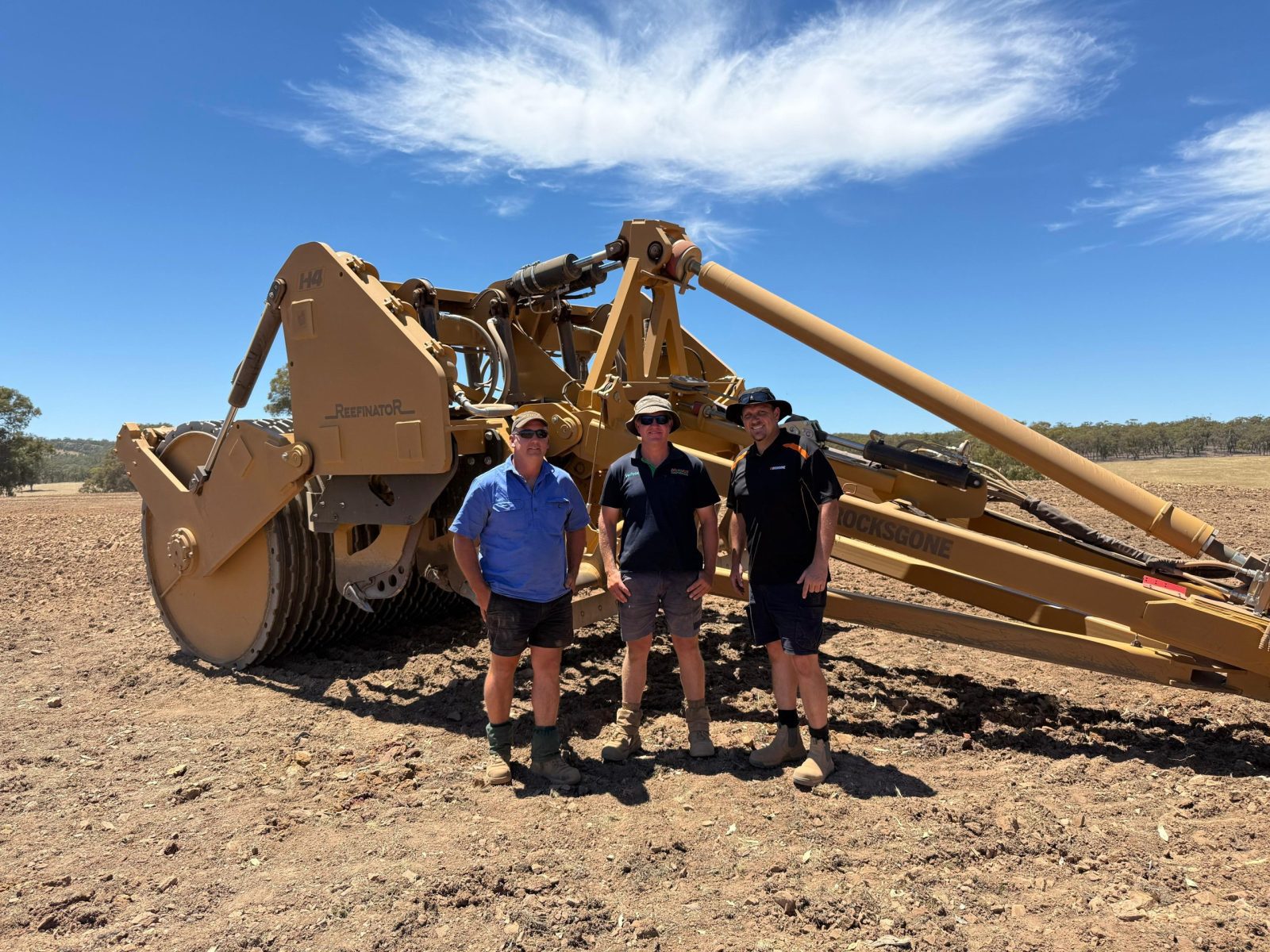
Rocks Gone’s Adrian Carr (right), Wehla grower Dale McCoy (centre), and one of the family’s farm workers, Tony Soulsby, with their Rocks Gone H4 Reefinator during summer work at the McCoy’s property. Photo: Rocks Gone
FARMER Dale McCoy might describe the family’s farm as situated on more marginal country in Central Victoria, however early transformation of some of its toughest areas is dramatically improving its farmability, production and land value.
Together with his wife, Stacey, children, Leah and Evan, and farm workers Tony Soulsby and Adam Roden, Mr McCoy farms 2830ha including leased land near Wehla in the Loddon Shire.
The family originally hails from Moliagul, near where the largest gold nugget in the world, Welcome Stranger, was found, just behind his father’s property.
Due to the poorer land at Wehla, barley has been preferred over wheat in their 1620ha cropping program, which also includes canola, oats, vetch and oaten hay, as well as some faba beans.
They also run 4000 sheep, including a self-replacing Merino flock and first cross Border Leicester ewes mated to White Suffolk sires for prime lamb production.
Older Merino ewes are joined to White Suffolk rams as well.
Mr McCoy said the farm, situated in a 400-450mm rainfall zone, comprised land ranging from goodcreek red loams up to rising ironstone and quartz country and lighter granite country.
He said following agribusiness group tours to Western Australia and Yorke Peninsula in South Australia, plus some local research, investment in a H4 Reefinator rock crushing machine from Rocks Gone had commenced their land transformation journey.
The 3m wide Reefinator comprises a levelling blade, four front-row and five rear-row hydraulic tines, and a following ribbed drum, all weighing 28.5 tonnes when filled with water, and digging down to 600mm.
The McCoys pull the machine with a 375kW New Holland T9 tractor and it also features Rocks Gone’s Depth Master automation technology.
Suitable for ISOBUS and GPS-integrated tractors, the system calculates speed over ground and tractor load or wheel slip to adjust machine depth up to 50 times per second, as well as the level of its blade, helping to ease the demands on operators and tractors.
In their first season with the Reefinator, the family targeted about 90ha of ironstone and sedimentary shaly country across different areas, aiming to dig at least 10cm and up to 15cm deep.
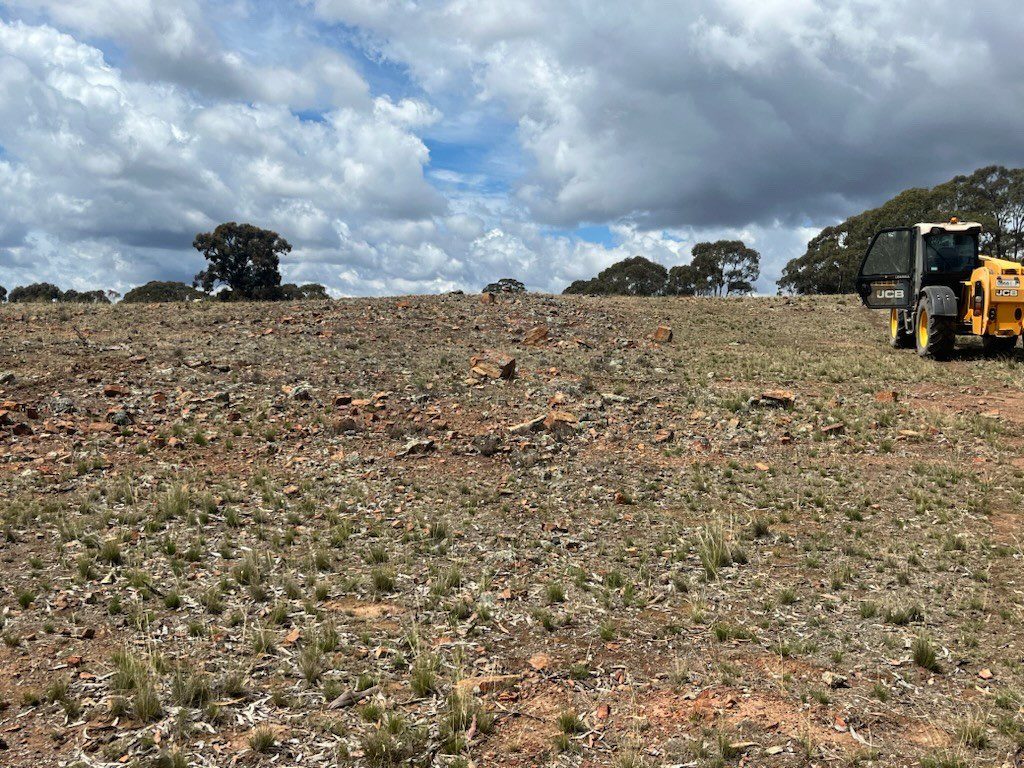
Tough country on the McCoy family’s Wehla property prior to “reefination” with the Rocks Gone H4 Reefinator machine. Photo: Rocks Gone
Mr McCoy estimated up to 500ha on the property could be worked with the machine.
“We started doing small patches in paddocks, but you seem to keep going further and further, and in the end we did the whole lot – and we will go over it again,” Mr McCoy said.
“We had our [Ausplow] DBS [seeder] go over it and that finds rocks, but what we noticed the most was that everything was fractured, so instead of pulling up boulders, they were just small stones.”
In a 30ha paddock, he said there were rock piles and stump areas and while it had been sown before, “it was a nightmare”, whereas now it could be farmed easily.
“We only have to go around the dam now.”
All areas were sown for sheep feed and Mr McCoy said in the 30ha paddock, sheep were removed and it was harvested.
“We sowed oats for forage and had 350 lambs on there for eight weeks, but it got away from them, so we stripped it.”
Oats were also sown into other areas that are accommodating ewes and lambs, and Dale said some of the toughest rubble country established the best crops.
“The Reefinator smashes up the rock and fractures it, the soil mixes in and the water penetrates and
it might concentrate the moisture better.”
He said they also “reefinated” some patches in a hay paddock they previously couldn’t sow and they cut the whole paddock, which had never been done before.
The McCoys have claimed about 40ha of tough country so far and they are targeting another 45ha of rough hills land, plus they have chemical fallowed a further 40ha in preparation for the Reefinator that has only been sowed once previously.
“The plan down the track will be to crop the rough stuff for two to three years, clean the weeds up
and bring it back to productive, permanent pasture.
“There’s about 320 acres (130ha) in the block, and our stocking rate will increase and instead of just running wethers there, we will be able to run ewes and lambs up there.”
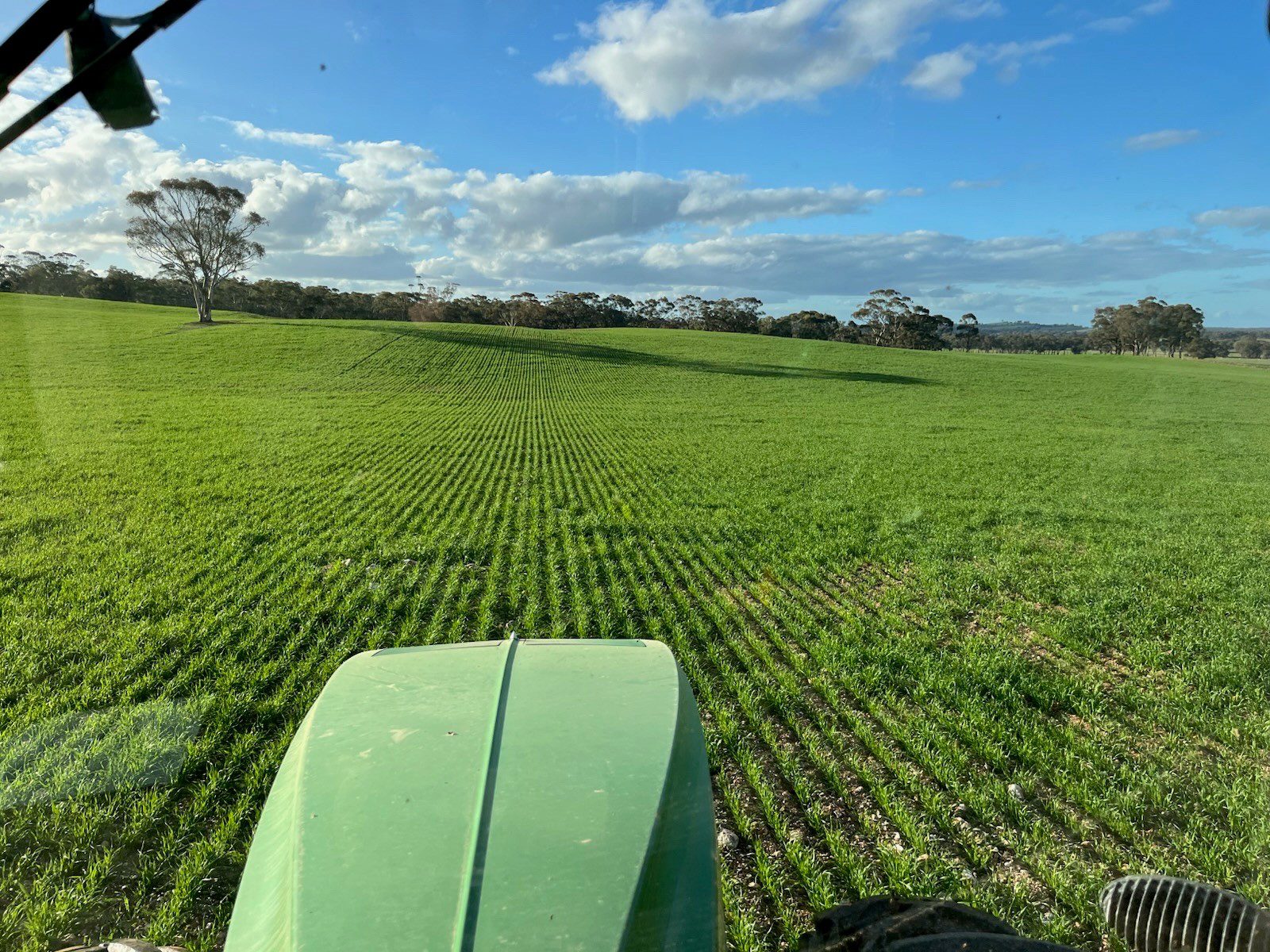
Looking over healthy crop germination on “reefinated” land on the McCoy’s property pictured early last season. Photo: Rocks Gone
He anticipated the transformation could be doubling the land value.
“Land prices have increased significantly, and from semi arable to totally arable, you are going from $1500/ac to $4000/ac.”
For the operation of their H4 Reefinator, Mr McCoy said it was a great outcome to maintain a dual tyre setup with their tractor, rather than switch to single tyres, which he said was a “totally different” experience for the machine and operators.
The Reefinator had been robust, with only its wear points being affected, and working into land with a hint of moisture helped to minimise wear.
“The operation is pretty slow going, but in saying that, we were surprised with how much we did achieve.”
The McCoy’s land transformation has attracted healthy interest and they have provided a contract “reefinating” service to some local growers.
Source: Rocks Gone
HAVE YOUR SAY