
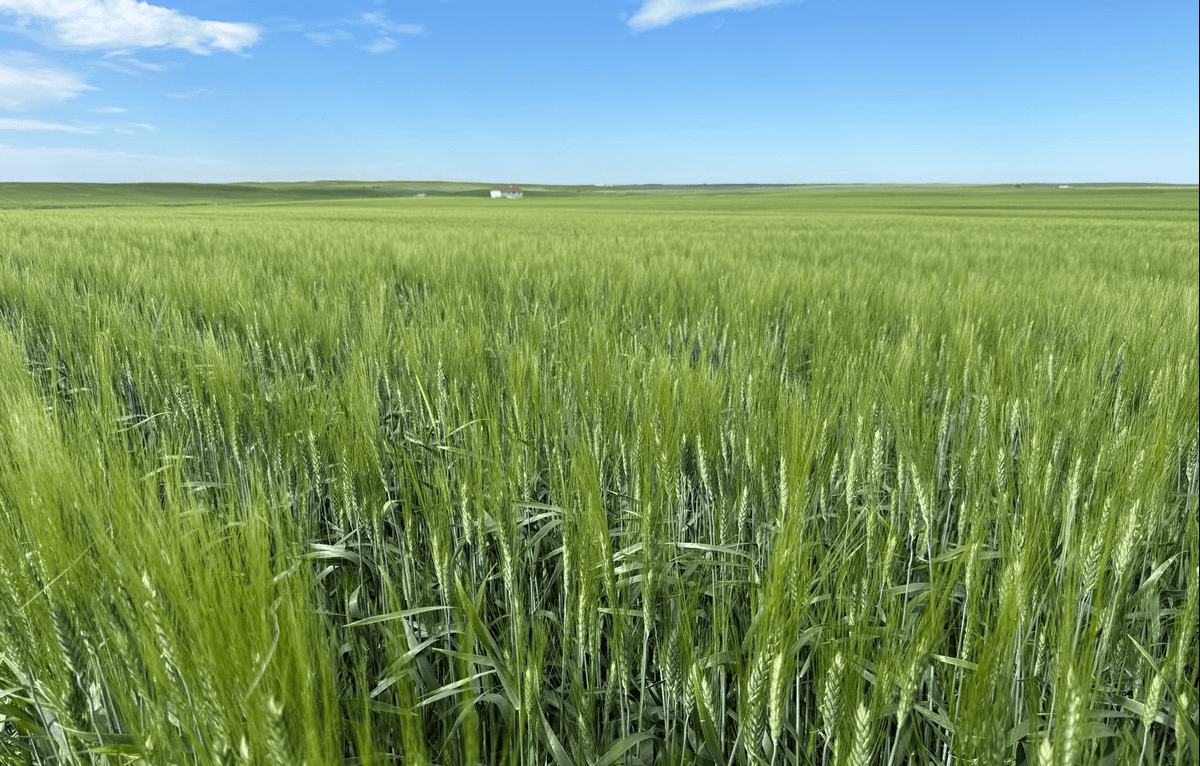
A durum crop on the Canadian Prairies shows good yield potential during flowering. Photo: Weisgerber Farms
PLANTING progress was slower than normal across much of the Canadian Prairies this season but was largely completed by the end of May, while central Canadian grain farmers completed the majority of their campaign by the middle of last month, in line with the long-term seeding pace, despite disruptions from unseasonably wet weather.
According to the 2026 June Field Crop Survey released last Tuesday and conducted over four weeks concluding on June 12, the nation’s farmers have increased the area allocated to canola, barley, corn and soybeans at the expense of wheat, oats, lentils and dry peas.
Responses from the 25,000 farms surveyed put the total area allocated to Canada’s principal field crops in 2026-27 at 31 million hectares (Mha), marginally lower than the record 31.1Mha planted last season. This compares to the five-year average of just under 30.9Mha and an average of 28.8Mha since the turn of the century.
Canola standout
Canola was the standout crop in the June report, with Canadian growers reacting to the favourable price outlook relative to other cropping options, and China’s reduction of anti-dumping tariffs on Canadian canola seed. Producers have reportedly planted a record 9.5Mha, surpassing the previous record of 9.3Mha set in 2017. The area is up from less than 8.8Mha in 2025 and exceeds the five-year average by more than 650,000ha.
The rise in canola allocation was primarily driven by Saskatchewan producers, who increased the seeded area by 9.8 percent to 5.4Mha. Growers in Alberta reported an estimated area of 2.7Mha, 6.9pc higher year on year, while the Manitoba area estimate of 1.3Mha is a 6.3pc increase compared to 2025.
Barley
Canada’s grain growers reported barley plantings of 2.7Mha in 2026, up on last year, but below both the five-year and 25-year average of 2.9Mha and 3.4Mh respectively. The increase in barley area was led by Alberta, where seeded area rose 12pc to 1.5Mha. Barley area rose 12.6pc to 1Mha in Saskatchewan, while area decreased 23pc in Manitoba.
Strong export demand appears to be a key driver, with monthly trade data putting exports of barley over the first nine months of the crop year (August to April) at almost 2.9 million tonnes (Mt). This is 1.2Mt, or 68pc higher than the same period last season and 35pc above the five-year average. China was the primary destination, accounting for nearly 60pc of total shipments, followed by Japan, Saudi Arabia, and the United States.
Corn and soybean
At the national level, the nation’s farmers have reported seeding a record 1.6Mha to corn in 2026, eclipsing the previous benchmark of 1.5Mha set three years ago. This is 4.8pc higher than the 2025 area and is 100,000ha above the average of the past five seasons. Ontario remains the main corn-growing province, accounting for nearly 60pc of the national total, followed by Quebec at just over 20pc, and Manitoba at 15pc, with the balance spread across the other provinces.
After peaking at 2.9Mha in 2017, the area allocated to soybeans dropped dramatically over the ensuing three years to a recent low of 2.1Mha in 2020. However, the area has increased every year since, with a further 3.1pc year-on-year rise to 2.4Mha in 2026. Ontario is the largest soybean-producing province, accounting for 48pc of the reported area, but plantings this year are down 0.6pc compared to 2025. The big mover is Manitoba with an increase of 16.2pc, while Quebec growers reported a 3.1pc decline in the soybean allocation.
Wheat
Wheat remains the largest crop by planted area in Canada this season. Survey results put the area at 10.3Mha, 5.9pc or 600,000ha less than the 2025 program, and around 100,000ha lower than the average of the past five seasons. However, it is still higher than the 10Mha average this century.
The spring wheat area fell from 7.6Mha to 7.3Mha but remains slightly above the five-year average of 7.25Mha. Durum plantings dropped 300,000ha to 2.4Mha from the five-year average of 2.5Mha, and the winter wheat area that survived the winter dormancy period fell from 680,000ha to 640,000ha.
The largest decrease was reported in Saskatchewan, where growers reported seeding of 5.3Mha, 5.9pc lower than 2025. The 2026 area estimate for Alberta fell 5.4pc to 3.1Mha, while Manitoba producers reduced their wheat plantings by 8.4pc to 1.2Mha.
Oats
Canada is one of the world’s leading producers of oats each season, but the country’s farmers are reporting a 200,000ha decrease in the area to 1Mha in 2026. This is around 300,000ha less than the five-year average and more than 500,000ha less than the average seeded area since 2020. Interest in the crop is declining across much of Western Canada, with plantings in Saskatchewan, Alberta and Manitoba down 15pc, 11.9pc and 27.9pc respectively.
Lentils and peas
On the pulse front, Canadian farmers have reportedly planted fewer lentils and dry peas in 2026 due to a sharp fall in farmgate prices and poor gross margin projections relative to other cropping options. The estimated lentil area of 1.6Mha is 10.9pc lower than last season and 6.3pc less than the five-year average. The dry pea area of 1.2Mha is 14.1pc lower than last year and 10.9pc below the five-year average. Saskatchewan accounts for around 87pc of the lentil area and just over half of the dry pea area in 2026.
Crops by province
Crops in Alberta are reported to be in good shape, despite well above-average rainfall in June. While ample soil-moisture reserves support crop development, there are concerns around the pace of plant development. At the close of last month, the province’s crops were rated 68pc good to excellent, three points above the five-year average, but three points below the 10-year average.
In Saskatchewan, almost all the crops have a good to excellent crop rating of 90pc or better on June 30, but the cool, wet weather has delayed plant development. The heavy rainfall has resulted in saturated fields with flooding of low-lying areas. Approximately three-quarters of fall cereal crops, two-thirds of the pulse crops and around half of the oilseed and spring cereal crops were at normal development. The remainder was behind normal.
Excess moisture and delayed plant development are a common narrative across many parts of Manitoba at the moment. Spring cereals are mostly between the tillering and stem -elongation stages, with the earliest fields having the flag leaf visible. Canola development has continued rapidly and is generally between the 5-leaf and bolting stages, with the earliest fields beginning to flower.
HAVE YOUR SAY