
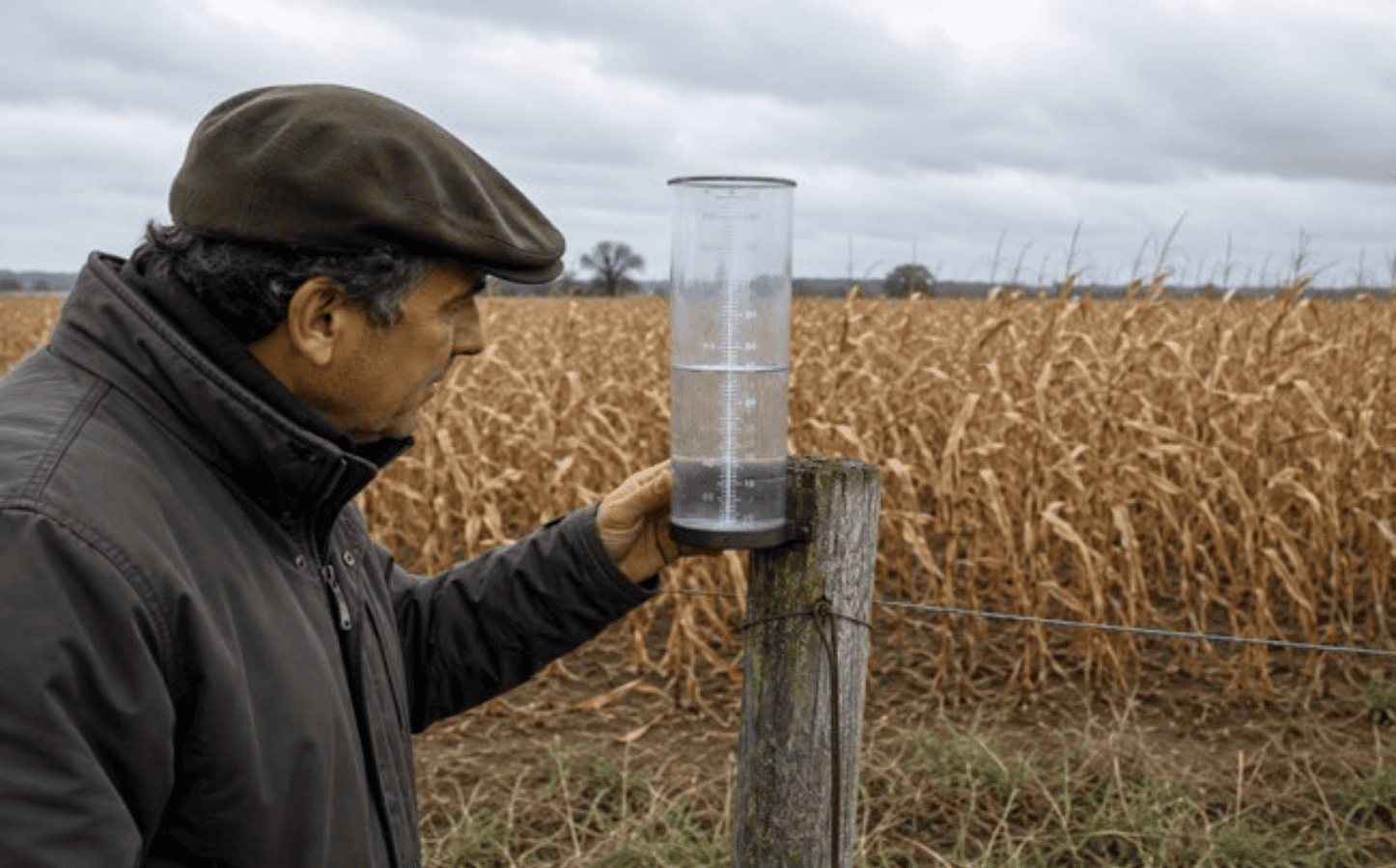
June brought widespread rainfall accumulations above the historical average in Argentina’s Córdoba region. Photo: Agroverdad
AS THE 2026 soybean harvest winds down in Argentina, focus now turns to the nation’s record corn crop, where the harvest has just crept past the halfway mark, as well as completion of the 2026-27 winter-crop planting program, both of which have been delayed by persistent wet weather.
Soybeans
Argentina’s farmers plant two distinct soybean crops each season. The seeding of the first crop, locally known as soja primera, commences in late October and typically runs through to mid-December. Around 70 percent of the nation’s soybean area is dedicated to the first soybean crop, with the harvest usually running from early April through to late May.
The second soybean crop, or soja de segunda, is sown from late December into early January, immediately following the winter wheat harvest, and is typically harvested from May through early July. It is commonly grown in a rotation with corn followed by winter wheat, then soybeans.
As a result of the later planting window and shorter growing season on fields that have already produced a winter crop, second-crop soybeans generally yield significantly less than first-crop soybeans. This is due to the plant’s heavy reliance on in-crop rainfall rather than soil moisture reserves, which are generally depleted by the end of the winter production cycle.
According to the Buenos Aires Grain Exchange, this season’s output finished up at 50.1 million tonnes (Mt), 0.4pc lower than the 2024-25 harvest of 50.3Mt. While the output is still 19pc higher than the average of the past five harvests, it is significantly lower than the 61.5Mt record of 2014-15. This forecast is in line with last week’s 50Mt projection from the Buenos Aires-based attaché for the United States Department of Agriculture.
While total soybean production is down season on season, the average yield of 3.13t/ha across both crops is more than 5pc higher than the 2024-25 campaign, and 21pc higher than the average of the past five seasons. Yields of the first and second crops averaged 3.4t/ha and 2.57t/ha respectively, with a high of 5.5t/ha recorded in the better-yielding soja primera paddocks.
On the corn front, the harvest is reportedly being delayed by high grain moisture and sodden fields that are restricting machinery operation. This is especially the case in Córdoba, La Pampa, and the central and southern parts of Buenos Aires province. However, frosts in the south of the country will help to decrease moisture in those districts.
Corn
Like soybeans, corn has two distinct planting windows each season. Seeding of the first corn crop commences in late September, as soil temperature exceeds the critical 12 degrees Celsius threshold and is generally completed by late November. Harvest of the first crop typically commences in March and concludes in May. The second corn crop is sown into winter-crop stubble commencing in early December and running through to early February, with the harvest usually commencing in late May and concluding in July.
Over the 20 years to 2023, there was a distinct swing away from the later-planted first-crop corn to seeding in the second-crop window. This was done to minimise plant pollination during the extremely hot and dry January and early February period, as the associated stress usually reduces the crop’s yield potential.
However, that trend reversed for planting of the 2023-24 crop, after the devastating leafhopper infestation of the 2022-23 crop was observed to have a much greater impact on the later-planted paddocks. Referred to locally as chicharrita, the tiny insect acts as a super vector, transmitting pathogens that cause corn stunt disease, which can reduce yields by more than 50pc.
The BAGE reported last week that the corn harvest was 56.4pc complete as of July 7, with the average yield currently sitting at 8.12t/ha. The pace has slowed from 4.6pc of the planted area per week in mid-June to just 1.7pc in early July, making this year’s harvest the slowest in the past five years.
The record yields harvest to date, in conjunction with an increase in the planted area from 7.1Mha in 2024-25 to 8.4Mha this season, support the BAGE’s current production forecast of a record 64Mt. This is 30.6pc, or 15Mt, higher than the 2025 harvest, and is 15.3pc higher than the previous benchmark of 55.5Mt set in 2018-19.
Wheat, barley
Meanwhile, the wet weather has also delayed planting of this year’s winter crop in some regions. The BAGE reports that as of July 7, the nation’s farmers had seeded 87.9pc of the projected wheat area, up 7 percentage points for the week. It is slightly behind seeding progress at the same time last year but is well ahead of the long-term average. This follows a week of dry weather that advanced the program by 15.1 percentage points in the week to June 30. The local bourse currently expects the wheat area to decrease by 200,000ha year-on-year to 6.5Mha.
According to the BAGE, planting of the 2026-27 barley crop advanced by 33pc over the fortnight to July 7. This put progress at 67.6pc of the bourse’s projected area of 1.35Mha, 50,000ha higher than in 2025. However, this is still 12pc behind the same time last year, 6pc behind the historical average, with access to waterlogged fields being the primary issue.
Plant emergence in the early-sown wheat and barley fields has been excellent according to the Buenos Aires Grain Exchange, and adequate to optimal soil-moisture conditions prevail in most regions. The exchange is currently projecting 2026-27 wheat production of 21.3Mt, 23.4pc lower than the record 2025-26 harvest of 27.8Mt. However, forecast barley output of 5.3Mt is on par with last season’s harvest.
HAVE YOUR SAY