
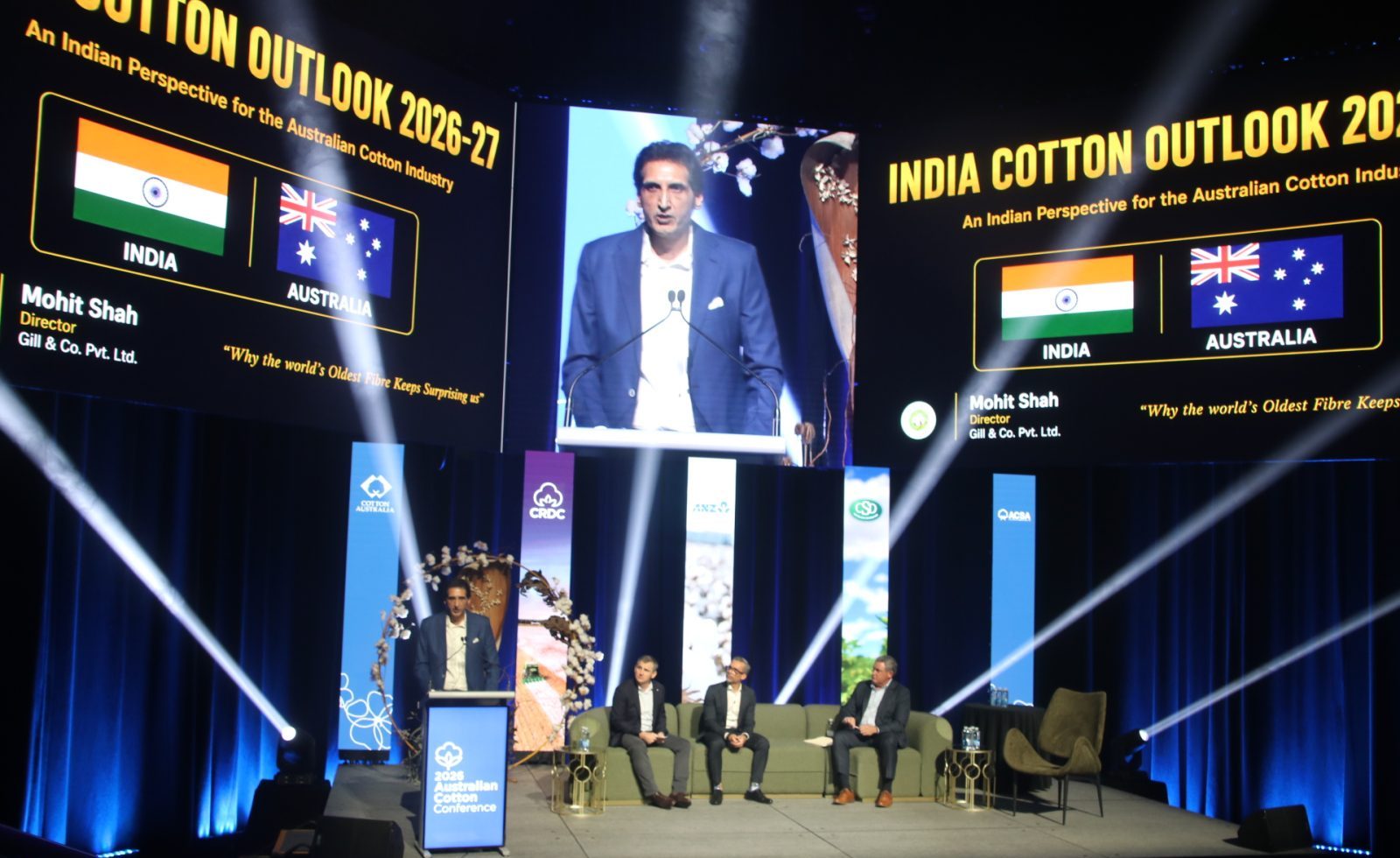
Gill & Co director and co-owner Mohit Shah presenting at the Australian Cotton Conference last week
A CO-OWNER of one of India’s oldest cotton companies has highlighted the strength of the relationship between Australian growers and Indian mills, saying the country’s cotton is valued for its performance, consistency and freedom from contamination.
Gill & Co director and co-owner Mohit Shah oversees global trading operations and corporate strategy at the family company, which was established in 1886.
Speaking at the Australian Cotton Conference held on Queensland’s Gold Coast last week, Mr Shah said Australian cotton was favoured by Indian millers for its “consistency, reliability and performance”.
“Australian cotton has earned a strong reputation for high grade, longer staple, better strength, and contamination-free cotton with excellent spin performance,” Mr Shah said.
“This helps our mills to produce better yarn, improve efficiency and reduce interruptions.
“Australian cotton has been coming to India for a long time, and its share continues to grow each year.
“It knows our mills, it knows our ports and it probably knows the Indian traffic better than most tourists.”
The optimism follows a stellar year for Australian cotton exports to India.
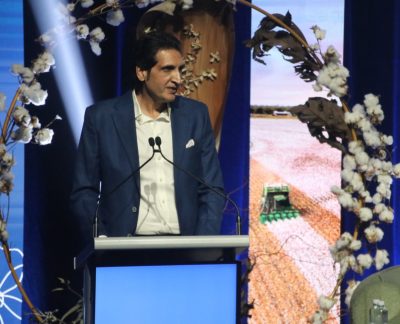
Mohit Shah speaking at the 2026 Australian Cotton Conference.
The removal of the Indian Government’s 11-percent import duty, alongside higher volumes of competitively priced cotton compared to the United States and Brazil, saw Australia emerge as the second largest supplier of raw cotton to India for 2025-26.
According to Mr Shah, India imported “a touch over 1 million tonnes” of cotton in 2025-26, with Brazil the largest supplier at more than 300,000t, followed by Australia with more than 200,000t, and the US with 180,000t.
The amount from Australia was the largest India has imported from Australia in at least five years, and also reflected a major high in global imports.
India’s cotton imports have fluctuated greatly in recent years; buying more than 650,000t in 2024-25, just under 200,000t in 2023-24 ,and about 370,000t in 2022-23.
Consumption vs production
Mr Shah said India had the “largest cotton-growing area in the world” but due to its low comparative yields and strong consumption, was still a net importer.
He said this season the area was due to grow by 3pc to 11.5 million hectares, and with an average yield of 490kg/ha, production was set to be stable at 5.4-5.5 million tonnes.
Based on a standard bale weight of 227kg, India produces about 2 bales/ha, with total production of about 23.8M bales.
Mr Shah said he was “cautiously optimistic” about the crop currently in the ground.
He said the delayed monsoon at the start of the season in June raised some concerns at planting, but widespread rainfall last month improved the outlook.
“Overall, the outlook is positive, but rainfall distribution remains uneven.
“August and September progress will be important in determining India’s cotton yield.”
While production was stagnant, Mr Shah said consumption was “expected to increase by 2pc to under 6Mt in 2026-27” based on the current trends.
“India is the world’s second-largest cotton consumer.
“India’s consumption will continue to rise due to strong demand from rising middle-class population, from domestic demand and with free trade agreements signed with the United Arab Emirates, Australia and the United Kingdom.
“Talks are already on to formally sign [an] India-EU FTA in December 2026, which will boost India’s textile exports.”
Mr Shah said this “supply-demand imbalance”, as well as the mills requiring specific quality that’s not always available domestically, was a driver of rising imports.
Cotton dominance
Mr Shah said the rise in consumption could also reflect India’s continued preference for cotton over polyester.
“Twenty-five years ago, cotton represented half [of] global fibre consumption.
“Today, it’s around 26pc and man-made fibre [is] at 74pc”.
“While cotton’s global share has declined, India remains the bright spot.
“Cotton accounts for 38pc of India’s total fibre production, well above the global average.
“Man-made fibres are growing, but cotton remains at the heart of the Indian textile industry, and that’s why I’m optimistic about India’s long-term cotton future.”
Mr Shah presented at a session at the Australian Cotton Conference last week titled: Markets in Motion: Futures, FX & Global Demand.
The session’s other speakers included National Australia Bank’s senior strategist Rodrigo Catril and United States-based StaplCotn president and chief executive officer Hank Reichle.
Grain Central: Get our free news straight to your inbox – Click here
HAVE YOUR SAY