

Weather:
In the US, rain from the remnants of Hurricane Polo is spreading from the Southwest through the Plains into the Midwest, with flooding risk extending corn and soybean harvest delays. HRW planting was already seven points behind average as of the 27 September numbers, although replenished moisture followed by drying could improve winter wheat establishment once planting resumes.
India’s monsoon closed 12.6 percent below the long-term average at 759.4mm against 868.6mm, the weakest since 2015, and IMD expects a strong El Niño to keep strengthening to a November peak, with below-normal rain across most of the country through December. That threatens rabi sowing moisture and reservoir levels, with food inflation already at 5.95pc.
In South America, central Brazil’s wet season is starting on time, mostly via fronts, but DTN warns El Niño may deliver good planting conditions followed by poor growth and drought risk. Southern Brazil and Paraguay face 5–10 inches over 15 days, while Argentina gets near to above-normal rain and cool temperatures that remove heat stress risk.
Markets
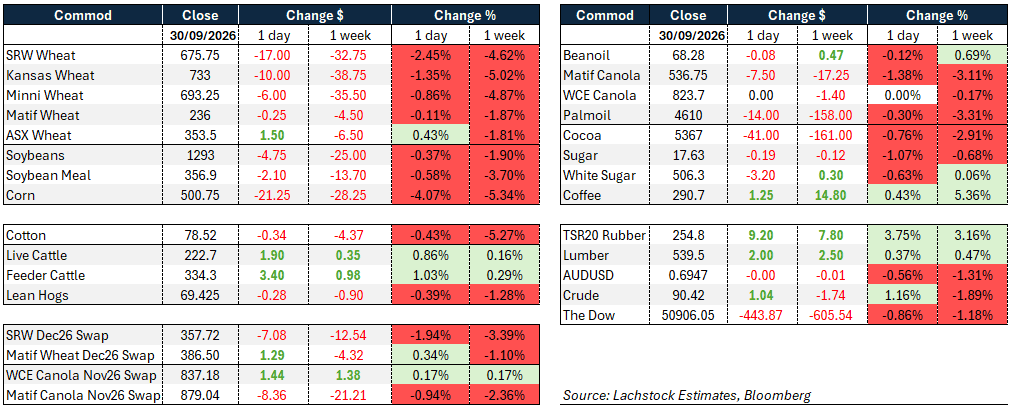
USDA’s stocks report broke the Q3 grain rally, with Dec corn down 4.07pc to 500.75 as a 414,000-contract fund long was exposed to bearish demand data. Harvest delays from Hurricane Polo’s remnants are the main offset to further liquidation.
Wheat classes diverged on the production numbers. A bigger winter crop (1.02 billion bu) weighed on SRW (-2.45pc) and KC (-1.35pc), while a smaller spring crop (450 million bu) cushioned Minneapolis (-0.86pc). Matif held near €236/t on SovEcon’s 4.7 million tonnes (Mt) cut to Russian wheat exports, widening the Matif Dec26 swap premium over SRW to around 28.80.
Oilseeds were softer on the week. Matif canola fell 3.11pc and its Nov26 swap dropped 8.36 to 879.04, and palm lost 3.31pc, even with crude up 1.16pc to 90.42. The cooling US diesel ban threat and possible European product stock releases reduce one source of biofuel-led support.
Australian macro is turning more hawkish, with markets weighing a November RBA hike to 4.85pc. The AUD still fell 0.56pc to 0.6947 on risk-off equities (Dow -0.86pc). A softer Aussie dollar partly cushions local grain values against weaker offshore futures into the ASX open.
Day Ahead – Australia
Not sure about your news feed but mine is running hot on the Aussie macro debate. The rate increase, coupled with current debate over the next one put the focus back on govt strategy, particularly as it relates to the national debt projections. Even with at rate increase the AUD softened. Bullock’s slightly less hawkish rhetoric after the rate announcement, CPI coming in slightly softer and a stronger USD based on their 4 rate increase prediction all added to the sell pressure.
Here is the rub – Australian 3 yr yields fell 8bp to 4.96pc the day the RBA increased rates. At the same time the AUD rate premium from the 2yr bucket out has closed significantly. Maybe the world is focusing on our data a little closer, not just assuming we are a good bet.
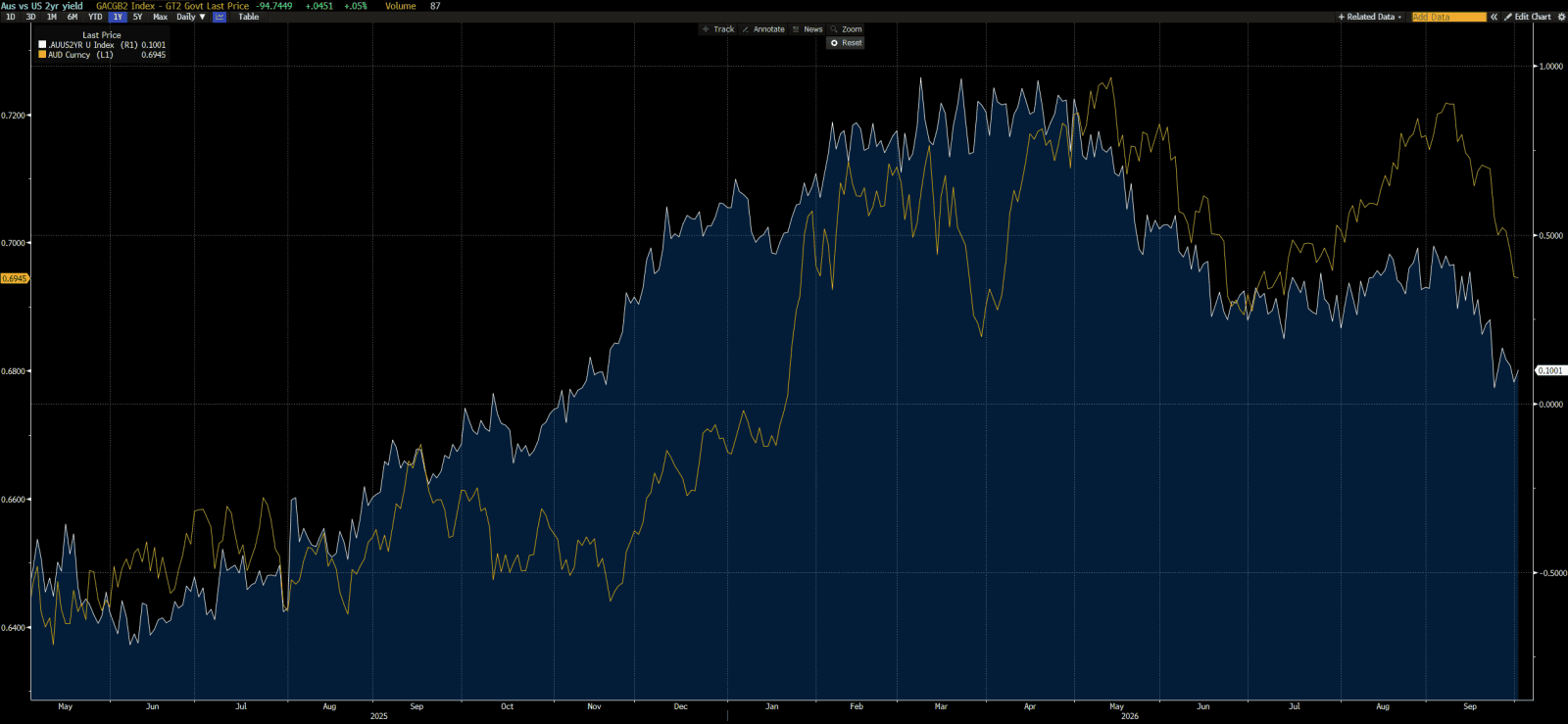
White line is the AUD 2y yield vs the US 2 yr yield, the yellow line is the AUD. Rate differentials matter for the AUD – and, despite the rate increase locally, the 2 yr (and longer dated) yield spread has tightened. Source: Bloomberg
Wheat: Wheat was dragged lower by the corn liquidation after USDA’s quarterly stocks and small grains reports, with Dec SRW settling at $6.75¼.
The production numbers split the classes. Winter wheat came in at 1.02 billion bushels against trade expectations of 987 million, while spring wheat was cut 21 million bushels to 450 million, well under the 473 million expected.
That kept Minneapolis the relative outperformer at 693.25 (-0.86%), with Kansas down 10.00 to 733 (-1.35%), and both still off nearly 5% on the week.
Despite the pullback, wheat finished the third quarter up around 15% since 1 July.
Matif held up better, easing only €0.25 to €236 (-0.11%), still supported by Black Sea disruption.
SovEcon cut its 2026/27 Russian grain export forecast to 44.7 Mt from 49.4 Mt and now expects Azov and Black Sea ports to stay shut until 2027, with the wheat export figure lowered by 4.7 Mt to 36.7 Mt.
India lifted its 2027-28 wheat MSP 1% to INR2,610/100kg as part of a broader rabi price increase worth an estimated INR909.6 billion to farmers.
ASX Jan rose 1.50 to $353.50 (+0.43%) but traded before the USDA release, and the swaps point to a softer local open, with the SRW Dec26 swap down 7.08 to 357.72 (-1.94%) while the Matif Dec26 swap gained 1.29 to 386.50 (+0.34%).
That widens Matif’s premium over SRW to around 28.80.
Other grains/oilseeds: Corn took the brunt of the report. Sept 1 stocks came in above expectations, which implies weaker demand than assumed, and it landed on a fund net long of more than 414,000 contracts as of 22 September.
Doug Bergman of RCM Alternatives said that combination sets up a larger pullback as weak hands are forced out.
Corn had traded higher before the report as rain from the remnants of Hurricane Polo slowed harvest.
The quarter still closed with corn up 15%. Demand signals were soft. US ethanol output fell 21,000 b/d to 1.007 million b/d, the lowest since January, and stocks dropped 818,000 barrels to 23.87 million.
In Europe, CVB corn sellers cut fob premiums against Chicago as harvest supply arrives.
Turkish demand remains thin, although a South Korean buyer took a November-loading cargo, likely for non-GM needs.
Brazilian and Argentine corn continues to dominate Mediterranean demand. Egyptian buyers are looking at Nov-Dec Brazilian shipments, with domestic October ex-warehouse corn at least 20¢/bu under import parity.
Spanish domestic corn at around €250/t ex-works is at parity with Americas cif offers, with import bids in the mid-$270s/t.
Nov soybeans eased 4.75 to 1293 (-0.37%) and are down 1.90% on the week, meal lost 2.10 to 356.9, and bean oil was steady at 68.28.
Matif canola fell €7.50 to €536.75 (-1.38%), and the Matif canola Nov26 swap dropped 8.36 to 879.04.
WCE canola was unchanged at 823.70, while the WCE Nov26 swap rose 1.44 to 837.18.
Palm oil slipped 14 to 4,610, down 3.31% on the week. India raised its mustard MSP 6.7% to INR6,613/100kg, a firmer domestic floor for the world’s largest rapeseed oil importer.
Macro: Trump signalled his appetite for a US diesel export ban has cooled after warnings it would push up gasoline prices.
Energy Secretary Wright flagged coming European announcements on new diesel supply. US retail diesel sits at $6.41/gal, just below last week’s record, and Rapidan cut its odds of hard export restrictions to 40% from 75%.
That matters for Australian harvest fuel costs given the reliance on imported diesel.
European gas steadied near €69.50/MWh after a 5% drop to a one-month low. With Hormuz near-closed and about a fifth of global LNG flows cut off, EU storage is just over 71% full against an 87% seasonal norm.
Geopolitical risk rose again as Moscow warned that European plants arming Ukraine are potential military targets, and NATO condemned Russian nuclear threats over Kaliningrad.
Locally, August trimmed mean CPI printed at 0.2% m/m (0.24%), slightly under expectations.
ANZ economists said the result is still consistent with their 1.0% q/q Q3 forecast and continue to see a November RBA hike to 4.85% as more likely than not. The AUD nonetheless slipped 0.56% as equities sold off.
Local: In the west of the country bids were stronger, with canola up A$20/t to $882, wheat at $382 and barley $325 FIS Albany.
Through the east canola improved to $817, with GM at a $27 discount, wheat was $355 and barley $290 track Geelong.
Rain started falling across SA overnight and will push into Victoria today. It is desperately needed through the Western Districts and areas further south, where crops are well set up but have just started to go backwards. Through the Mallee and Wimmera, it should help finish off what are shaping up as record crops.
There is some demand emerging for old-crop lentils, with bids around $610 delivered port versus new crop at $600. Canadian growers remain slow sellers, but it is worth noting the stocks are there, with lentils one crop they have been able to get off. If Canadian selling picks up, it will add pressure to prices. Locally, the race is on to get lentils off early, with the first tonnes potentially attracting a $10–20/t premium before the bulk of harvest hits the market.
Reports suggest China is sniffing around for some Australian wheat. It would be pleasing to see business done given how little Aussie wheat China has bought recently, although it is not something I would be hanging my hat on yet in terms of generating meaningful positive price movement.
HAVE YOUR SAY