

Weather:
The US Corn Belt: excessive rain has pushed corn and soybean harvest behind average, with Iowa worst affected. An extended dry window should let saturated fields dry out and combines resume, but more rain arrives from late this week and threatens a winter wheat planting campaign that is already 10 points behind average.
Brazil: central Brazil’s wet season looks to be starting on time as fronts push north, but the CPC puts a greater than 90 percent chance on a very strong El Niño and a 75pc chance it exceeds the strength of any event since 1950, peaking October to December. DTN warns the pattern may deliver good planting conditions but poor growth and drought risk in central and northern Brazil, while the already saturated south faces waterlogging, fungal disease and planting delays. • Australia: Rain is forecast across southern, central and eastern Australia to 8 October, heaviest in Victoria and south-eastern NSW, which would give a timely lift to grain fill. The October to December outlook leans below median for parts of the southeast but above average for WA, Queensland and northern NSW.
Black Sea: Ukrainian forecasters said adequate September rain improved soil moisture for winter crop sowing across nearly the whole country, with 1.6m ha (about 30pc) sown. In southern Russia, the key winter grain region, low soil moisture is persisting for a second straight year and farmers are sowing into dry ground, which keeps the 2027 crop a live risk for wheat.
Markets
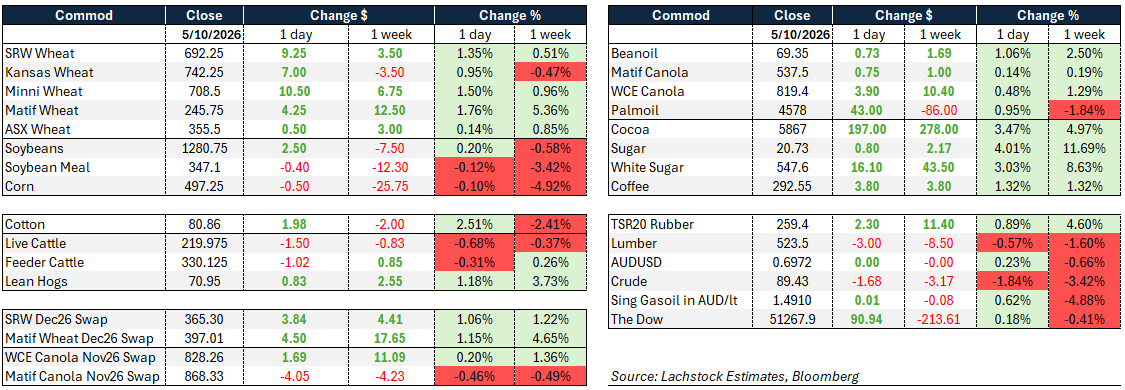
Wheat outperformed on Black Sea escalation, with Matif up 5.4pc on the week. Saudi’s 683kt purchase at US$339.24/t C&F, $70 above July, confirms importers are paying up, while Ukraine’s 36.6pc export slump contrasts with Russia’s record Baltic flows and steady $213/t fob cash.
Corn is consolidating just under $5 after a 4.9pc weekly fall, with 495 holding three sessions running. Falling conditions, a slow harvest and an Iowa yield question set up Friday’s WASDE as the next directional catalyst against the larger stocks base.
Soybeans gave back a BRL-driven rally to harvest selling. Meal dropped 3.4pc on the week while soyoil gained 2.5pc and lifted crush margins. Canola followed veg oils higher, but record Malaysian palm stocks and softer crude cap the oilseed complex.
Crude fell 1.8pc as the G7 stock release and Saudi price cuts outweighed Houthi strikes on Aramco and the Hormuz standoff, easing diesel costs with Singapore gasoil down 4.9pc on the week. The AUD held near 0.697 as domestic housing weakness and rising global bond yields build a softer growth backdrop.
Day Ahead – Australia
Rain forecast from 10-35mm for the next 8 days right across the east coast growing belt – nothing like dropping a heap of hay to wake up Huey.
Export markets are paying close attention to Argy values – last season is fresh in our minds after Argy’s massive crop set the tone for value into South East Asia. So, despite the Russia/Ukraine conflict getting worse FOB values have actually softened over the week – now it’s just a matter of what energy and freight does. The recent strategic oil reserve release will be welcomed, it’s just a matter of refining capacity.
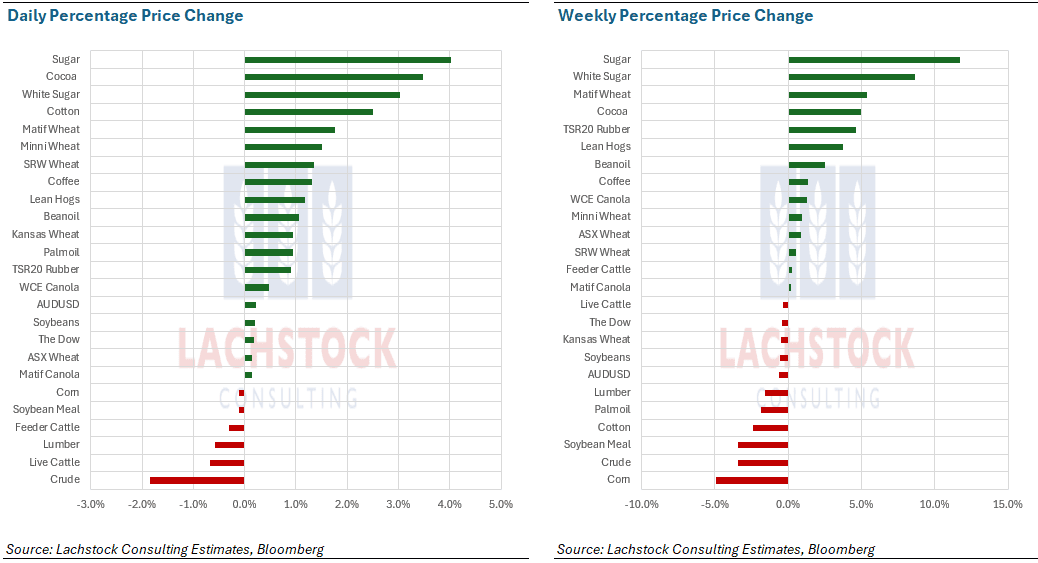 Wheat: Wheat led the row crop complex higher as the Black Sea war escalated again. Russia hit port and industrial infrastructure in Odesa and the Northern bridge over the Dnipro in Kyiv, Ukraine vowed to keep striking Russian refineries, and Moscow promised to intensify its campaign against Ukrainian infrastructure.
Spring wheat led, Matif added another 1.8pc to take its weekly gain past 5pc, and WZ implied vol rose to 27.85pc from 26.96pc.
The SRW Dec26 swap gained A$3.84 to A$365.30 and the Matif Dec26 swap A$4.50 to A$397.01, up A$17.65 on the week.
Ukraine’s September grain exports fell 36.6pc y/y to 1.49 million tonnes (Mt), with seaports effectively blocked since late July and cargoes forced through Danube terminals where Sulina Canal delays are pushing coaster freight higher. Russia, by contrast, keeps moving grain. IKAR put September wheat shipments at 2.4Mt, 20pc above forecast, with Baltic ports handling a record 1Mt-plus, and June to September exports at 6.4Mt, while Russian cash held at $213. Rusagrotrans sees exports to Kazakhstan up 41pc to 3Mt this season, and Agriculture Minister Lut said state intervention buying could begin at the end of October.
On demand, Saudi Arabia’s GFSA bought 683kt at an average US$339.24/t C&F, up $70 on its early July purchase after cancelling a tender in between, and Egypt is said to be shopping harder.
Turkey’s TMO is reported to be offering 5.5Mt of bread wheat and durum, though the source text is garbled and it is unclear whether this is a purchase or a domestic sale.
In the US, inspections of 302kt beat estimates but left the export pace 35pc behind last year, and winter wheat planting at 36pc against a 46pc average will slip further with more rain due from late this week.
Other grains/oilseeds: Corn traded both sides and finished fractionally lower, with CZ finding 495 as its low for a third straight session after the liquidation that followed last week’s larger-than-expected stocks. US export competitiveness has improved. Argentina remains the cheapest origin into most destinations, but the PNW is now below Brazil landed into Asia.
Inspections of 1.368Mt matched estimates, the pace is up 4pc y/y, and Mexico bought 129,540t of new crop.
Corn conditions fell 3 points to 54pc against 57pc expected.
Harvest reached 23pc against 25pc expected and is now 4 points behind average, with Iowa only 7pc done against a 20pc average. StoneX expects a drier stretch to get combines rolling again.
Friday’s WASDE is the next test: harvest complaints point to a lower yield, though RCM’s Doug Bergman notes the bigger stocks make “tight” hard to reach.
Soybeans rallied 19c early on a sharp BRL rally after Flávio Bolsonaro took 47pc to Lula’s 45pc in Brazil’s first round, setting up a 25 October runoff. Harvest selling into the strength trimmed the gain to 2.5c. Soyoil gained 73 points and lifted the Dec crush 4.75c to 245.75. Inspections of 1.138Mt put the pace up 31pc, and 104kt sold to unknown destinations.
Conditions slipped to 57pc and harvest reached 25pc against 29pc expected, now 8 points behind average, with Iowa only 5pc done against a 38pc average.
China returns from holiday later this week.
Canola tracked firmer veg oils, capped by weaker crude, and Alberta harvest reached 31pc.
The WCE Nov26 swap rose A$1.69 to A$828.26, while the Matif canola Nov26 swap fell A$4.05 to A$868.33.
Palm was rangebound. A Reuters survey expects Malaysian September stocks to hit an all-time high above the December 2018 peak as record output outpaces exports, although Intertek showed exports for 1 to 5 October up 2.96pc m/m.
Macro: Crude fell after the G7 announced a 100 million barrel release of oil and fuel products and Saudi Arabia cut its Asian selling prices to six-year lows.
The supply measures outweighed a hotter Middle East: the Houthis claimed missile and drone strikes that caused major fires at Aramco sites in Riyadh and Khurais, Saudi-backed forces retook positions on the Bab el-Mandeb Strait, and Iran’s parliament speaker said Hormuz stays shut until seven conditions from the June interim deal with the US are met.
Germany’s spy chief warned of the risk of being drawn into conflict with Russia. Brazilian assets rallied on the Bolsonaro result, and 21shares’ Stephen Coltman warned that rising European bond yields risk turning into credit contagion for euro zone sovereigns.
At home, the RBA’s hike last week is feeding through housing. Cotality shows national sales down 17.4pc in the three months to September, led by Brisbane (-26.3pc), Sydney (-24.8pc) and Perth (-23.9pc), with prices 5.2pc off peak and HSBC’s Paul Bloxham seeing a 13pc fall. UBS estimates a hit to state revenues of up to $30 billion, plus up to $12 billion in extra interest costs from higher global yields.
The week ahead brings EIA on Wednesday, export sales on Thursday, and WASDE and COT on Friday, with WASDE landing about 2:30am Saturday Adelaide time.
Local: In the west of the country bids started the week a few dollars higher on barley, unchanged on wheat and slightly softer on canola. New crop bids in Albany PZ were A$865/t FIS for canola & $850 for GM, wheat $380, and barley $329.
Northern markets are starting to see some harvest, despite most of southern Qld jagging 10-20mm. Interesting that spot homes are a little hard to find with many delivered markets only bidding for deferred.
Vic and SA markets are becoming a battle between export parity numbers and growers willingness to chase things lower. Supply chain performance is king and value maybe a simple function of what is going out on boats that week.
HAVE YOUR SAY