

Weather:
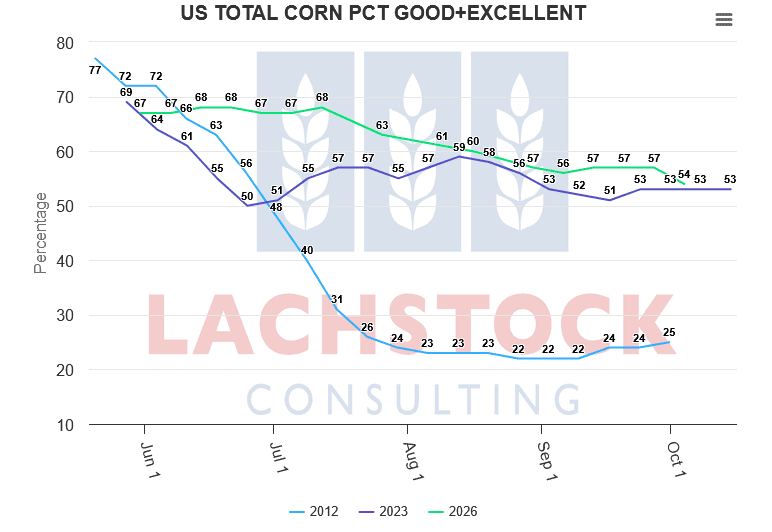
In the US Corn Belt, record September rain in Iowa saturated soils and cut corn to 54 percent G/E, and a drier week now opens a harvest window, though seed moisture needs several days to fall. In the Plains, showers have improved soil moisture for winter wheat planting in parts of the Central and Southern Plains, but drought remains a problem for much of the region.
Across the Black Sea and Europe, one third of Ukraine’s winter wheat area is in moisture deficit and dry soil is delaying Russian planting, with lost export revenue and dearer diesel potentially cutting Russian area. In Europe, Ukrainian rapeseed is at least 85pc planted, but dry areas of France may reduce French rapeseed area.
In South America, El Niño is splitting Brazil’s season, with excessive rain in the South bringing waterlogging, disease and planting difficulties while the Centre-West faces dry-spell risk during establishment and a possibly shortened second-crop corn window.
Imea expected Mato Grosso planting to gain traction in the first half of October, while in Argentina cold, dry conditions have been unfavourable for developing wheat and corn planting.
Markets
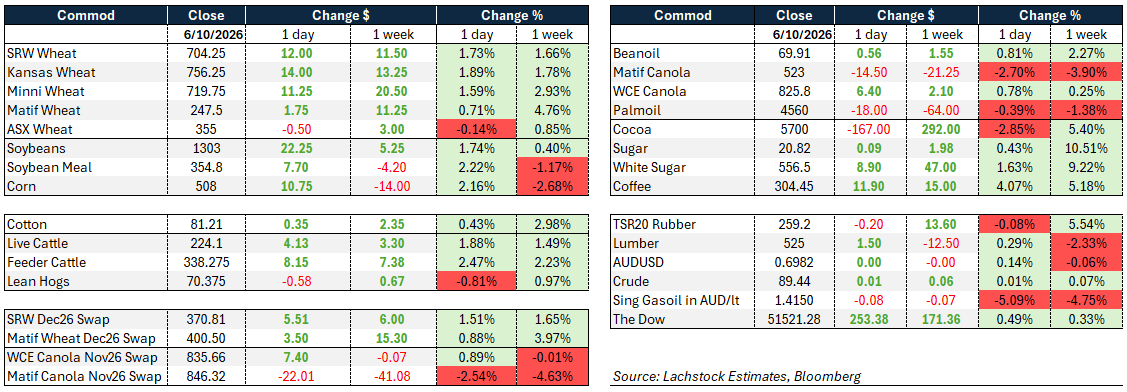
Grains staged a pre-WASDE short-covering rally on a weaker dollar and the surprise 3-point cut to corn condition, with corn up 10.75c, beans up 22.25c and meal up $7.70, though corn is still 14c lower on the week and Friday’s numbers will test whether the bounce holds.
Wheat gained across the board, with Minneapolis up 20.5c and Matif up 4.76pc on the week as dry Black Sea sowing moves into focus, but ASX dipped A$0.50 to A$355 and the Matif Dec26 swap at A$400.50 holds a premium of nearly A$30 over SRW.
Oilseeds diverged, with Matif canola down €14.50 as the expiring Nov weakened, pulling the Nov26 swap down A$41 on the week to A$846.32 and its premium over the WCE swap down to about A$11, a softer reference point for Australian canola as harvest approaches.
Energy pressure is easing at the product level as Hormuz flows recover and the G7 diesel release works through, with Sing gasoil down 5pc in AUD terms, while the AUD is flat near 0.698 against long-end Treasury yields at 24-year highs and the Siberian plague case adding a new geopolitical wildcard.
Day Ahead – Australia
More of the same from a market perspective. Rain forecasts are sticking around and, generally, temps are not a problem aside from the north.
Corn firming isn’t the sort of rally that pulls up FOB wheat – yes we will see some activity in the futures markets but there really isn’t much fundamentally that you can get your teeth into. The best indicator of value today remains Argy wheat.
 Wheat: Wheat rose with the rest of the complex, with WZ up 12c, KWZ up 14c and MWZ up 11.25c.
There was little wheat-specific news. A softer dollar brought managed money back into commodities, and Consus’ Karl Setzer saw shorts being covered ahead of Friday’s WASDE.
Corn’s condition shock pulled the grains higher together.
Minneapolis has now gained 20.5c on the week. Matif lagged on the day at €247.50, but its €11.25 weekly gain is the strongest of the wheat contracts.
The market is shifting its focus to next year’s Black Sea crop.
Dry soil is slowing Russian winter wheat sowing, and dearer diesel plus lost export revenue are raising questions about area.
A third of Ukraine’s intended winter wheat area is in moisture deficit while it is still shipping a 25.3 million tonnes (Mt) harvest.
Locally, ASX slipped A$0.50 to A$355 despite the offshore gains. The Matif Dec26 swap rose A$3.50 to A$400.50 and the SRW Dec26 swap rose A$5.51 to A$370.81, leaving Matif carrying a premium of nearly A$30.
Other grains/oilseeds: Corn recovered 10.75c after USDA cut good-to-excellent ratings by 3 points to 54pc.
That is an unusually large fall this late in the season. StoneX’s Matt Zeller noted the crop now rates only a point above 2023, which finished as the worst-rated crop since 2012.
September rainfall records fell in Iowa, leaving soils saturated and combines parked.
Soybeans are 25pc harvested against a 33pc five-year average, with conditions at 57pc G/E.
Cordonnier expects drier weather this week, but seed moisture will take several days to come down before harvest resumes in earnest.
Beans added 22.25c and meal led the products, up $7.70.
Corn is still down 14c on the week, so the day’s gains look more like short-covering ahead of Friday’s WASDE than a change in direction. Farm sentiment soured further.
The Purdue/CME barometer fell to 123 from 135 on input costs. Trump’s order allowing red-dyed diesel on highways is expected to do little for farmers, who already burn it in machinery.
Ag Bull’s Jim Wiesemeyer warned it could even tighten rural supplies during harvest.
WCE canola edged up C$6.40 to C$825.80 despite a loonie two-tenths of a cent firmer. Volume eased to 76,249 contracts, with Nov/Jan trading 12.80 to 13.80 under.
Matif canola went the other way. Nov dropped €14.50 as the expiring contract weakened while deferreds rose.
Dryness in parts of France is also threatening rapeseed area.
The Matif Nov26 canola swap fell A$22.01 to A$846.32, down A$41.08 on the week. That leaves it only about A$11 above the WCE swap at A$835.66, which rose A$7.40. Soyoil firmed and palm slipped.
Macro: A suspected plague death in Siberia has become a geopolitical risk. A 28-year-old lab worker at an Irkutsk anti-plague institute died of severe pneumonia, and almost 200 contacts are under observation. Trump has a call with Putin scheduled and promised more detail within a day. Rubio pressed Moscow for transparency, and the US Embassy told Americans to leave Russia. The CDC sees no broader threat to the US and notes plague is treatable with antibiotics.
Oil was steady, with Brent near $101 after Monday’s 2pc fall, as Gulf producers push more tankers through Hormuz. BNEF has crude exports back to within 5pc of pre-war levels in late September.
Refined product exports remain 30pc short, held back by Russia’s extended diesel export ban, slower Middle East product recovery and high freight. Middle East product exports did rise 38pc m/m to 5.1m b/d.
The G7 emergency diesel stock release has softened European gasoil spreads, and Europe’s diesel imports are set to jump in October.
Trump has also confirmed the US will not ban diesel exports.
ARA jet stocks remain at their lowest since April 2020. The EIA nonetheless lifted its Brent forecasts to US$98 for 2026 and US$84 for 2027.
The 5pc drop in Sing gasoil in AUD terms is the clearest local signal of easing fuel tightness.
Bond markets remain the macro stress point. Long-end Treasury yields are at fresh 24-year highs, and Bessent’s renewed promise to bend the debt curve was met with scepticism.
The deficit is running near 6pc of GDP despite low unemployment, and tariff revenue is only now resuming after US$180bn of refunds. The CRFB’s Marc Goldwein argued growth alone cannot substitute for fiscal discipline. The US trade deficit widened to US$105.6bn in August, the widest since the pre-Liberation Day frontloading. Imports rose 4.3pc, led by crude, gold and capital goods, and deficits with Mexico and Vietnam hit records.
Europe calmed, with French, Italian and Greek bonds rallying after Le Pen proposed cutting the deficit to 3.7pc in 2027 and below 3pc from 2028.
That would need about 3pc of GDP in consolidation, and its credibility is questioned.
The AUD held near 0.6970, insulated from the euro-driven dollar rally. Australian 10-year yields rose 6bps to 5.40pc, and Chalmers flagged budget pressure from the selloff.
Consumer confidence fell further after the rate hike. ANZ-Indeed Job Ads rose 2.2pc m/m to sit 12.9pc higher y/y, but ANZ expects them to trend lower as rate hikes work through.
Local: Bids were stronger through the west, with canola up $5 to $870, while GM remained at a $15 discount. Wheat was $382 and barley $327 FIS Albany.
In the east, canola was $805, wheat $355 and barley $290 track Geelong.
Harvest is fast approaching through southern NSW, with barley around Griffith expected to start coming off within the next week. Canola through the Victorian and SA Mallee is likely to begin being windrowed within the next fortnight.
Rain over the past week was desperately needed through Victoria’s Western Districts. Big crops that were well set up but beginning to go backwards have now received a timely finish and look increasingly likely to reach their yield potential.
HAVE YOUR SAY