
 Weather:
US Corn Belt – showers continuing across the Corn Belt into next week, with milder air following a slow-moving cold front through the Ohio Valley easing recent heat stress; areas south of the front trend warmer and drier. Ridge-rider activity flagged for the weekend, detail to follow tomorrow.
Europe – backdrop remains the deteriorating French maize conditions.
Black Sea – Russian wheat harvest pegged at 11.63m ha according to Argus, 46 percent done but equal to the slowest pace over the last 5 years.
Markets
Wheat firmed on the week but the intra-week volatility washed out to almost nothing, with BSEA execution risk still the core driver and Russia’s slow August export pace the number to watch heading into next week.
Corn is in a holding pattern ahead of Wednesday’s WASDE, caught between a shrinking EU crop and Ukraine’s export downgrade on one side and comfortable US yield expectations near 182 bu/ac on the other.
Soybeans stayed rangebound as China continued to buy both US and Brazilian origin, with the market still needing to clear the report before committing to direction.
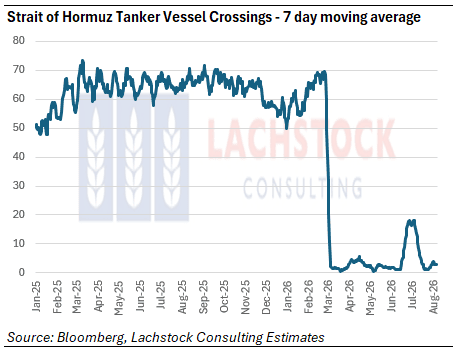
Crude’s weekly slide reflects growing expectation of a Strait of Hormuz reopening even as a final Iran-Oman deal remains unsigned, while canola was the week’s standout on stronger vegetable oil values and AUD strength ahead of Monday’s RBA decision.
Day Ahead – Australia
Game changing rainfall through SA/Vic and into NSW. Areas such as the Griffith market zone jagged over an inch which not only solidifies production in that area but also adds to the supply for the northern market.
The reality is, there is enough grain to go around but the export timing will be crucial for the Aussie grower. It doesn’t look like the Black Sea conflict is improving and, contrary to Donalds sound bites, I think it will be a while before we see boats steaming out of the Strait – but, until we hear the phone ring, supply should dominate pricing – lower to start the week for me.
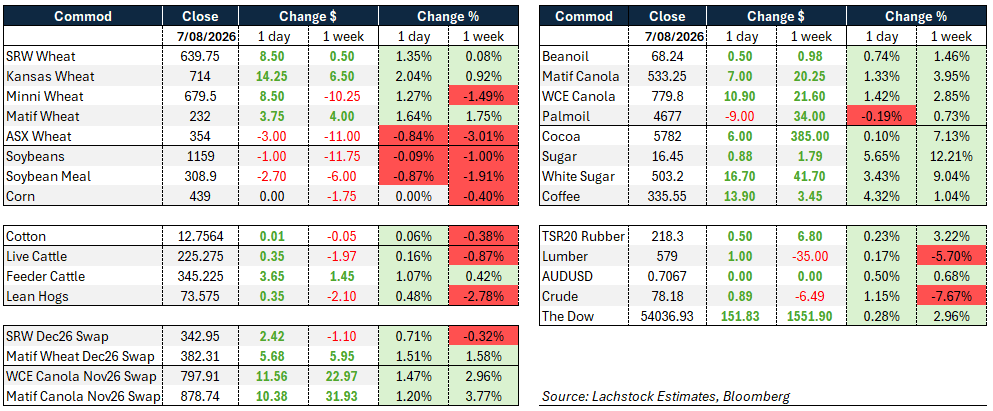
 Wheat: Choppy session Friday, higher finish.
KC led again, up 14.25c, with WU and MWU both adding 8.5c — strength in KC relative to Chicago and Minneapolis is proxying BSEA execution risk for now.
For the week WU managed just half a cent, KWU rose 6.5c, MWU gave back 10.25c. Matif Sep firmed €3.25/t on the day and €0.25 for the week, while Russian wheat was assessed $2/t lower at $223 versus $226 last Friday.
For all the week’s headline noise, WU finished up half a cent and Matif up €0.25 — the intra-week swings proved largely illusory.
The underlying themes are unchanged. BSEA execution deteriorates by the day as customers sit on their hands waiting for clarity.
The USDA’s Ukraine attaché made a first pass at the damage, cutting 26/27 Ukraine wheat exports by 3.7 million tonnes (Mt).
The bigger story is Russia — there’s still no Moscow attaché estimate, but Russia typically moves 4.8Mt of wheat in August and current pace suggests barely half that gets done.
Russian farmers preparing for winter wheat harvest have been contending with surging diesel prices and adverse weather, driven in part by Ukrainian strikes on energy infrastructure that have disrupted fuel supply across many regions.
ASX continued to fade against the international complex, down A$3.00/t on the day and 11.00 for the week (-3.01pc), a reminder that the export logistics narrative out of the Black sea hasn’t seen a material shift to Aussie… yet.
Other grains and oilseeds: Corn chased wheat higher early but couldn’t hold against more aggressive offers into the close.
The early bid also had an Ukraine attaché tailwind, with UKR corn exports slashed 9Mt — but that volume was shifted straight back into ending stocks rather than removed from the balance sheet, so it’s a problem deferred rather than solved.
EU corn deterioration remains the parade story: this is being called the worst French corn crop since 1980, and FranceAgriMer cut French maize condition scores to 31pc good/excellent versus 34pc last week and 67pc a year ago.
US Corn – trade yield guesses cluster 180-185 bu/ac and the average trade estimate heading into Wednesday’s WASDE sits at 182.4. USDA also confirmed 286,097t corn sold to Mexico — 29,808t for 26/27 and 256,289t for 27/28 — with StoneX’s Mike Castle flagging that the bulk of recent Mexican corn business landing in the 2027/28 window reflects the structural growth in Mexican feed demand tied to livestock-sector expansion even as the border phases back open to Mexican feeder cattle.
Beans were two-sided in a 10c/bu range, finishing with SU down 1c and SX down 1.5c. Products carried an oil tilt — BOU settled 50 points higher, SMU down $2.70, leaving Sep crush up fractionally to 271.25.
Brazilian July shipments set a new record, but the US still looks set to land its 25 mil ton China number as buying stays active: 238kt beans were announced to China on the day, and China was in for both Brazilian and US origin, with the US side totalling 3-4 cargoes.
Average trade guess for the bean yield ahead of Wednesday sits at 52.9.
Canola had the standout session, canola futures pushing into the weekend on stronger comparable oils and short-covering ahead of Wednesday’s report. Crude oil gained roughly US$1 a barrel as markets awaited fresh news on a deal to reopen the Strait of Hormuz, while Chicago soyoil and European rapeseed also firmed; Malaysian palm oil was the outlier, declining on the day.
The Canadian dollar added more than four-tenths of a US cent after Statistics Canada reported Canada added 75,000 jobs in July, dropping the unemployment rate to 6.4pc, a two-year low.
Nov canola volume totalled 59,073 contracts versus 40,187 Thursday, with spread trade accounting for 32,814 of that.
Macro: Crude’s Friday bounce sits against a heavy weekly decline, and the Hormuz story explains both.
Iran and Oman remain short of a final deal to reopen the Strait, though Trump has signalled patience, saying the US can afford to wait out Tehran’s economic pain.
Iran has ruled out direct talks with Washington for now, with Foreign Minister Araghchi citing repeated violations of June’s interim agreement, while exchanging messages through intermediaries instead.
Araghchi separately described the Oman shipping-route pact as “very close.” Iran’s conditions for a full reopening include the US lifting its naval blockade on Iranian ports, withdrawing regional forces, removing sanctions, releasing frozen assets and paying war-damage compensation — a demand list that keeps the market pricing a resumption of Gulf barrels as directionally likely but not imminent, which is the more coherent explanation for the week’s ~7.7pc slide even as Friday firmed on delay headlines.
Houthi rebels also claimed a strike on Saudi Aramco’s Jizan refinery, with Saudi authorities confirming a fire that was quickly extinguished, keeping a geopolitical premium in the price.
AUD firmed modestly into the weekend. Locally, the calendar turns busy: RBA delivers its cash rate decision Monday 11 August (market looking for a hold at 4.35pc after last month’s cut to 4.35pc, alongside the Statement on Monetary Policy), with NAB business confidence/conditions due the same morning and home lending data out Thursday.
Local: In the west of the country, bids were slightly stronger to end the week, with canola at A$845/t and GM $825, wheat $370 and barley $321 FIS Albany.
Through the east, canola was +$10 to $797 while GM was $750, wheat $362 and barley $306 track Geelong.
A wet weekend for most cropping regions, with 50mm+ falling across large parts of SA and Vic and 25mm+ through much of SNSW/Central NSW. It will be interesting to see if the rainfall sees basis soften today.
HAVE YOUR SAY