

Weather:
US Corn Belt: July closed 2.3°F above normal (warmest since 2012), precip 0.1in below normal (lowest since 2014) per NOAA data; western belt heat continues to linger.
Europe: another wave of intense heat sweeping an already parched region this week, raising wildfire risk and further straining low river levels including the Danube.
India: monsoon rainfall to date at 472.6mm vs a 535.6mm normal (June-September season, as of Aug 10).
Markets
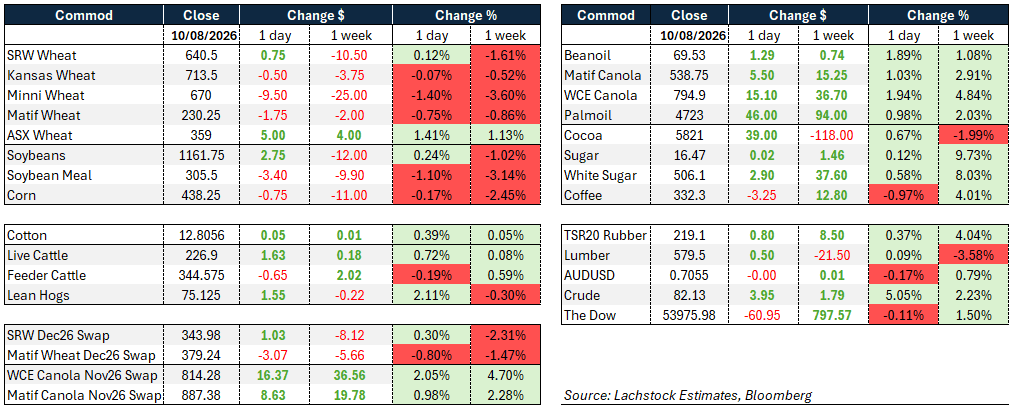
Wheat remains directionless and frustrating for all sides — BSEA logistics keep deteriorating (Turkey now requiring Black Sea transit permits, Danube at record lows) while consumers stay content to wait, leaving the market spinning its wheels.
Corn and beans sit in wait-and-see mode into Wednesday’s WASDE, with yield ideas clustered 180-185bpa for corn and the trade bias to buy the report regardless of the print.
Canola extended its rally, closing above its 20-day average on Hormuz-driven crude strength lifting the whole vegetable oil complex plus short-covering.
Crude spiked over 5 percent as Trump’s fresh reparations demands on Iran and Tehran’s own conditions dimmed hopes for a quick Hormuz resolution, though broader equity risk appetite stayed largely unmoved.
Day Ahead – Australia
The game of chicken continues – supply constrictions vs sluggish demand.
Safe to assume that a) the Strait isn’t opening any time soon and b) Russia/Ukraine are still intent on bombing each other to smithereens.
Roughly 2.5 million tonnes (Mt) of grain moves out through the Danube per month and, with anther heat wave about to hit EU, river levels are getting horribly low.
Aussie values are about southern rainfall and supply side pressure – Downs values have been pricing imports from both southern NSW via road, and SA and WA by boat – so the Downs cattle feeder is trading Vic values by default.
Canola up, grains sideways for me today.
Wheat: Nobody in this market is happy right now — longs, shorts and flats alike.
Matif Sep gave up €5.25/t, Dec €2.75, Russian cash held flat at US$223/t.
The only genuine wrinkle was Turkey requiring permits for commercial traffic into the Black Sea, a move that could force diplomatic channels open but hasn’t yet — the Danube route is no better with water levels running record-low and straining flows through Romania.
Ukraine trimmed its 2026/27 grain export forecast to 38-40-Mt-range from 43Mt, citing Russian strikes that have effectively shut Odesa, with the Ag Ministry flagging an 11Mt storage shortfall risk.
BSEA is running at a trickle, consumers are content to wait on the view a logistical fix arrives before they need to chase, and discretionary money is spinning its wheels trying to hedge a risk nobody can price.
On data, US wheat inspections at 421kt were in line but leave the marketing-year pace down 25pc yoy; spring wheat conditions fell a surprise 4 points to 51pc against 54pc expected, though harvest progress (spring 24pc vs 19pc avg, winter 91pc, near average) should let spring gain ground on its winter counterparts into Wednesday’s WASDE.
Other grains and oilseeds: Corn traded higher early in sympathy with wheat before settling into a tight range that left CU and CZ each fractionally lower.
Yield ideas remain bunched 180-185bpa, which is why the trade’s average guess for Wednesday sits at 182.4. Evan Basse’s LaSalle letter preview flags NOAA Corn Belt data showing July averaging 76.7°F — 2.3° above normal and the warmest since 2012 — with precip 0.1in below normal and the lowest since 2014; the resulting weather model points to a yield near 180-181bpa, and history isn’t kind to comparable years, with three of the four prior instances since 2000 of July running 2°F-plus above normal producing sub-trend yields.
Export inspections at 1.740Mt left the pace up 25pc yoy, and another flash sale of 105kt new-crop corn went to unknown destinations.
Conditions held at 61pc, matching expectations, though North Dakota took a double hit with good-to-excellent down 10 points and poor-to-very-poor up 10.
Beans firmed modestly as bean oil led, chasing diesel higher on the crude spike, while meal sold off on the rally in oil share — SX up 3.25c, BOU surging 129 points, SMU down $3.40. Inspections at 399kt were in line but leave the marketing-year pace down 18pc yoy, with China taking just under 66,000t of that — well behind Germany, Mexico and Japan — though hope persists for fresh Chinese purchase announcements after China’s own 500kt reserve auction continues clearing space for US arrivals.
Conditions slipped a point to 62pc, a touch under the 63pc expected but in line with the five-year average and below last year’s 68pc.
Canola extended its rally on the ICE, closing above its 20-day average as crude’s Hormuz-driven surge — Brent up roughly 5pc toward $88 — pulled the wider oilseed-oil complex higher alongside Chicago soyoil, European rapeseed and Malaysian palm oil, with short-covering adding fuel.
Macro: Hormuz remains the dominant driver across energy and grain-adjacent macro.
Trump piled fresh demands onto Iran over the weekend — compensation for roadside-bomb victims, protestors, and now damages tied to Lebanon, Syria, Yemen and Gaza — while Tehran doubled down on its own reparations demands as a precondition for reopening the Strait, dimming hopes of a quick resolution.
Brent’s near-5pc jump toward $88 and a 10pc-plus spike in European diesel, compounded by refinery attacks in Saudi Arabia, Libya and Russia, pulled crude up over 5pc on the day.
Trump has signalled a preference for letting economic pressure build rather than escalating militarily, though he kept the option open, and Iran reshuffled its security leadership, installing hardliner Mohsen Rezaee atop its Supreme National Security Council.
Oman-mediated shipping-lane talks are reportedly close, but Tehran has ruled out direct US negotiations for now.
None of this has yet dented broader risk appetite meaningfully — the Dow eased just 0.11pc on the day and remains up 1.5pc on the week.
AUDUSD sits flat on the session but firmer on the week, with the improving domestic wheat outlook offering some support ahead of the RBA decision.
Separately, JBS’s move to sell 25pc of its Australian/NZ business to Indonesia’s Danantara sovereign fund — a deal worth up to A$7.1b in combined investment capacity — underscores the broader southeast Asian protein-demand growth theme; JBS Australia CEO Brent Eastwood said initial focus is on Indonesia itself rather than Australian acquisitions, though speculation continues around potential targets locally.
Local: Canola was firmer to start the week in the west, bid at A$857/t with GM at $840. Wheat was $376 and barley $319 for 2026/27 FIS Albany.
In the east, bids were firmer to steady, with canola +$5 to $804, wheat at $356 and barley $305 track Geelong.
Delivered barley markets were softer to start the week following the good rainfall. SA Murraylands markets are around $290–295 Jan+, Geelong/Melbourne $325 and the Downs $415.
Canola markets have staged a comeback over the past week and are expected to strengthen again today following gains across global oilseeds. Given current values relative to cereals, growers are likely to be willing cash sellers through harvest, and with the size of the crop expected this season, domestic harvest pressure remains a key risk.
HAVE YOUR SAY