

Weather: The US harvest is behind after heavy Midwest rain. Only 23 percent of US corn was harvested by October 4, below the 27pc five-year average and the 26pc analysts expected. Last week’s dry window is closing, as a more active pattern is expected to return to the central US around October 12-16, pulling Gulf and subtropical moisture into the Plains and Midwest. That could slow harvest and delay farmer selling, which supports nearby spreads.
In South America, AgRural had Brazil 7.3pc planted to soybeans in early October against 9pc a year earlier, with dry breaks interrupting fieldwork in Paraná, frost damage in parts of Rio Grande do Sul, and Mato Grosso only starting on irrigated areas. In Argentina, around 10pc of core-zone wheat, about 160,000ha, is rated only regular after below-normal September rain, leaving yields reliant on timely showers.
In the Black Sea region, southern Russia, a major source of the country’s winter grain base, is sowing into low soil moisture for the second consecutive year. Farmers are adapting to dry soils and high temperatures, which points to weak crop establishment going into winter, and adds risk to the 2027 export surplus.
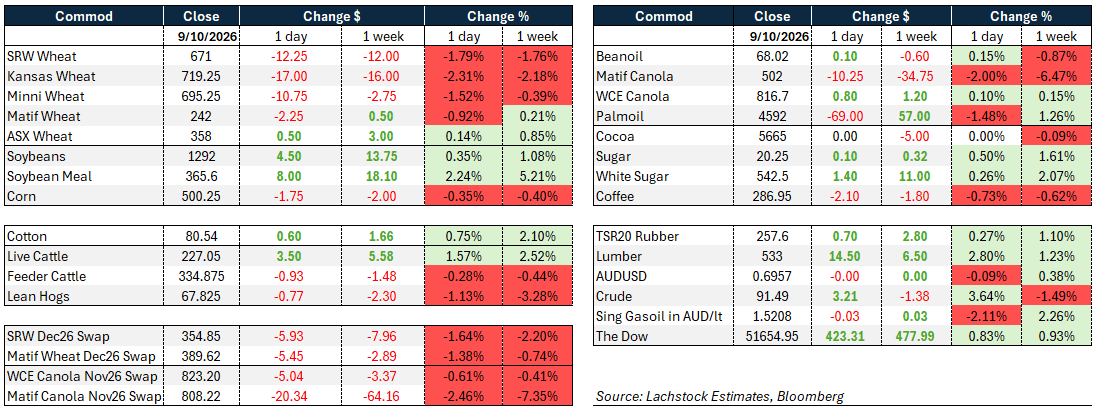
Wheat: US carryout rose, and the Russian export cut was diluted by offsets for Canada and Argentina. Corn spillover drove Kansas wheat down 17 cents per bushel, while MATIF and the ASX held up relatively well. Weak import demand, Indian and Australian offers, and cheaper feedgrain alternatives leave wheat struggling to find a floor.
Wheat was dragged down by corn as much as by its own numbers. USDA lifted US 2026-27 carryout, and cut exports and feed and residual. By class, HRW, white and SRW rose, while HRS fell, which put Kansas at the front of the selling.
On the world sheet, Russian exports were cut 3 million tonnes (Mt) to 40Mt, partly offset by 500,000t increases each for Canada and Argentina, and Ukraine unchanged.
Spreads were weak to flat and WZ implied volatility eased to 24.68p from 26.25pc.
MATIF March lost €3/t and Russian cash held at $204. The SRW Dec26 swap fell 5.93 to 354.85 and the Matif Dec26 swap dropped 5.45 to 389.62, while ASX edged higher.
Demand remains the problem. Russian shipments ran 38pc lower over July to September, yet buyers see India sitting just above the market and Australia eager to offer new crop.
Commerzbank notes Russia’s Baltic port grain capacity has nearly tripled to 23.5Mt, while Ukraine leans harder on the Danube.
US trade commentary expects corn’s collapse to give consumers more staying power, leaving wheat on the defensive.
Corn: The October WASDE yield increase, on top of the September stocks surprise, added more than 10.8 million tonnes to US supply in 10 days. Carryout jumped, and a crowded fund long is now unwinding. Expect further liquidation, heavier farmer selling and a bearish lean into the November report. The corn yield increase was bonkers, especially when you look into some of the state changes, but the numbers are the numbers. StoneX warns further liquidation should not surprise. US trade commentary expects farmer selling to pick up and nearby spreads to work to keep the pipeline supplied. World changes were minor, with Argentina up 1Mt to 64Mt, Ukraine exports flat at 22Mt, and the EU crop nudging higher again.
Oilseeds: Soybean meal strength from crush delays, an oversold processor book, firm South American premiums and the fire at Cargill’s Owensboro, Kentucky soybean plant lifted soybeans, meal and oil higher, with beans lifting despite the higher carryout detailed in the October WASDE. Canola only drew modest support against harvest pressure, and MATIF rapeseed shed 6.47pc on the week, setting up a volatile week for the complex.
ICE canola traded in the C$813.40-$823.50/t range, picking up Chicago’s short covering but capped by harvest pressure as the Prairie harvest nears completion. The WCE Nov26 swap eased 5.04 to 823.20. Weekly Canadian exports rose to 248,400t from 130,700t. MATIF rapeseed fell another 2pc to be down 6.47pc on the week, taking the Nov26 swap down 20.34 to 808.22.
Macro: Brent is sitting above US$100 per barrel on the Middle East escalation, a firm US dollar and a US 10-year near 5.4pc keep energy and input costs high and the risk of higher rates alive ahead of US CPI. A steady AUD near 0.70 offers Australian sellers little currency help against falling offshore grain values.s.
Local: Rain is building in the north, which will be very much welcomed for the sorghum and cotton country. South Australia and Victoria received another 10-15mm over the weekend. The next week or so looks more conducive to making hay. It’s hard to see markets getting too excited with harvest fast approaching and some weather around.
Prices were steady through the west to end the week, with canola at A$870/t, wheat at $381 and barley at $325 free in store Albany.
In the east, canola improved to $811, while wheat was $352 and barley $288 track Geelong.
Chickpeas remain well bid at around $1000/t delivered Brisbane, supported by strong export demand and a small crop. Southern growers will hope this strength flows through to lentil prices, but with a record lentil crop expected, prices are more likely to move the other way once new-crop tonnes start flowing.
HAVE YOUR SAY