
 Weather: El Niño is still strengthening. NOAA puts the odds of a very strong event in January to March 2027 above 83 percent and says it could be the strongest since records began in 1950. The usual effect is lower rainfall and higher temperatures across Australia, Indonesia, India and parts of South Asia, which feeds the El Niño supply concern now building in palm oil alongside the Indonesian fires and haze.
Northern Hemisphere winter wheat is going in behind pace and into dry soils. US planting is 7 points behind average, and Plains drought was expanding again ahead of seeding, with Colorado around 91pc in drought and Nebraska 78pc. Southern Russia faces low soil moisture for a second year, so its crops risk entering winter in weak condition.
In Brazil, soybean planting was 7.3pc done in early October against 9pc a year earlier, according to AgRural, after dry breaks in Paraná, frost in Rio Grande do Sul and a slow rain-fed start in Mato Grosso. Central Brazil was very hot. Local forecasters expect El Niño to disrupt the distribution of rain there rather than shut it off, making CONAB’s crop numbers on Thursday a key read.
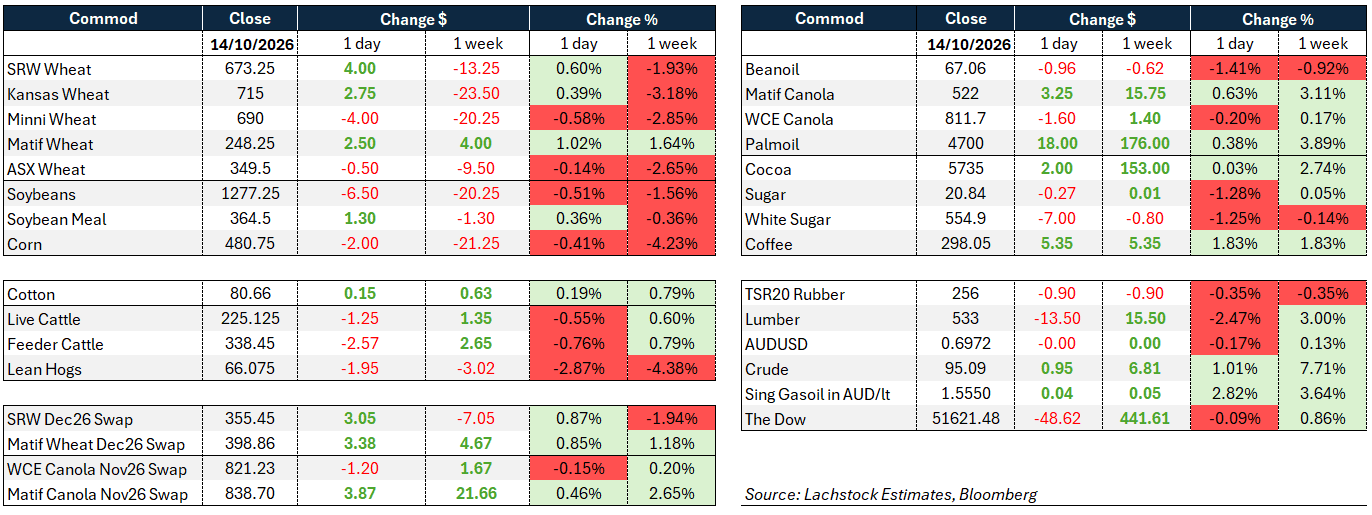
Markets: Wheat is rangebound in Chicago between the mid 660s and 680. Matif is outperforming on a weaker euro, rising fund length and steady import demand, shown by Algeria paying up at $326 landed. ASX was slightly lower, but the Dec26 swaps gained about A$3 on offshore strength with the AUD flat.
MATIF maize at €303 against wheat at €248 is the key spread for Europe. It points to stronger feed wheat demand while Ukrainian corn shipments lag. US corn stays capped by harvest and the larger balance sheet, despite better export competitiveness out of the PNW.
In soybeans, China’s buying was largely priced in and Chicago slipped, with meal leading oil and crush soft ahead of NOPA and CONAB. In veg oils, palm’s export-driven rally and a weak Canadian dollar supported canola, while bean oil weakness capped it. MATIF rapeseed is up 3.1pc on the week.
Macro risk has turned more hawkish. Hot US CPI has made the October FOMC live, supporting the US dollar and yields. Crude’s 7.7pc weekly gain and higher Singapore gasoil lift biofuel economics and on-farm diesel and freight costs. The Australian dollar near 0.697 offers little offset for local growers.
Day ahead – Australia: Feels like harvest is just around the corner for the last month. Headers are rolling but we are still waiting to really get into things. The Aussie market is watching the Black Sea with particular interest – it feels like the Asian exporter is going to keep some powder dry just in case the world returns to normal, whatever that is. The mid-terms in the US have the potential to shape the future – at an extreme, the US relationship with both Iran and the Ukraine could change – nuts that the Aussie grain markets are so exposed to what’s going on in US politics.
Wheat: Wheat traded both sides overnight. Chicago gained 4c per bushel, and KC added 2.75c, while Minneapolis lost 4c. Chicago and KC spreads were firm, the Minneapolis curve sold off, and Chicago implied vol rose to 23.76pc from 22.31pc.
The delayed Crop Progress showed US winter wheat 51pc planted as of October 11, up from 36pc but 7 points behind average. Joe Davis of Futures International said that leaves the crop exposed to weather over the next few weeks.
Chicago remains stuck in a range, with support in the low to mid 660s and offers near 680. MATIF Dec rose €2.50/t and March €1.25, helped by a weaker euro and firm demand.
Funds added 12,000 to their MATIF long, taking it to 143,500. Algeria bought around 750,000t at $326 landed, sourced from the Baltic, South America and the Black Sea, when French origin would have been cheaper. Russian 12.5pc protein was steady near $204.
France nudged its soft wheat export outlook higher and cut corn. The Black Sea backdrop has not improved.
The US diesel deal with Russia and limits on Starlink use have opened a visible rift with Kyiv, and Zelensky said he felt betrayed by Trump. UK PM Burnham pledged continued support, while both sides kept attacking energy and data infrastructure. The conflict looks further from resolution than ever.
Locally, the SRW Dec26 swap closed at A$355.45/t, up A$3.05, and the MATIF wheat Dec26 swap at A$398.86, up $3.38. US export sales are delayed to Friday because of the Columbus Day holiday.
Corn and oilseeds: Corn has settled into a range between its 100 to 200-day moving averages and closed 2c lower. Harvest is 33pc complete, up 10 points on the week but 6 points behind average.
The standout was MATIF maize. Nov added €14 to settle at €303, after gaining €12 the previous session, against MATIF Dec wheat at €248.25. That spread makes feed wheat the obvious choice in Europe. The maize rally likely reflects the EU feed position while Ukraine fails to ship the corn Europe needs from November. US corn is more competitive, with PNW now the cheapest landed origin into Asia. Even so, harvest pressure and the roughly 400 million bushels recently added to the US balance sheet cap rallies.
CONAB on Thursday is expected to put Brazil’s 2026-27 corn crop at 148 million tonnes, down 800,000t, versus the USDA’s 139Mt. The EIA is expected to show ethanol output of 1.065-1.095 million barrels per day, from 1.053bpd.
Beans opened firm after China took 8-10 cargoes and the USDA confirmed a 470,000t flash sale, its first to China in about three weeks. Prices then slid to the low 1270s before a late meal rally trimmed the loss to 6.5c. The market expects China to take another 10Mt, so that demand is already in the balance sheet.
Meal recovered from a loss of more than $5 to finish up $1.30. Bean oil fell 96 points, about 300 off the previous session’s highs, and Dec crush slipped 1.25c to 262.25.
The US soybean harvest is 46pc complete, 4 points behind average.
Thursday brings the September NOPA crush, expected at 203.7M bushels by Reuters and 206.3M by Bloomberg, with oil stocks at 1116M and 1189M lbs respectively.
CONAB is expected to put Brazil’s soybean crop at 181Mt, against the USDA’s 186Mt.
Canola chopped either side of unchanged and finished about C$11/t off its highs. Chicago soy and softer palm weighed on prices, while the Canadian dollar at 18-month lows supported crush margins and export demand.
The WCE Nov26 swap closed at A$821.23, down A$1.20, and the Matif canola Nov26 swap at A$838.70, up A$3.87.
Palm rose for a third session. Malaysian exports for October 1-10 jumped 34pc on the month, according to ITS, as India restocked ahead of Diwali after cutting import duties.
Soyoil’s premium to palm widened to about $343/t, against a one-year average near $292.
Local: In the west, canola bids strengthened yesterday to around $870, while wheat was $382 and barley $323 FIS Albany. In the east, canola bids improved to $806, while wheat was $352 and barley $288 track Geelong.
Early reports from this week’s GIAV crop tour suggest production records could be set this year. The final report may provide a clearer picture of just how big the crop is.
Lentil bids have softened over recent days as the remaining shorts have been covered and packing space is largely booked. Strong container margins continue to drive competition for capacity, prompting some packers to lift fees to temper demand.
HAVE YOUR SAY