
 Weather: The World Meteorological Organization expects central and eastern Pacific sea-surface temperatures to reach record levels over October to December, with El Niño still intensifying ahead of a December peak and driving large, coherent shifts in rainfall. Locally, south-eastern Australian crop tours are reporting strong Mallee crops heading into harvest regardless.
Europe’s rivers remain the binding constraint on EU grain logistics. Germany’s hydrology institute puts the chance of Kaub staying below its 77cm navigation reference at 100 percent through October 19, while the Lower Danube flow is only about 31pc of what is normal for October. This follows Copernicus finding the lowest summer river discharge across Europe since records began in 1992.
Brazilian soybean planting reached 7.3pc in early October against 9pc a year earlier, with dry breaks in Paraná, frost damage in parts of Rio Grande do Sul, and Mato Grosso only starting on irrigated area. Central Brazil saw extreme heat last week, which lifts the weather premium as the main planting window opens.
Indonesia has been drier since late June, particularly in Sumatra and Kalimantan, while Malaysia has yet to see critical dryness. Rainfall over September to November will decide how much El Niño cuts 2027 palm output. August hotspots more than doubled year on year in both countries, so the yield hit is likely to arrive with a lag.
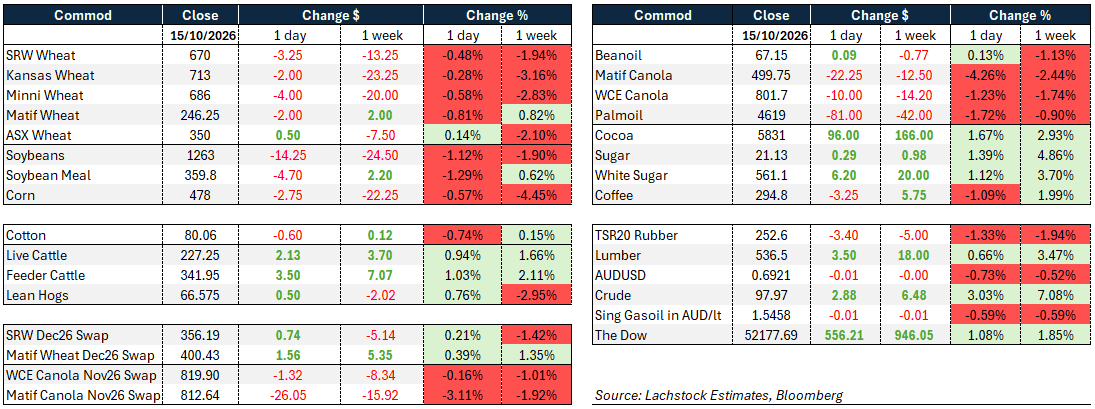
Markets: SRW wheat is range-bound around 670-680 cents per bushel, despite a near halt in Russian Black Sea shipments. Buyers won’t chase with so much supply sitting behind the conflict, but waiting for the Southern Hemisphere runs into freight-capacity limits, and Black Sea logistics face winter. Downside looks limited from here.
Corn fell 4.45pc on the week and broke its 200-day average on harvest pressure and bigger US estimates. EU import demand and the absence of Ukrainian corn are the main support, with value seen 10-15c lower.
The oilseed complex no longer responds to Chinese buying. The NOPA miss and palm weakness hit canola hardest, with MATIF canola down 4.26pc, and local canola has opened $5/t lower, despite AUD support. Australian harvest supply will dominate the canola and barley outlook into November.
Crude rose 7pc on the week on Hormuz and Russian refinery risk, while hot US inflation raised Fed hike risk and pushed the AUD down to 69.2c, cushioning local bids. Fertiliser disruption is the key medium-term risk to 2027 plantings and feed grain supply.
Day ahead – Australia: There is always a head fake at the start of every harvest – it’s just a matter of working out what it is. Early doors quality could be this year’s. The barley harvest in southern NSW is showing some signs of the on-again-off-again season with reports of low test weight and high screenings. This isn’t expected to carry through but it does introduce the concept that big crops can throw up some twists and turns.
PIRSA’s best guess at the South Australian crop is in line with the market – it’s a thumper. Lentils pose an interesting challenge for the long i.e. the grower.
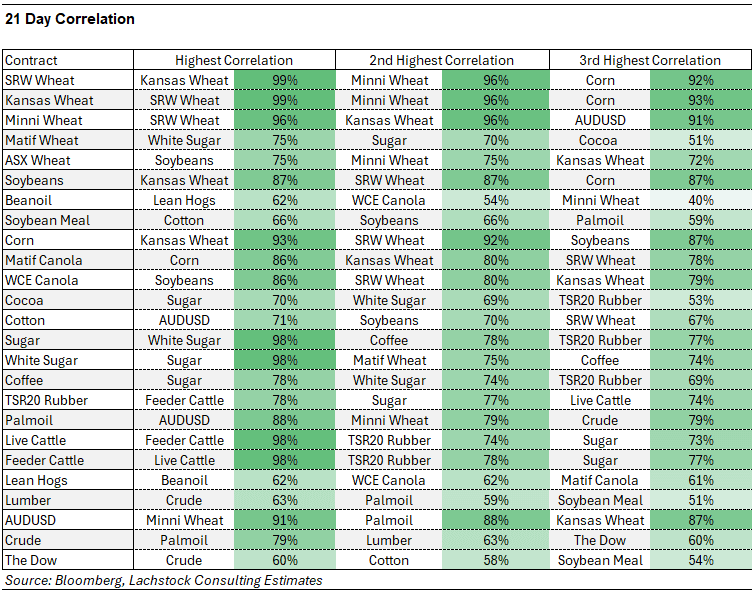
Over the past 21 days, ASX wheat is more correlated to CME soybeans than any of the wheat futures contracts. Source: Bloomberg.
Wheat: Chicago remains boxed in, with buyers fading rallies above 680 and sellers thinning out below 670. The market keeps looking past the Black Sea. Another two tankers were set alight off Romania, Bucharest is now openly blaming Moscow and asking NATO for more capability, and the EU will debate a moratorium on attacks on civilian shipping as well as limits on Russian grain transit.
SovEcon says no wheat has left Russia’s Black Sea ports since late September and puts October Russian exports at 2.5 million tonnes (Mt), 2.9Mt below last year, with July to October flows down 53pc for Russia and 42pc for Ukraine. Kyiv says it shipped only half its potential agricultural volume over October 1-13.
The IGC held world wheat at 820Mt. On the 2027 crop, Expana cut EU soft wheat area by 2pc on rising input costs, and Strategie Grains trimmed its area slightly.
Quality is becoming a theme. Egypt is unhappy with recent Bulgarian cargoes and wants cleaner wheat than what is left in Romania, which will cost it around $5/t more, and early Argentine new-crop quality concerns are surfacing. Argentina is still the cheapest origin into South-east Asia, but it would need record December to February exports to take more share from Australia, so the pace of its harvest logistics is worth watching.
The SRW Dec26 swap firmed 0.74 to 356.19 and the Matif Dec26 swap gained 1.56 to 400.43.
In Australia, crop tours through the Mallee in north-west Victoria and south-west New South Wales found strong wheat and barley less than a month from harvest.
US export sales tonight are expected near 450,000t.
Corn and oilseeds: Corn settled below its 200-day moving average for the first time since early August. Harvest pressure is weighing, along with bigger US numbers in recent reports. The IGC lifted world corn 6Mt to 1.307 billion tonnes, largely by following the USDA US estimate, which yield reports are not yet backing up.
The counterweight is Europe. EU corn imports are near 6Mt, up 29pc year on year, as drought and low rivers leave the bloc short, and that shortfall should push more feed demand toward wheat and widen the US-EU spread. Value buying is seen 10-15c lower.
CONAB held Brazilian corn at 148Mt and put soybeans at 181.6Mt against 181Mt expected. NOPA September crush came in at a 13-month low as the slow harvest and a plant fire limited throughput.
Soybean oil stocks fell but oil imports capped any rally. Soymeal fell while bean oil edged up, leaving the Dec crush 5c higher at 267.25.
Another near 600,000t of US flash sales to China and unknown destinations failed to lift prices. With roughly 10Mt still to buy, Chinese demand is already in the balance sheet. Export sales are forecast at 850,000t for soybeans, 400,000t for meal and 850,000t for corn.
Canola took the heaviest hit. MATIF canola fell €22.25/t, or 4.26pc, to €499.75 and WCE dropped C$10/t, or 1.23pc, to 801.7, with the MATIF Nov26 swap down significantly.
Palm oil gave back 81 (-1.72pc) to 4619, snapping a three-session rally, despite Malaysian exports jumping 43pc over October 1-15. India’s sunflower oil imports hit a four-year low as the war curbs Black Sea supply, which pushed Indian palm buying to a seven-month high.
The local supply story takes over once harvest ramps up at month end. Barley should hold unchanged on AUD support.
Europe’s corn deficit pulls EU supply away from Saudi Arabia, but tours across SE Australia confirms the massive crop on the way. Weak Chinese demand and competition for freight capacity remain the constraints.
Further out, high fertiliser costs and reluctance to plant into Black Sea surpluses could reduce global feed grain area into 2027, which argues for a medium-term view on barley.
Local: Bids were steady in the west, with canola at $870, wheat $386 and barley $324 FIS Albany. In the east, canola was $804, wheat $352 and barley $285 track Geelong. Faba bean bids remain subdued at around $420 delivered port, with new crop at similar levels. Protein wheat remains well bid, with H2 premiums around $10 and H1 $15. Protein is expected to be scarce, with the season shaping up to favour quantity over quality
HAVE YOUR SAY