

Weather:
Europe continues to battle the ongoing drought, with French corn conditions slipping again to 29 percent good-to-excellent from 31pc, poor-to-very-poor at 43pc, triple last year’s rate.
Heat is building across the US south and west, stressing corn and bean fill in those regions.
Excess rain persists through the heart of the Midwest, with another deluge expected over the weekend just ahead of Monday’s Pro Farmer tour.
Prairie weather stayed favourable through the week, capping canola’s rally into the close.
Markets
Funds remain short 32k contracts in Chicago wheat, leaving the market skewed toward further short-covering as Russian export logistics keep deteriorating.
China’s soybean demand shows no sign of slowing, with a seventh flash sale this month confirmed Friday.
Canola ran to a three-week high on old-crop covering and narrowing Western Canada basis, though favourable Prairie forecasts capped the advance.
Rate markets continue to reprice toward a more dovish Fed after the soft retail sales read, with AUDUSD little changed on the session.
Day Ahead – Australia
The relief valve for a portion of Russian availability is the Baltic – news over the weekend that Ukrainian drones hit a Baltic port is significant.
A week ago there was talk that Turkey had brokered a deal to leave grain infrastructure and boats alone. Roll forward a week and the Ukraine had one of its busiest barrage, targeting more crude supplies along with more hits on Russian ports.
What this means for the Australian trade is in front of us – does demand grow as northern hemisphere supply drops? Can our export states do the heavy lifting and will the grower be happy to provide the liquidity?
Markets firm across the board today despite more moisture on the way.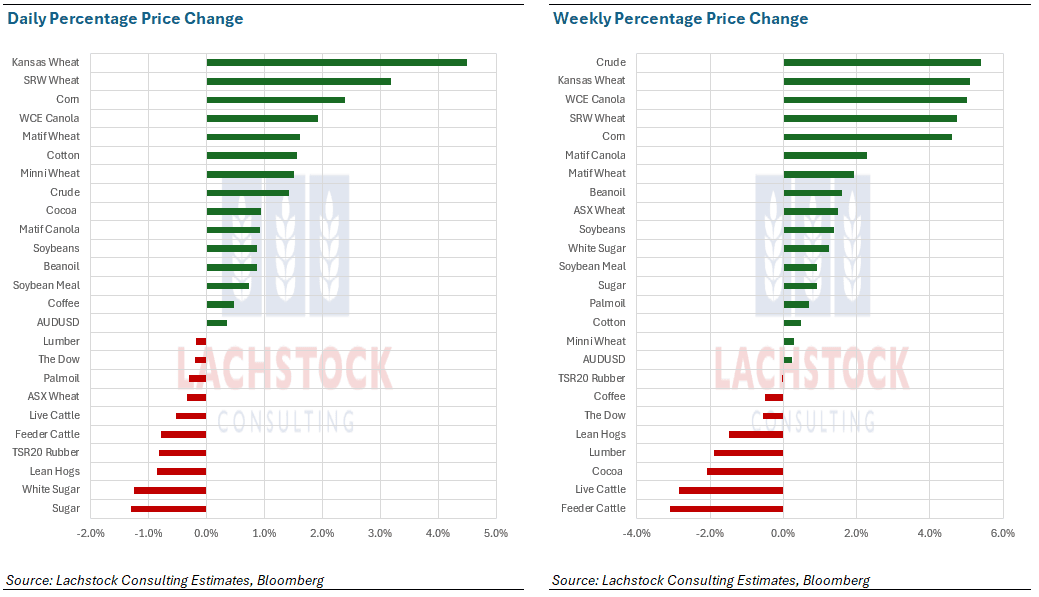
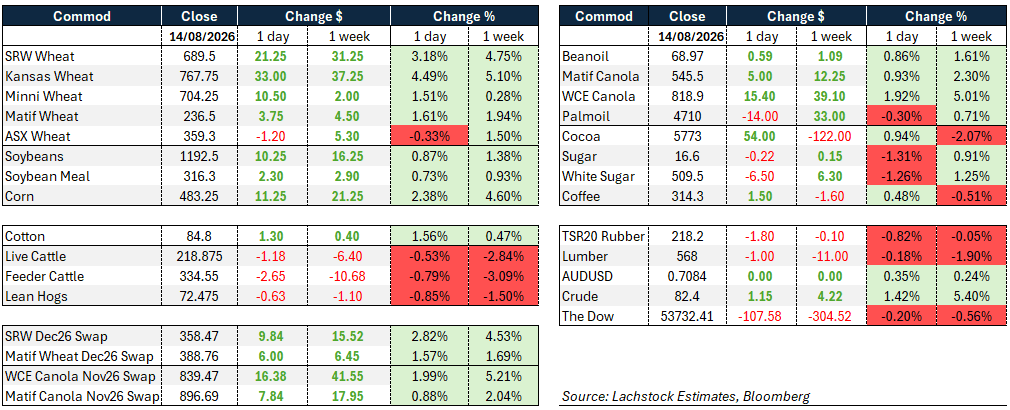
Wheat: Dec CBOT wheat settled 3.1pc firmer at $6.89, but the leadership sat in KC, up 33.75c against SRW’s 22c and a subdued 9c gain in Minneapolis, where the HRS curve stayed narrowly mixed. Paris couldn’t lead the move — Sep Matif added €6.50/t, Dec €3.75 — while Russian cash held flat at US$221/t fob as export capacity keeps tightening.
Zakharova said Friday Moscow has received no formal Turkish channel on a BSEA pause and sees no grounds for a half-measure that hands Kyiv a temporary reprieve, citing the West’s bad-faith unwind of the 2022-23 moratorium; a diplomatic outcome remains distant.
More telling was Ukraine’s reach into Ust-Luga on the Baltic, the alternate outlet Russia had been diverting BSEA-displaced cargo through — only 3-5 million tonnes (Mt) a year moves through it even at full tilt, but with most Black Sea terminals dark there’s little else left to redirect to.
IKAR flagged Russia may clear only 2Mt wheat in August against a 4.8Mt average (4.4Mtt last year, 5.5Mt the record).
Front-running of expected Russian retaliation into the weekend added to the bid, and with funds still short 32k contracts in Chicago, further short-covering looks the path of least resistance as the logistics squeeze deepens.
Buyers are voting with their feet — Indonesia, Vietnam and Bangladesh have all sourced away from the Black Sea, the last Algerian tender skipped it entirely, and Turkey, Morocco, Egypt and Pakistan are the next to watch.
KC’s outperformance and Matif’s inability to lead were the session’s tells; HRW is the tallest nail in this complex and would need much deeper dysfunction — likely not this calendar year — to get properly involved.
Other grains and oilseeds: Dec corn settled 2.5pc higher at $4.83¾, erasing Thursday’s losses as CU added 11c and CZ 11.25c — supply worry back on the table after a day of indifference.
French conditions slipped again to 29pc good-to-excellent from 31pc, poor-to-very-poor at 43pc, triple last year’s rate, with EU import need rising against increasingly uncertain Ukrainian flows; at home, heat across the south and west sits alongside excess rain elsewhere, with more falling over the weekend.
History suggests August may already mark peak yield, acreage fears have faded, and a 10pc stocks-to-use ratio leaves little cushion if Ukrainian export capacity keeps slipping.
Nov beans lagged most of the session before a strong close lifted SU 11.75c and SX 10.25c; yield uncertainty mirrors corn’s — hot in the west and south, wet through the belt’s core — with next week’s Pro Farmer tour the next real data point.
China’s flash-sale streak is now the dominant support, a fourth straight day (136,000 tonnes for 26/27) and seventh this month, even as rain-fed yield ideas build; Monday’s NOPA crush is pegged at 221.5 million bushels with oil stocks near 1.454 billion pounds, and the market needs to respect the crush ratio rather than chase beans in isolation.
Canola ran to a three-week high, Nov WCE up C$15.40/t to C$818.90 and well clear of its major moving averages as end users covered old-crop needs into harvest with basis narrowing across Western Canada; Matif followed in sympathy.
Canadian exports for the first week of 26/27 came in at 231,000 tonnes, sharply up week-on-week but still 9pc behind a year ago, with favourable Prairie forecasts capping the advance.
Macro: A soft July US retail sales print pushed markets further away from Fed hike expectations, though one month of data after five straight solid gains won’t shift the policy read on its own.
The resilience in US consumption through 2026 masks growing bifurcation: sentiment sits near record lows and income growth is losing the race against inflation, while positive wealth effects tied to equities have kept aggregate spending propped up — a narrow base, given the top 20pc of households hold 87pc of total household equity.
The savings rate fell to 2.7pc of disposable income in June, the lowest outside pandemic distortions since just before the GFC, and liquid assets as a share of GDP for the bottom 80pc sit below pre-pandemic levels; the buffer is eroding even as the AI capex cycle keeps the headline growth story intact.
Crude carried its Hormuz-driven premium into the weekend as US-Iran tensions escalate further; equities eased on the softer data and cooling rate-hike odds.
Ukraine’s drone campaign pushed deeper into Russian logistics overnight — a Wildberries hub near Moscow was hit, the 20th such warehouse struck since mid-July, with Russia claiming a record 822 intercepted drones — while Moscow continued targeting Kyiv, Kremenchuk and Kryvyi Rih, damaging the Kremenchuk refinery and halting blast-furnace output at the ArcelorMittal complex; stray drones over Romania underline the spillover risk to the broader logistics chain underpinning the wheat story above.
Local: APW1 2026/27 multigrades rallied around A$10/t over the week, canola more like $20/t.
Delivered markets were more muted with Downs slightly lower over the week.
This probably tells you whats going on at the moment, with the Russia escalation and some really good rain through parts of the country, the domestic market is a little more comfortable while the export path is starting to hunt a little.
HAVE YOUR SAY