

Weather: On 12 November NOAA’s Climate Prediction Center kept its El Niño Advisory in place, with the Niño-3.4 index at +2.5°C.
In Indonesia’s key palm areas, past 30-days precipitation has been mostly less than 50 percent of normal, with dry conditions featured in the outlook through November to January, and the Indonesian palm oil association has flagged production dropping by almost 9pc in 2027 to 53.69 million tonnes (Mt).
In Brazil, Inmet forecasts above-average rain in the South and parts of the Centre-West and Southeast, with below-average falls across much of the North and Northeast between November 2026 and January 2027. Conab had soybeans at 66pc planted in the first week of November, with Mato Grosso at 95.6pc and production forecast at 181.6Mt, and the improved rain outlook is weighing on CBOT beans.
In the US Plains, most of Kansas and eastern Colorado were drought-free as of early November after widespread fall rainfall, and AccuWeather expects the El Niño subtropical jet stream to deliver heavy rain to Oklahoma and Texas this winter, which improves HRW establishment prospects for 2027.
Markets
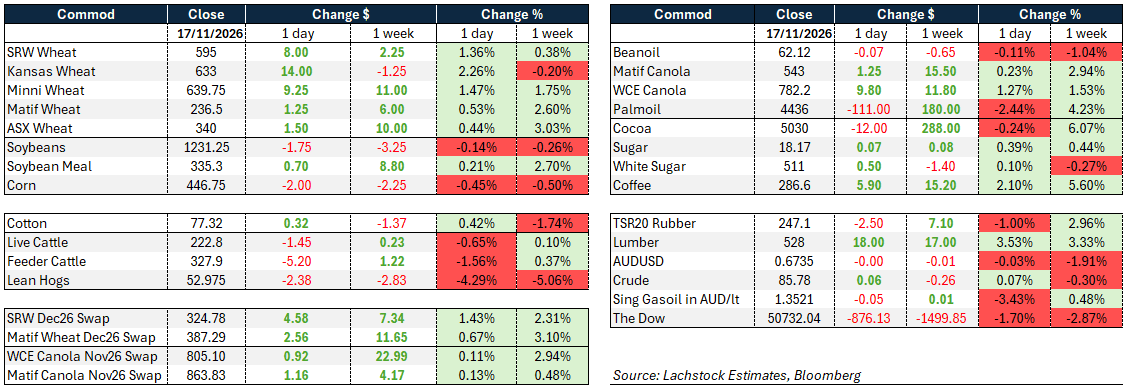
The Kerch Bridge strike put Black Sea risk premium back into wheat, with Kansas (+2.26pc) outperforming Chicago (+1.36pc) and Matif (+0.53pc). Near-term direction hinges more on Thursday’s APEC meeting and the Berlin talks than on fundamentals.
Corn and soybeans are drifting below their post-WASDE highs. Firm spreads and slow farmer selling underpin corn, while improving Brazilian rain and a weak real keep soybeans pinned in their range.
Vegoils were mixed. Palm’s 2.44pc fall weighed on the complex, while ICE canola held technical support on crush demand and the Ukrainian crush-plant damage, and Matif canola is up 2.94pc on the week.
Risk-off macro is a headwind for US export competitiveness, with the Dow down 1.70pc and the US dollar near 19-month highs on Fed hike pricing. The AUD’s 1.91pc weekly fall is cushioning local values, keeping ASX wheat up A$10 on the week at A$340.
Day Ahead – Australia
More cyber attacks yesterday with Apple and HSBC amongst those hit. Hard not to get excited about these attacks after outlook went down, then US air travel was impacted – so far, markets have largely ignored this but it remains a risk into the Aussie harvest.
The rain event hitting this weekend isnt great timing – growers moving from barley to wheat is a common story. Nearby shipments are the first impact, particularly southern barley.
AUD is trying to find its feet – certainly helping our export competitiveness.
Values should be firm today across the board.
 .
Kansas led the complex, up US14 cents per bushel, and Minneapolis gained 9.25. StoneX’s Mike Castle said Azov shipments are already well below pre-war norms, but the damage could substantially delay any resumption of flows even if a deal is reached. He added that speculative selling on peace-talk optimism has run ahead of what is happening on the ground, where there has been nothing but escalation.
Russian attacks on Chornomorsk on 15 November keep Ukrainian port risk live.
Diplomacy is moving quickly, so headline risk cuts both ways into the weekend.
US envoys Witkoff and Kushner meet Ukrainian and European officials in Berlin on Thursday, and Trump is due to meet Putin and Xi on the sidelines of APEC in Shenzhen the same day.
Matif firmed a more modest € 1.25/t overnight but is up € 6/t on the week, lifting the Dec26 swap 2.56 to A$387.29. The SRW Dec26 swap gained 4.58 to A$324.78, and ASX wheat rose A$1.50/t to A$340, up A$10 on the week.
RCM’s Doug Bergman pointed to firming calendar spreads and slowing cash movement as harvest winds down and farmer selling dries up.
Harvest is 88pc complete, against 92pc on average.
Soybeans have stayed rangebound since WASDE raised the US crop less than expected. Futures International’s Joe Davis cited improving Brazilian rain forecasts and a stronger dollar against the real, which are eroding US export competitiveness ahead of Brazil’s new crop in early 2027.
Meal edged up 0.70 while soyoil slipped 0.07.
Wednesday’s EIA data is expected to show ethanol output easing to 1.123 million barrels a day, and export sales are due Thursday.
ICE canola consolidated after Monday’s sharp fall, holding 200-day moving average support near C$770/t.
End-user buying and reports that drones damaged two Bunge crush plants in Ukraine lifted January canola 9.80 to C$782.20.
Headlines that China and Canada have expanded tariff relief, as Xi met Carney, add a supportive undertone for Canadian canola.
Palm oil’s 111 ringgit (2.44pc) slide capped the vegoil complex.
The WCE Nov26 swap rose 0.92 to A$805.10 and the Matif canola Nov26 swap rose 1.16 to A$863.83.
Macro: The Dow shed 876 points as US data strengthened the case for more Fed hikes. October retail sales rose 0.2pc as expected, but the control group rose 0.6pc after 0.1pc.
St Louis Fed President Musalem warned that several further hikes may be needed before spring. A December hike is now fully priced, with close to 70pc odds on January, and the DXY sits around 103.60, near a 19-month high.
The AUD held at 0.6735 but is down 1.91pc on the week.
RBA minutes showed most members judged forward-looking inflation pressures had increased, though the minutes gave no explicit signal of further hikes, and Governor Bullock flagged elevated oil as an upside inflation risk. With the Fed set to tighten more than the RBA, AUD rallies are likely to be capped, which supports A$ grain values.
Crude was little changed at US$85.78 ahead of Wednesday’s EIA inventory report.
Thursday’s first Trump, Putin and Xi meeting is the geopolitical focal point.
The US has reportedly asked Kyiv whether it would cede Donbas in exchange for NATO membership, while Europe insists the fighting must stop before security terms are discussed.
The administration is pushing to show progress before the new Democratic Congress sits in January.
Local: Bids through the west of the country were mixed yesterday, with canola around $845, wheat $379 and barley $331 FIS Albany.
In the east, canola was $787, wheat $344 and barley $280 track Geelong.
Offshore futures strengthened overnight as the Black Sea conflict showed little sign of resolution, prompting shorts to head for the exits. Expect some gains to flow into local bids today, although weaker basis will likely absorb much of the move.
Finally, some warmer weather over the next day or two before rain returns. Expect headers to be out in force across SA and Victoria today, with many growers racing the clock.
Beef processors continue to cut shifts ahead of Christmas, with some eastern plants operating just three days a week or reducing daily kills by 30–40pc. Rain and green feed have producers holding cattle, with some expecting stock to come forward 30–50kg heavier in February–March. Eastern SA grids are around $8.85/kg for HGP-free four-tooth grass ox and $8.10/kg for good heavy cows. A weaker dollar is helping exporters, but high cattle costs continue to squeeze margins.
HAVE YOUR SAY