

Weather:
Corn Belt showers have extended from the lower Great Lakes into the lower Missouri Valley this week, slowing fieldwork even as they replenish topsoil moisture in drier pockets such as Missouri, with the heaviest weekend totals expected in a corridor from Iowa through southern Minnesota, Wisconsin and northern Illinois.
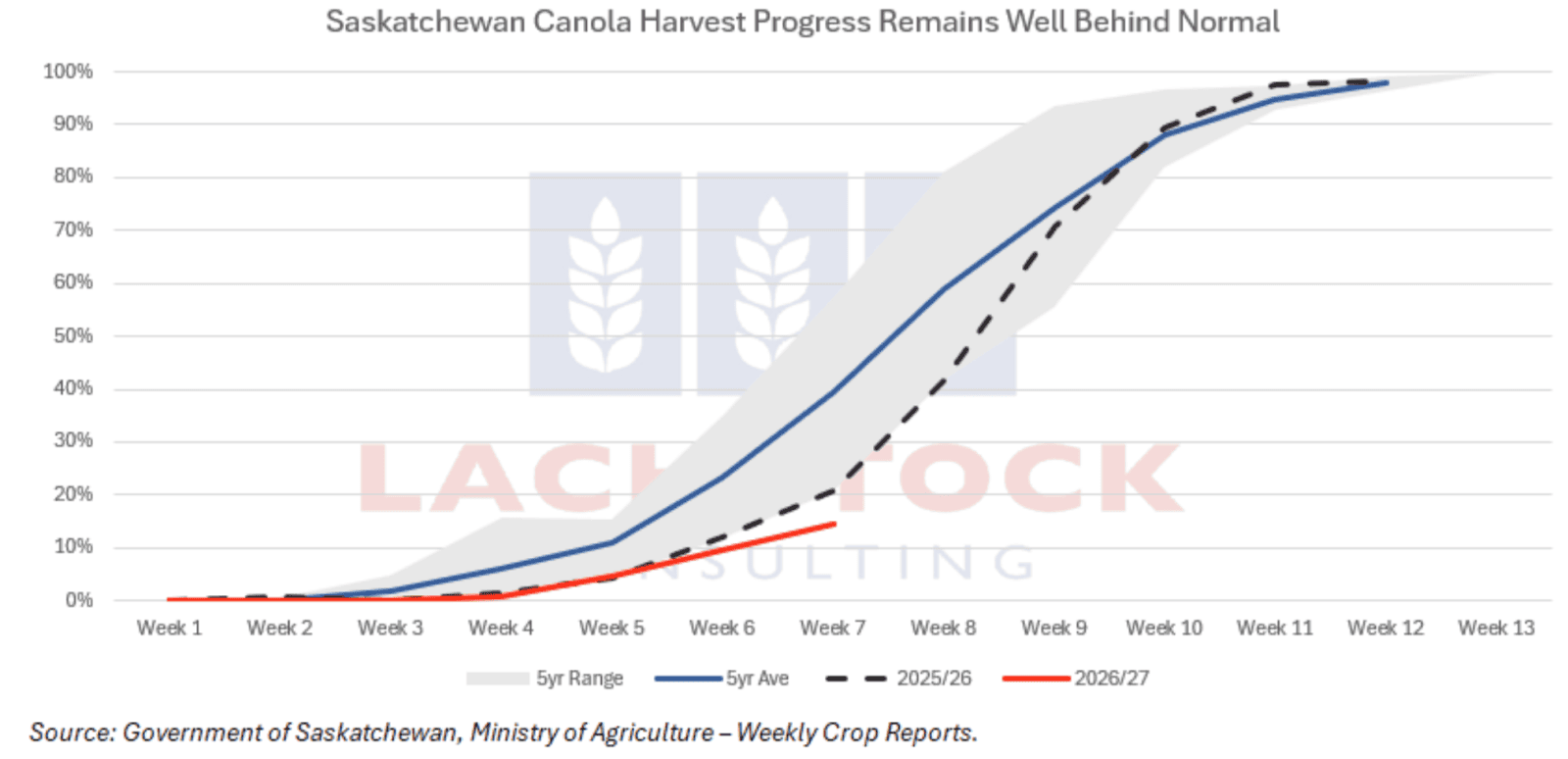
The Canadian Prairies took another 20-40mm of rain through Saskatchewan and Manitoba this week, deepening a harvest already one to two weeks behind schedule with Manitoba only 28 percent off the field including 15pc of canola.
NOAA’s outlook favours above-normal rainfall across much of the Plains through September 20, a boost for Hard Red Winter wheat establishment even as the eastern Corn Belt trends closer to normal to below-normal into next week.
Markets
Black Sea war-risk has escalated rather than eased – Odesa bridge damage, overnight strikes on Kyiv and fresh US sanctions – even as Russian September wheat shipments trend above 2 million tonnes (Mt) on stronger rail flows.
Wheat stays stuck in a range as the market waits to see whether managed-money longs or the consumer blinks first, with Egypt still conspicuously absent from the tender calendar.
Soymeal continues to outperform on tight processor coverage while soybeans lean on Trump-Xi optimism and thin Brazilian farmer selling into an uncertain El Nino season.
Next week’s Trump-Xi summit and this weekend’s Bessent-He Lifeng meeting remain the key catalysts the whole complex is trading around for clarity on Chinese demand.
Day Ahead – Australia
IMF flags that Govt spending is borderline out of control.
JP Morgan has basically given up on predicting a) what the impacts of the Iran conflict are and b) when this thing ends. An investment bank without an opinion is unnerving to say the least.
The markets are doing it again – this time for sure Rocky. The exuberance around Saudi squirting oil through Oman seems to be glossing over the fact the Houthis seem to be shifting gears. Anywho, today at least, there isn’t an energy crisis.
Diesel refining capacity has been massively impacted through both conflicts. China has been able to soften the blow by stepping out of the market to a large extent but, how long does this last. The other canary in the coal mine could be the VLCC market – Ocean tankers – since the cyber attack, vessel freight has rallied over 280pc since the beginning of Aug.
 Wheat: Nothing to see here, carry on.
Russian cash sits unchanged at US$210/t fob while the Black Sea conflict escalates rather than eases: Russia has damaged a bridge in the Odesa region that Ukrzaliznytsia says will significantly limit Ukraine’s grain movement to its Danube ports, and Russian missiles and drones hit Kyiv and other cities overnight, injuring more than two dozen, hours after Congress passed a fresh sanctions bill the Kremlin says will make a peace deal harder to reach.
Lloyd’s Market Association has expanded its Black Sea war-risk reporting area to cover Russian and Ukrainian coastal waters. Even so, IKAR’s Dmitry Rylko now sees Russian September wheat shipments topping 2Mt, up from an earlier 1.5-2Mt view, on stronger rail flows, and the IGC still trimmed its 2026-27 global wheat trade forecast by about 2Mt to 201Mt as Black Sea bottlenecks bite – down roughly 6pc on 2025-26.
Rouen loadings fell to 104,520t in the week to Wednesday from 158,371t, mostly to Morocco, Cameroon, Burkina Faso and Mali. Egypt remains conspicuously absent from the tender calendar and the standoff is really a game of chicken – can managed-money longs outlast a consumer drawing stocks to the bone hoping for a truce.
Matif Dec/March should lead given the fund is already long 162,000 contracts with commercials holding a decent share of the crop.
US wheat sales were a pedestrian 326,000t, matching expectations and running 43pc of USDA’s full-year pace through week 15, split 122,400 HRS, 117,800 SWW, 44,600 HRW and 40,800 SRW.
Saskatchewan’s spring wheat harvest reached 17pc versus 13pc a week ago, well behind 56pc at this point in 2025.
Tunisia says its wheat stocks cover demand to January 2027 after a roughly 1.1Mt cereal harvest, about 70pc durum.
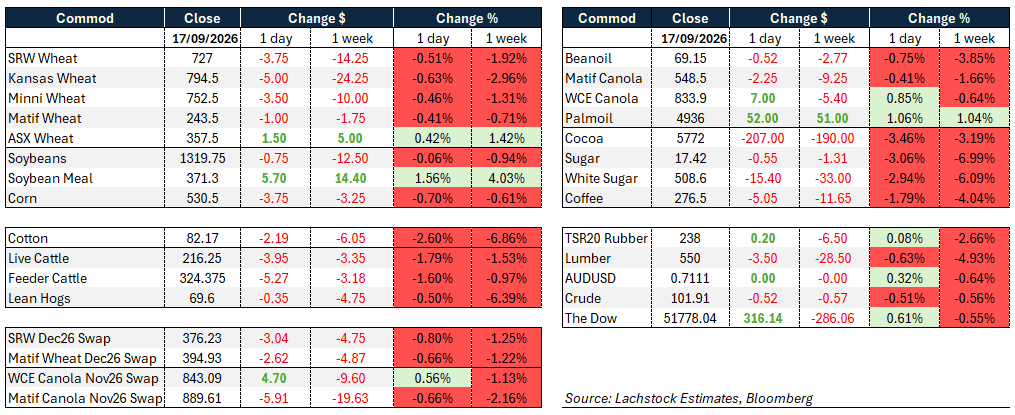
Other grains/oilseeds: Corn spent most of the session lower before settling down 3.75c, with sales of 1.03Mt falling short of the 1.35Mt expected even as Mexico took just over half the total.
Showers are hampering parts of the Midwest again this week – a wet pattern running from the lower Great Lakes into the lower Missouri Valley is slowing fieldwork while replenishing topsoil moisture in drier pockets such as Missouri – yet growers keep selling regardless, and commercial ownership of the crop keeps building.
Yield chatter stays negative: AgResource wonders whether NASS cuts the national corn yield another 2-3 bushels an acre in October after early harvest returns disappointed against the September WASDE’s 178.5 bu/acre figure.
Beans barely moved, finishing fractionally lower, while meal did the heavy lifting again – soybean meal spiked $5.70 to $371.3 with bean oil down 52 points as the rotation out of oil share persists; December crush firmed 7.5c to 257.75.
Processors are reportedly short beans and scrambling to cover commitments they may struggle to honour, particularly nearby, while Brazilian growers hold off marketing with El Niño now the season’s wildcard.
In China, Zhengzhou rapeseed meal touched its highest intraday level since July 27 as crushing-plant inventories fell 2pc in the week to September 11 and lower Canadian output bites, while Dalian soymeal hit a three-month high on the Chicago rally; Beijing has passed the halfway mark on its pledge to buy at least 25Mt US soybeans this year ahead of next week’s leadership summit.
Canadian harvest remains the bigger canola story – Manitoba was just 28pc off the field as of September 8, including only 15pc of canola, and a fresh 20-40mm of rain moved back through Saskatchewan and Manitoba this week – though WCE still found late strength Thursday, looking past StatsCan’s satellite-based 22.1Mt crop estimate.
Malaysian palm oil pulled back from a 21-month high, pressured by soft exports and expectations of a stock build this month.
Macro: Oil fell for a third day as Middle East supply fears ease and Saudi Arabia moves to restore about half the capacity of its damaged East-West pipeline; WTI slid toward $101 and Brent settled below $105, still up more than 70pc year to date given the Middle East and Russia-Ukraine conflicts.
Trump told Axios he is nearing a “big decision” on re-escalating strikes on Tehran ahead of a Gulf states meeting next week, with JPMorgan’s Natasha Kaneva saying the bank now has no baseline view on how the Iran war resolves.
On currencies, the IMF’s Article IV statement – flagging inflation risks still tilted to the upside and urging the RBA to stand ready to hike while government spending is reined in – gave AUD/USD support, per CBA’s Carol Kong, while the 3-year bond yield eased under 1bp to 4.98pc and the 10-year fell 3bps to 5.32pc.
Markets are looking to next week’s Trump-Xi summit and the Bessent-He Lifeng meeting over the weekend for clarity on Chinese demand, still digesting Wednesday’s Fed rate hike.
Geopolitically, Trump says “major progress” is being made on a new US Army base in Poland even as the Pentagon reviews troop levels in Europe, while Polish PM Donald Tusk warned Russia is planning hybrid-style drone and missile strikes on nations supporting Ukraine.
Local: Through the west of the country, wheat was +A$5/t yesterday to $385, canola softened to $880 and barley was steady around $330 FIS Albany.
In the east, wheat was $355, canola $820 and barley $296 track Geelong.
Hay continues to hit the ground, with momentum building as we move into warmer temperatures over the next two weeks. Cereal hay is currently around $200/t ex-farm across SA and Victoria, with vetch hay around $100/t dearer.
There have been some reports of light frost through parts of SE SA and the SA/Vic Mallee. There is still enough moisture around to limit the severity, with the impact expected to be minimal.
The more growers you speak to, the bigger the crop becomes in the south. Some on the Eyre Peninsula are now expecting production around 20pc above the previous 2022/23 record. If realised, there will be some very big tonnes to move and strong margins for those with access to shipping capacity.
HAVE YOUR SAY