
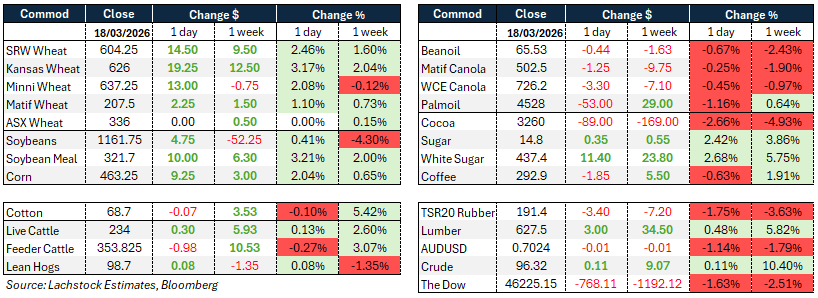

Weather: The US weather looks challenging – hot, windy and little rain on the way.
We are still looking for rain on the Qld/NSW border – BOM giving us some small hope today.
Some heat hitting EU and the Black Sea also.
Markets
Honestly, I don’t know where to start. I read a funny quote from a guy giving his opinion on crude – “these are the craziest markets I have seen in my 10 days as a crude trader” – yep, everyone is an energy trader at the moment.
The rally in wheat makes sense from a distance. The 21-day correlation is 98 percent between crude and Kansas Wheat – capital flow is the rising tide that lifts all boats. However, the heat and lack of rainfall through the US Plains is becoming a concern. Additionally, the CFTC report highlights that the shorts really haven’t got out as yet. Yes the net position has improved but that’s largely due to the fact that longs have piled in – but the short presists – where do they hit the eject button?
Diesel and urea are all anyone can discuss at the moment and it feels like yield models based on NDVI will have a challenging year ahead.
Day Ahead – Australia
Liquidity vacuum. Until it changes, I will leave that in. I felt like things were trying to improve yesterday only to wake up to news Qatar’s LNG storage was hit – thats a big deal. The fact Iran hit Qatar is massively significant, even more so than the other neighbours but I guess you can’t be surprised any more.
We still haven’t seen the Asian wheat buyer turn to Australia to fill up their cupboards – barley and sorghum still dominate the supply chain.
Australian growth has to deal with the massive pressure of largely unavoidable increased energy costs and, now, a rate increase. Kind of baffling when government spending and energy costs are pretty impossible for mums and dads to control.
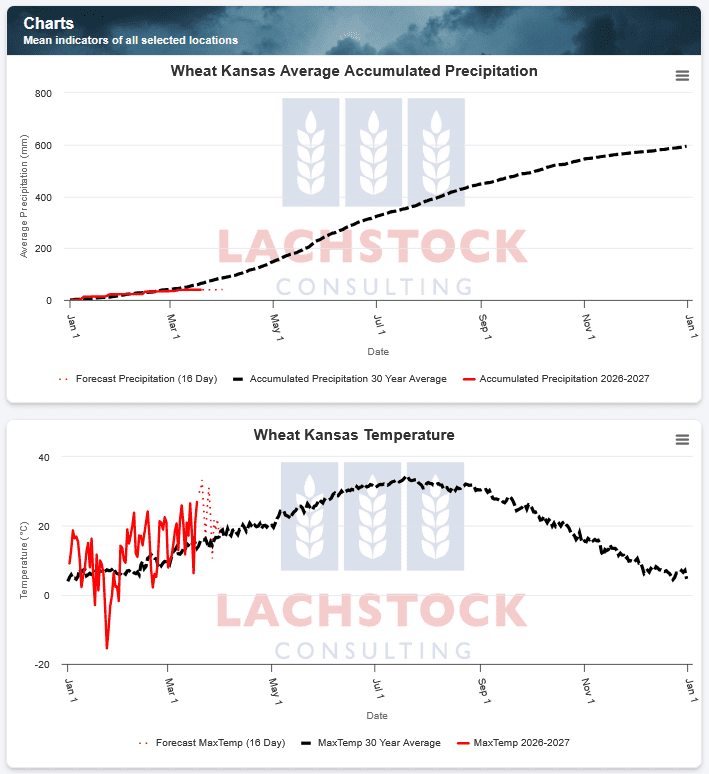 Global wheat: Chicago +14.50c, Kansas +19.25c, Matif +€2.25
Wheat markets rebounded strongly with Kansas leading, supported by rising crude, escalating Middle East tensions and renewed fund buying as wheat is increasingly viewed as a food security hedge.
The disruption in the Strait of Hormuz and attacks on energy infrastructure have reinforced inflationary narratives, drawing speculative length back into the market. At the same time, US fundamentals are tightening, with HRW regions facing hot, dry and windy conditions, shifting focus from acreage reductions toward potential yield losses.
Production estimates are being questioned, with some trade calling for lower HRW output. Export demand remains solid with US sales already tracking well ahead of required pace.
Globally, Russian exports continue to dominate and cap upside structurally, with March shipments potentially reaching 4.3–4.5 million tonnes. However, geopolitical risk and weather are currently outweighing competitive pressure in price direction.
Other grains and oilseeds: Corn +9.25c, Soybeans +4.75c, Matif canola -C$3.30
Row crops were firmer overall, led by corn which continues to attract fund length amid strong demand, elevated energy prices and uncertainty around US acreage.
High fertiliser and diesel costs are reinforcing the inflation narrative and supporting corn through both cost and biofuel demand channels, with Brazil also seeing delayed safrinha planting and increased ethanol incentives.
Soybeans found support from strength in meal and tightening physical markets, particularly in South America where slow harvest pace and logistical constraints are driving cash rallies and supporting global values.
US meal demand is strong, highlighted by fresh export sales, while crush margins remain elevated. Ongoing uncertainty around US–China negotiations is keeping optionality in the market, although timing risks remain for old crop demand.
Canola traded both sides, initially supported by strength in veg oils and crude before easing on profit-taking and softer energy late in the session.
Broader veg oil markets remain caught between biofuel-driven demand optimism and weaker discretionary consumption.
Macro: AUD weaker, Dow -1.6pc, Crude higher
Macro conditions continue to be dominated by the escalating Iran conflict and its impact on global energy markets.
The Strait of Hormuz remains heavily disrupted and effectively controlled by Iran, with reopening unlikely without a ceasefire, sustaining elevated oil prices and ongoing supply chain stress.
Attacks on key energy infrastructure across Qatar, Saudi Arabia and the UAE have intensified volatility and reinforced inflation expectations globally.
Central banks are responding cautiously, with the RBA hiking rates citing energy-driven inflation while the Fed, BoC and others remain on hold but acknowledge rising uncertainty. US inflation data remains firm, with PPI showing continued price pressures, particularly in goods and food.
The broader outlook points to a prolonged inflationary environment driven by higher energy costs, rising input prices and geopolitical instability, with markets increasingly pricing in persistent volatility rather than a near-term resolution.
Local: WA bids eased yesterday with canola around A$745/t, wheat $325 and barley $328 FIS Albany.
Through the east canola was $725, wheat $326 and barley $310 track Geelong.
Lentil markets continue to trade sideways, with delivered Geelong/Melbourne sitting around $660, broadly unchanged over the past month. Occasional short-covering has pushed values ~$20 higher, but these moves have been short-lived.
Planting sentiment is beginning to shift, with a modest swing expected towards pulses on the back of elevated input costs. Canola is likely to lose some area, while barley is expected to pick up acres given lower inputs.
HAVE YOUR SAY