

Weather:
Weather is increasingly split. With another 25mm likely for SA and Vic over the next 8 days. Better rain prospects across the US southern Plains weighed slightly on Kansas late in the session, while heat across the US soybean belt is becoming supportive for beans. India remains a concern after a dry August and another below-normal monsoon forecast for September. Canadian harvest weather and early yield reports are now becoming increasingly important for canola.
Markets
Geopolitics continued to drive the bus. Wheat pushed higher as Russia rejected another attempt to reopen Black Sea grain flows and Ukrainian exporters were effectively told to prepare for months without deep-water ports. Fighting between the US and Iran also resumed, sending crude around 5% higher as renewed attacks and fresh risks around the Strait of Hormuz tightened the global energy outlook. That move spilled straight into oilseeds, with soybeans and canola rallying alongside stronger soyoil, palm and rapeseed, while corn pushed to fresh highs on lower US production expectations.
The warning light remains competitiveness. US wheat and corn are now well above competing world origins, meaning futures are becoming increasingly reliant on continued Black Sea disruption and lower US production becoming reality. With war risk now supporting both grains and energy markets, volatility remains elevated and 10–15c moves in wheat in either direction are likely to stay common.
Day Ahead – Australia
Canola will be the strongest market locally after the combination of surging crude, ICE canola, soy oil, palm oil and Matif rapeseed. Barley supported from record-high US corn, although the size of the Australian crop remains the limiting factor. Australian Q2 GDP today — ANZ expects +0.5% q/q versus the market at +0.3%
.
 .
.
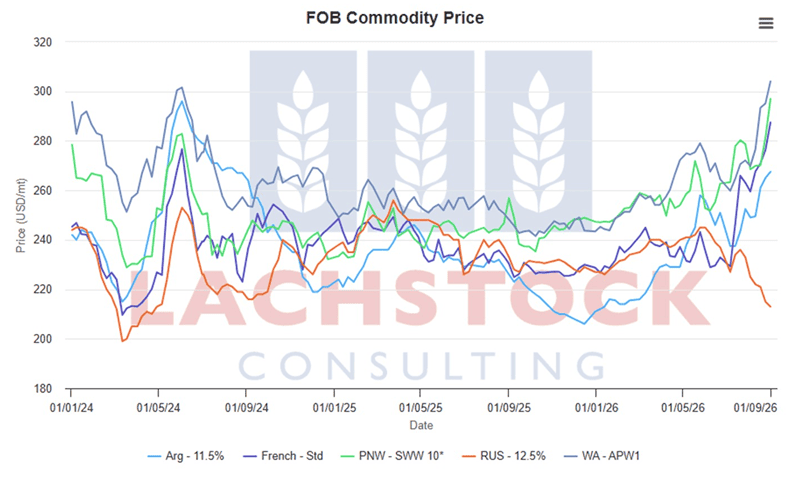
Wheat: US wheat finished higher again: Chicago +8.5c, Kansas +7.25c and Minneapolis +13.75c, while Matif Sep/Dec jumped €8.25. Russian cash slipped to US$214/t.
Black Sea disruption remains the core bullish driver. Russia dismissed Turkey’s proposed grain-corridor revival while attacks on Ukrainian ports, border infrastructure and Russian assets continued.
Ukraine’s largest farm group is telling exporters to plan on deep-water ports remaining closed until at least Dec/Jan. Danube and rail alternatives can cost up to US$50/t more and may only handle around half the previous Black Sea export volume.
The Danube is already congested, with roughly 80 vessels queued, reinforcing the idea that Ukraine cannot simply reroute all displaced tonnes.
The catch is price: US HRW is reportedly around US$142/t over Russian wheat, leaving US origin badly uncompetitive. The bullish story remains intact, but futures are vulnerable to sharp corrections if headlines quieten.
Elsewhere, EU soft-wheat exports are 4% behind last year at 4.2mmt, while Kazakhstan exported a record 8.3mmt in Sep–Jul, +15.7% y/y .
Other grains and oilseeds: Corn made fresh contract highs, with December +8.25c. Lower US yield expectations and reduced Ukrainian export capacity continue to underpin the market.
Like wheat, US corn has become expensive relative to competing origins, with Argentina and Brazil cheaper into Asia and North Africa. That could eventually slow the rally unless US production estimates keep falling.
Soybeans surged after crop conditions disappointed and heat spread across the US growing belt. Meal gained US$7.10 and soyoil +162 points, while the US confirmed another 136,000t soybean sale to China.
Canola surged, helped by the roughly 5% spike in crude, stronger soy products, Matif rapeseed and palm oil. November ICE canola moved further above its key moving averages.
Canadian harvest uncertainty remains supportive, with anecdotal reports suggesting highly variable Prairie crop conditions. Upcoming provincial reports should provide the first meaningful read on actual canola yields.
Malaysian palm oil rose around 2% to 4,992 ringgit/t, with stronger crude and competing oils outweighing sluggish August exports.
India is another weather concern: August rainfall was 16% below average, September is forecast below normal and USDA FAS sees Indian rice production potentially falling around 4.5% y/y.
Macro: Oil was the standout move. WTI jumped around 5.1% to US$90.8/bbl and Brent roughly 5.9% to US$95.3/bbl as fighting between the US and Iran resumed.
Hormuz remains the pressure point. Tankers have again been struck and Iran says restrictions through the Strait are tightening. Meanwhile Saudi Arabia, the UAE and others are accelerating pipeline projects designed to bypass Hormuz over coming years.
US crude inventories fell another 2.6m barrels, while 3.1m barrels were drawn from the SPR, leaving the reserve at just 286.6m barrels. Distillate stocks remain well below normal.
Higher energy prices revived inflation fears: the US 10-year yield rose to 4.79%, the USD strengthened, equities weakened and gold fell 2.5%.
Fed Governor Barr stressed next week’s August CPI and PPI will be critical. The market is again considering the possibility of a September hike if higher energy prices start feeding through to underlying inflation.
US labour data remain relatively balanced, with JOLTS openings at 7.27m, while manufacturing remained healthy with ISM at 54.6.
Canada-US trade tensions are also escalating, with Canada preparing dollar-for-dollar retaliation from 8 September following new US tariffs.
Local: Cereals were slightly softer through the west, with wheat back $4 to $390 and barley at $333. Canola was largely unchanged, bid $875 for both conventional and GM.
In the east, canola was bid $815 and GM $785, while wheat was $365 and barley $296 track Geelong.
Temperatures are expected to push into the low 30s across QLD over the next week, with hay and silage already starting to hit the ground as many growers lose confidence in grain yield potential from later-sown crops. Chickpeas planted on the late rains appear to be struggling the most. The domestic market remains around $425 for new-crop wheat and $405 for barley delivered Darling Downs.
Cattle prices are running well ahead of export beef fundamentals, with saleyard strength forcing processors to lift cow grids by 20–30c/kg despite falling US manufacturing beef values. Southern processors appear willing to wear short-term losses to keep kills moving ahead of an expected lift in cattle supply from mid-September, but current cow values are estimated to be around 50–60c/kg above breakeven .
HAVE YOUR SAY