
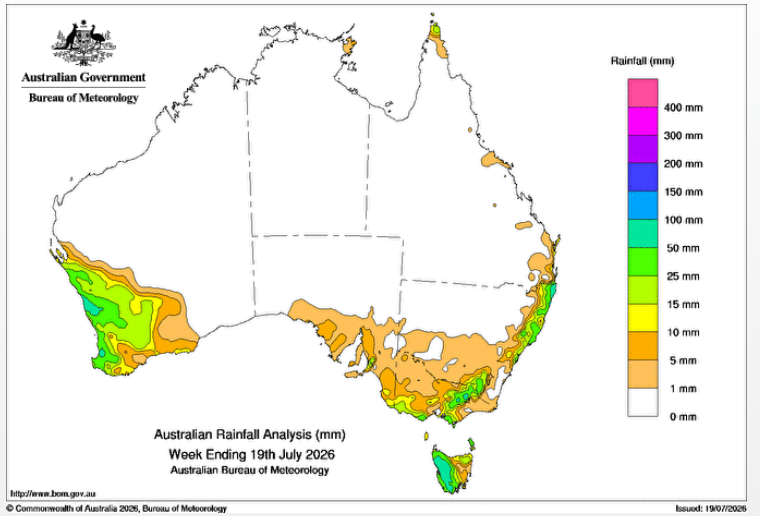
 Weather:
Virtually nothing exciting for the whole east coast of Australia. WA got a decent drink particularly in Geraldton port zone.
Mudhya Pradesh is rated as “large deficit” as the monsoon progresses. Uttar Pradesh had a “normal” week.
Keeping an eye on Argy – not a big deficit just yet but temps have been up to 10°C above normal for this time of year.
Markets
Bad to worse. Both wars escalated over the weekend with no real end in sight. Tanker crossings are back to one or two a day and infrastructure damage across the region is starting to mount up again.
Bulls need feeding so it will be an important week for grains. As I sit here, the night market has opened firm again with wheat and corn up 5-6 cents.
Day Ahead – Australia
Lack of rainfall on the east coast will keep the offer side quiet.
Values should firm slightly on last weeks close.
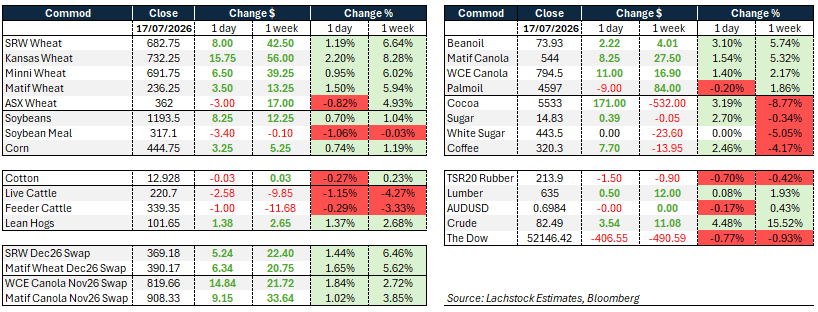
 Wheat: Black Sea risk drove the week. The Kerch Strait closure last Friday touched off continuous vessel and port strikes: Ukraine hit 12 Russian shadow-fleet ships overnight Thursday, 159 since July 6, while Russia answered Sunday with its largest ballistic missile barrage of the war on Kyiv, plus strikes on Pivdennyi and Odesa ports and four military-linked cargo ships.
Russia’s harvest is over 21 million tonnes (Mt) but behind on area, with fuel logistics now strained by Ukrainian refinery attacks.
Suderman (StoneX) notes the market still assumes Black Sea grain eventually flows as it did in 2022, but both sides now have better drone tech to threaten the alternate routes that saved the trade then.
GIWA cut its 2026 WA wheat estimate to 9.5Mt.
French wheat cutting is 92 percent done but ratings slipped to 65pc good-excellent from 69pc.
US spring wheat is expected lower Monday after Northern Plains heat stress, though Kansas outperformed Minneapolis despite HRS bearing the brunt.
Bergman (RCM) frames it as short US crop, stressed EU crop, El Niño risk to Australia; uptrend intact, volatility expected. SRW Dec26 swap settled 369.18, up 1.44pc day, up 6.46pc week.
Other grains and oilseeds: Corn firmed as the Plains heat dome starts to lift, though forecasters lack conviction on what follows, leaving Sunday night’s outlook key ahead of Monday’s crop progress.
IGC cut its 2026-27 global corn forecast to 1.306 billion tonnes from 1.343 billion on European heatwave damage.
Brazil and Argentina stay aggressively competitive on nearby corn; Safras lifts Brazil’s 2026-27 soy area 1.2pc to 49.1 million hectares, corn to near 145Mt.
China’s pull is structural: Argus reports domestic port corn at six-year lows for this point in the cycle, sorghum and Australian barley running Yn90/t to over Yn250/t cheaper landed, Kpler tracking at least 4Mt corn, barley and sorghum arriving July-September, Guangdong stocks near 3Mt versus the prior two years.
Beans capped the week on fresh demand: Friday flash sales totalled 706,634t for 2026-27 (340,000 China, 256,634 Mexico, 110,000 unknown), plus 10-12 China cargoes for September-October.
Castle (StoneX) says continued Chinese buying toward its alleged 25Mt commitment could tighten the US balance sheet materially.
Bean oil rallied on strong EPA RIN data, August crush up 10.75 cents to 322.75.
Canola tracked the same crude/soyoil strength plus fund length and thin farmer selling; one analyst expects November through C$800/t shortly, up near C$17 since July 10; another flagged slow crop development and frost risk before mid-September.
Cumulative 2025-26 canola exports reached 8.56Mt, above AAFC’s 8.4Mt estimate but short of last year’s 9.23Mt; loonie firmed to 71.37 US cents.
Palm oil logged a second weekly gain on India festival demand and El Niño concerns.
Macro: Brent rallied above $90 for the first time since mid-June, up over 3 percent to $90.99, after a weekend US-Iran escalation Tehran says has ended the ceasefire.
Iran’s navy halted four vessels attempting an unsafe Hormuz route, two meeting accidents; Kuwait took the brunt of retaliatory strikes on an oil facility, Bahrain also hit, Israel intercepted an Iranian drone near the Syrian border.
Kavonic (MST Marquee) sees scope for a broader, longer conflict, with direct hits on regional oil infrastructure or a Houthi move on the Red Sea route as the next accelerant.
Wright says Hormuz transit volumes are down even as larger tankers keep moving.
Suderman also flags the conflict’s threat to 2027 fertiliser supply, tying the energy shock to next year’s corn and wheat production risk.
Equities softened on the same headlines; AUD held narrow, up marginally on the week.
Local: In the west of the country on Friday bids eased for canola and wheat, and were a touch firmer on barley. New crop bids in Albany PZ were A$870/t FIS for canola and $840 for GM, wheat $366, and barley $331. It should be a positive start to the week with the strong close in offshore futures on Friday night.
Downs wheat continued to firm last week on slow grower engagement. Forecasts this morning are basically devoid of moisture for the entire NSW and QLD growing regions which will keep the offer side vacant.
HAVE YOUR SAY