

Weather:
Argentina: The Rosario Board of Trade lifted its 2026/27 wheat forecast to 23.8Mt from 21Mt, but rain and frost have caused some crop damage. In the north, persistent drizzle has delayed the start of harvest and raised grain quality concerns.
Brazil: Soybean planting reached 66.8pc of the projected area by 9 November, and Mato Grosso is practically finished. In Rio Grande do Sul, rain and hail interrupted planting and caused localised damage to young plants.
US Plains: By early November most of Kansas and eastern Colorado were drought-free after widespread fall rain, and El Niño is expected to bring more moisture. Drought remains a concern in Oklahoma, particularly the southeast.
Markets
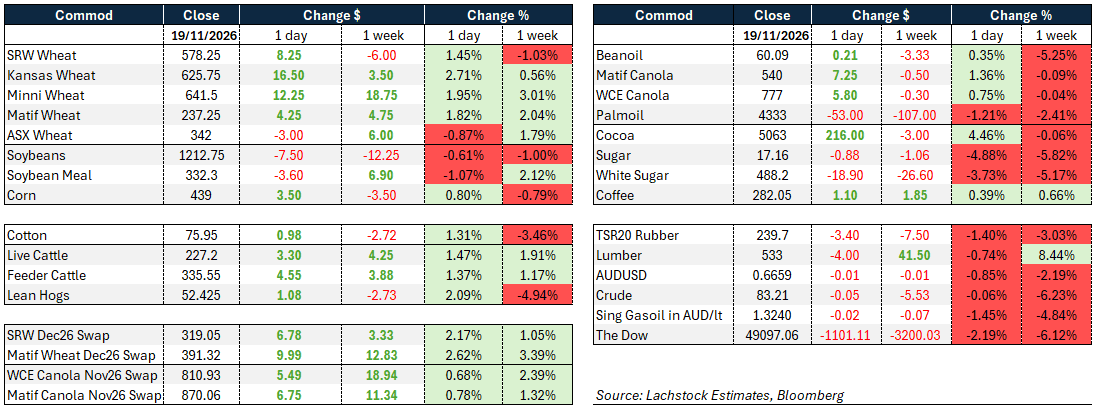
Wheat rallied on quality worries, with Kansas leading on widening southern hemisphere protein spreads, while ASX slipped.
The soy complex fell as China delays bean imports at ports on weak livestock demand and overflowing stocks.
Canola firmed on veg oil spillover, with palm down for a third session on record Chinese olein stocks.
Markets were risk-off: the Dow fell more than 1,100 points, the US dollar is near a 20-month high and the BRL is above 5.80.
Day Ahead – Australia
Shocking reports from the EP with hail and wind damage along with a bunch of powerlines going down.
Fingers crossed we get through this forecast with headers still rolling.
The 3 big fellas sat around a table and decided that owning more oil would be a good idea – not the sound bite the market was looking for.
 .
Lachstock has NSW 63pc done, WA is 40pc in the bin and SA and Vic are early days.
ASX fell A$3/t to $342 despite the offshore rally. A softer AUD lifted the Matif Dec26 swap by $9.99 to $391.32, which leaves local values looking cheap to offshore parity.
US weekly sales were 345kt against 300kt expected, and South Korea may have bought 100kt of SWW overnight.
Ukraine struck the Kerch Bridge for a third time in a week and rail services were suspended. Putin vowed to retaliate and ruled out a truce.
AgResource sees Russian wheat exports at 26.5Mt, 32pc below USDA, and says a corridor deal alone would no longer restore the flow.
December options expire tonight.
The BRL trading above 5.80 is a headwind for US corn.
Rabobank sees support from the EU’s 10Mt drought shortfall and Ukraine’s inability to ship.
Weekly sales were 1.59Mt, in line with estimates, and Korea’s KFA bought 63kt privately.
Beans rose early and then turned lower.
China is delaying bean imports at some ports, with crush margins negative, hog prices slumping and port stocks high. Mexico took 200,844t in a flash sale, and weekly bean sales were 1.5Mt.
Beijing said the China-US agriculture working group will meet soon, but the roughly $17 billion US farm goods package has yet to be implemented.
Jan canola rose C$5.80/t to $777, helped by firmer soyoil and Matif rapeseed. Weaker meal and palm capped the gains, and an analyst flagged risk of a pullback on Friday .
Macro: The Dow fell 2.2pc and is down 6.1pc for the week, while a near 20-month high in the US dollar weighed on commodities.
The Shenzhen meeting between Trump, Xi and Putin produced little beyond a pledge to lift refined fuel supply, and Trump holds a White House press conference on Friday to outline the trip’s results.
Kushner and Witkoff head to Berlin for Ukraine talks with Zelenskiy and European leaders.
Western officials see a growing chance of further US strikes on Iran.
A suspected Houthi missile hit the headquarters of the Saudi sovereign wealth fund in Riyadh.
Trump is also urging Congress to pass a new Farm Bill before the 2027 planting season.
Local: Bids were softer through the west yesterday, with canola down A$20/t to $836, wheat down $5 to $376 and barley at $332 FIS Albany.
In the east, canola was back $15 to $777, while wheat was $344 and barley $281 track Geelong.
Storms smashed through the Eyre Peninsula yesterday, bringing down transmission lines and cutting power across large parts of the region. The worst of the hail damage appears to be around Port Neill and Rudall, where early reports suggest crop losses of more than 50pc in some paddocks.
The Aussie dollar continues to lend a hand to local bids, slipping below US67¢ after weak employment data and US inflation figures. As a rule of thumb, every US1¢ fall adds around A$4/t to cereal values, all else equal, so a US3¢ drop is worth roughly A$12/t.
HAVE YOUR SAY