
 Weather: Southern Russia is sowing winter grains into dry soils and above-normal temperatures for a second straight year, raising the risk of weak establishment and winterkill. Winter sowing had reached 70 percent of plan by 16 October, according to Agriculture Minister Lut, so the next few weeks of rainfall will decide whether this becomes a structural yield risk.
Brazilian soybean planting is running well ahead of pace, with Veeries citing record early sowing in Mato Grosso. However, October rainfall in central Brazil has been sparse, and after a front brings rain this week, falls are forecast to turn scant again next week, which puts rainfall frequency in focus heading into December pod fill.
French grain maize is set to nearly halve to 7 million tonnes (Mt) after record heat and drought, the lowest since 1976. Dry Midwest weather should accelerate a lagging US corn harvest. In Argentina, the Buenos Aires Grains Exchange sees wheat falling to 23.4Mt from 27.8Mt, while soybean and corn output rise.
Markets
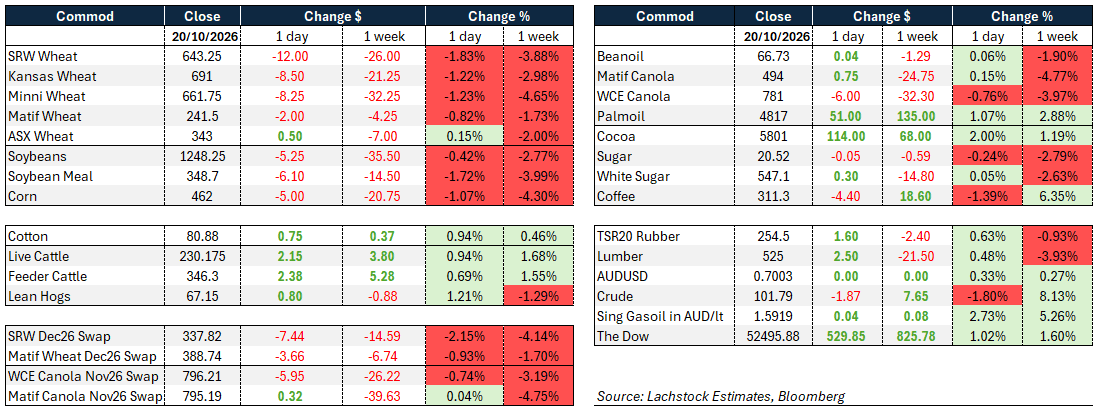
Peace headlines on Iran and Ukraine drove a broad risk-premium unwind. Dec SRW fell 12.00 to 643.25 and closed below its 200-day moving average for the first time since June, and the SRW Dec26 swap dropped 2.15pc to A$337.82. That leaves US wheat far more competitive for regional demand.
Corn’s sixth straight lower close to 462 puts the August low of 457.25 in range, as managed money liquidation meets harvest pressure. The French maize collapse and Ukraine’s export status are the main supports against further downside.
Oilseeds were split. Meal liquidation and China’s sow herd cuts weighed on beans despite a 612kt China flash sale, and WCE canola hit a near two-month low at 781. Palm gained 1.07pc on export tax waiver talk.
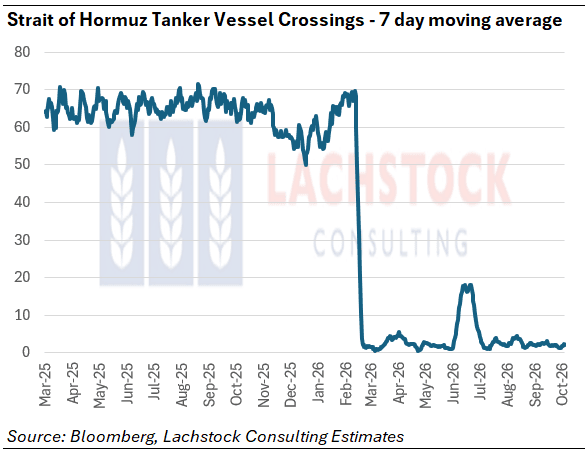
Crude fell 1.80pc on the day but is up 8.13pc on the week. Escalating Hormuz engine-room strikes are tightening tanker supply and lifting freight, which keeps fuel and fertiliser input costs elevated even as grain prices fall. The overnight desk commentary and the US rates note weren’t attributed in the pastes, so I’ve framed their views as the authors’ rather than house views.
Day Ahead – Australia
The rain in the north has moved from being positive for the feed grain balance sheet to deeply concerning for cereal quality. We have at least 2 weeks of predicted rain with most regions through the downs into Northern NSW looking at a min of 100mm.
Southern early harvest has been super mixed quality – BarX specs are circulating widely – 100pc below the screen!
BOM is catching some more heat – reports that they have cut and paste from one year to the other adds to the pile on.
This feels like a messy harvest. Already.
Wheat: Wheat led the complex lower as peace optimism on two fronts stripped out risk premium. An early overnight bid collapsed when a report that Qatar and Pakistan had a framework to restart US–Iran talks knocked crude.
In the Black Sea, Witkoff’s Oslo meeting with Zelenskyy produced constructive headlines on Starlink, intelligence sharing and an energy ceasefire, and Witkoff now heads to St Petersburg to meet Putin on Wednesday.
EU foreign affairs chief Kallas is also pushing a Black Sea freedom of navigation agreement with Turkey, India and food-importing nations, and NATO is sending additional surveillance assets to the region.
The ground picture argues against complacency. Russia’s Defence Ministry claimed a strike on a dry cargo vessel near Odesa, Ukrainian drones continue to hit Russian energy, territorial positions remain far apart, and Trump kept up public pressure on Kyiv to compromise.
The technical damage is real: Dec SRW settled below its 200-day moving average for the first time since late June, and Dec KC touched its own 200-day.
The SRW Dec26 swap lost 7.44 to A$337.82 (-2.15%) and is down 4.14% on the week. Matif slipped 2.00 to 241.50 (-0.82%) after Egypt took four to five cargoes of French wheat, with flat price rolling over once the buying was done.
The Matif wheat Dec26 swap eased 3.66 to A$388.74 (-0.93%).
EU soft wheat exports have reached almost 8.5 Mt since 1 July, led by Saudi Arabia, Nigeria and Algeria, while barley exports are down 41% y/y at 2.2 Mt.
ProZerno ranks Iran as the largest buyer of Russian grain this season at 1.72 Mt, mostly barley and corn, ahead of Egypt at 1.35 Mt.
Jordan cancelled its tender and reissued for Jan/Feb shipment, with offers due 27 October.
After this slide, the US looks far better placed to win regional business than it did six weeks ago. ASX wheat edged up 0.50 to 343 (+0.15%).
The GIAV crop tour put Victorian wheat yields at 3.8 t/ha, up 52% y/y and above ABARES forecasts. Barley yields came in at 5.5 t/ha, with state barley production seen at 6.4 Mt.
Corn and oilseeds: Dec corn posted its sixth straight lower close and sits just 4.75c above the August low of 457.25, as managed money unwinds length into harvest.
USDA put the corn harvest at 44% complete against a 52% average. StoneX expects dry Midwest weather to lift the pace this week, and yield anecdotes from the core belt remain strong. AgResource notes farmers are reluctant sellers at these levels.
US Gulf corn is still uncompetitive against South America, though PNW into Asia should favour the US.
The forward demand case largely depends on whether Ukraine returns to export trade.
In Europe, AGPM sees French grain maize nearly halving to 7.0 Mt, the lowest since 1976, after reduced sowings and record heat and drought. EU corn imports are up 40% at 6.6 Mt.
Soybeans held up better than grains but still closed lower as meal liquidation gathered pace, with meal down 6.10 to 348.70 (-1.72%).
USDA confirmed a 612 kt flash sale to China for 2026/27, and the trade talked of a further 10 to 15 cargoes.
RCM estimates China has now covered more than 60% of its 25 Mt commitment.
The US bean harvest is 64% complete against a 65% average, with yields matching last year’s record.
China imported 360,878 t of US beans in September, but Jan–Sep US arrivals are down 34% at 11.06 Mt while Brazilian volumes rose 3.4% to 65.84 Mt.
In Brazil, Veeries reports the earliest planting on record in Mato Grosso, which sets up an ideal window for safrinha corn.
Soyoil was flat at 66.73 (+0.06%).
WCE canola fell 6.00 to 781 (-0.76%), its lowest in nearly two months and down 3.97% on the week.
The WCE Nov26 swap lost 5.95 to A$796.21.
Matif rapeseed steadied at 494 (+0.15%) after a heavy week (-4.77%), leaving the Matif canola Nov26 swap at A$795.19 (+0.04%).
Palm rose 51 to 4817 (+1.07%) on Dalian vegoil strength and talk that Malaysia may waive the CPO export tax.
Two livestock items matter for demand. China’s breeding sow herd fell 10.7% q/q to 36.02 m head as Beijing pushes capacity cuts, a medium-term negative for meal demand.
Brazil also confirmed Newcastle disease at a Santa Catarina turkey farm, putting poultry exports at risk.
Macro: Crude whipsawed on the Qatar–Pakistan Iran report but the Gulf is deteriorating rather than calming.
At least 23 attacks on vessels in or near Hormuz were logged in the first two weeks of October, at least five hitting engine rooms.
Iran has shifted from drones to missiles, and two vessels sank last week.
US Energy Secretary Wright puts flows at about 80% of normal, but the binding constraint is tanker availability and freight cost.
The UK is deploying RAF Typhoons to defend Saudi Arabia against Houthi attacks.
Singapore gasoil rose to A$1.5919/L (+2.73%) and is up 5.26% on the week.
On the policy side, Trump announced an $8 bn harvest fuel relief program to offset farm diesel costs ahead of the 3 November midterms. He also floated three-way arms control talks with Xi and Putin.
Goldman argues the grain sell-off does not mean ag risk has faded, pointing to war-driven fuel and fertiliser costs.
US pricing for an October Fed hike eased after weak September housing starts and home sales, with 30-year mortgages at 7.25–7.50%.
The broader economy is still running hot, with Atlanta Fed GDPNow at 3.5% for Q3 against a 3.0% consensus, and Goolsbee called the September inflation data discouraging.
The ADP four-week average slowed to 18.5k, consistent with about 80k monthly payrolls, which is enough to hold unemployment steady. The source note argues this supports further FOMC tightening.
The Dow rose 529.85 to 52,495.88 (+1.02%)
Local: Through the west of the country, canola was back $10 to $845, wheat eased $3 to $380 and barley was $322 FIS Albany.
In the east, canola was softer at $786, wheat was $353 and barley $280 track Geelong.
Barley quality issues are emerging through the Riverina, with high screenings and low test weights pushing a significant portion into BARX. This is unlikely to have a major bearing on local delivered markets, with BAR1 available nearby.
Faba beans remain around $420–430, with decent container export demand, but we are still waiting for Egypt to return in a meaningful way to lift new crop prices.
Rain across Queensland and northern NSW has tightened cattle supply, lifting some processor grids 10c/kg and strengthening saleyard prices. Southern Queensland offers are around 840c/kg for grass ox and 750c/kg for heavy cows, with eastern SA around 850c/kg and 790c/kg respectively. Further rain could encourage producers to hold cattle into next year, although increasing spring supply in Victoria and SA may pressure southern grids.
HAVE YOUR SAY