

Weather:
US harvest weather is trending broadly favourable under a strengthening El Niño, per Corteva/DTN, though drought persists in pockets of northeastern Nebraska, southeastern South Dakota and southwestern Minnesota, and forecasters remain uncertain whether a good drydown window arrives in September or is delayed into November.
Ukraine’s state weather forecasters told APK-Inform that as of 10 September roughly 50-60 percent of intended winter grain land was affected by soil drought and unsuitable for sowing, with only the north and west holding adequate moisture; meteorologists said the optimal 15-25 September sowing window is likely to pass with little rain across the east, centre and south.
French and EU maize belts have carried persistently dry, hot conditions through the season, with FranceAgriMer ratings tracking near multi-year lows and little relief signalled in the near-term outlook, keeping European corn import demand elevated.
Markets
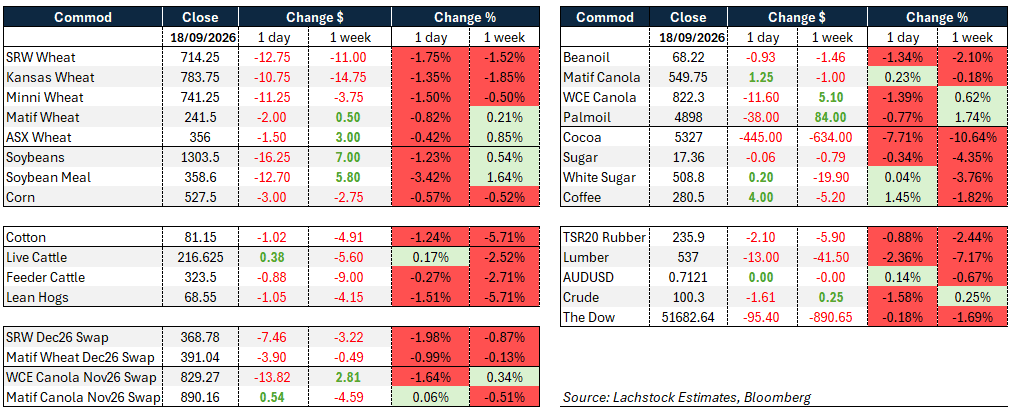
Wheat led the grain complex lower as funds trimmed longs ahead of Friday’s CFTC COT data and next week’s Trump-Xi summit, with volatility easing and BSEA strikes continuing without denting the broader risk-off tone.
Beans and meal sold off sharply once Thursday’s meal short squeeze unwound, overshadowing a fresh 111,000-tonne Chinese soybean purchase, while corn losses stayed comparatively contained into harvest.
Canola slipped in Winnipeg on weaker crude and favourable Prairie harvest weather, while Matif canola eked out a small gain against a backdrop of delayed European rapeseed sowing.
Crude steadied near recent lows as US-Iran diplomatic efforts offset lingering Middle East supply risk, with equities and the Australian dollar softer as markets braced for a heavy US-China and Fed-adjacent news week.
Day Ahead – Australia
Albo in the US talking tough leading into the UN general assembly. He has been pretty vocal about pushing the under-16’s social media ban while quietly reintroducing the “Online Safety Amendment” bill back home which, amongst other things pushes the onus back to the platform providers, including AI models.
Ukraine hit Moscow over the weekend, targeting oil facilities.
China/US meeting is still in the wind but it looks like the respective teams are talking. This has particular importance for Ags with some suggesting that wheat could be a key component of the discussion.
Employment data out this week in Australia – certainly important for our rate prospects which have at least one rate increase baked into the forward curve.
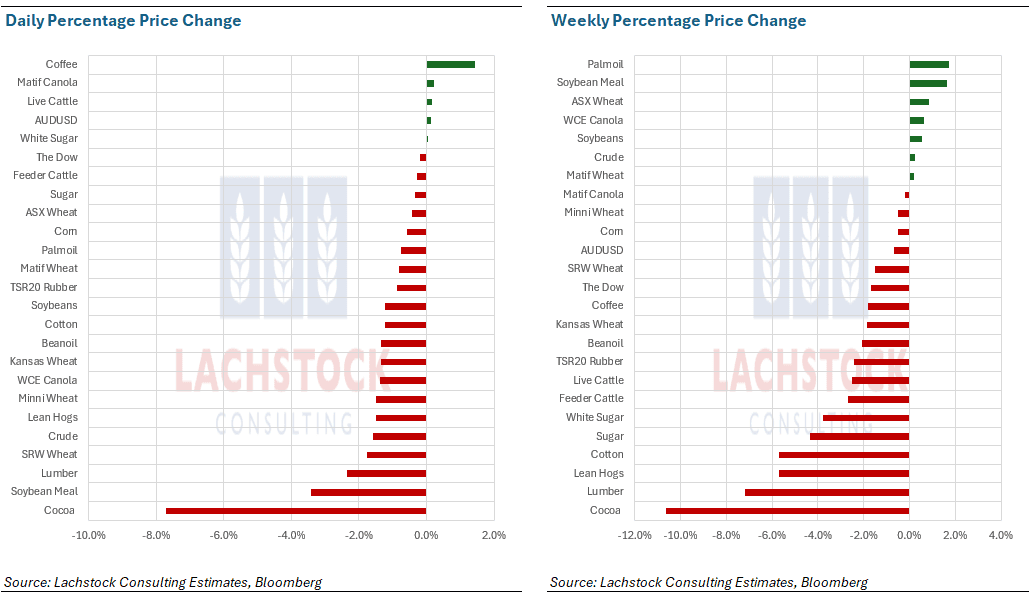 Wheat: Wheat led the grain complex lower into the weekend as managed money trimmed long positions ahead of Friday’s CFTC Commitment of Traders release and next week’s Trump-Xi summit, with Marex’s Charlie Sernatinger noting funds appear to be selling Chicago wheat against beans and corn longs.
The Black Sea remains the swing factor: Russia’s defence ministry reported strikes on three more vessels at Ukrainian ports, Turkey has floated a fresh proposal to halt attacks on civilian shipping, and Russia is preparing Murmansk as an alternative Arctic grain outlet from October, though volumes there are unlikely to offset BSEA disruption.
SovEcon pegged combined Russian and Ukrainian exports for the first quarter of 2026/27 at 8 million tonnes (Mt), the lowest since 2010/11 and roughly 10Mt below the five-year average.
Domestically, GIWA lifted its Western Australian outlook to 10Mt wheat, 6.6Mt barley and 4.8Mt canola, citing timely late-August rain, while Pakistan’s traders continue narrowing offers on its 750,000-tonne tender toward the low-$349-353/t c&f range.
The Hightower Report flagged scope for wheat to feature in a Chinese purchase package tied to next week’s meetings, a possible source of support once the current long liquidation runs its course.
Other grains/oilseeds: Corn losses were modest given the scale of the wheat and bean selloff, with the market well owned by funds into harvest; early yield reports are softening even as attention turns to whether Ukraine can resume its usual October ramp-up in export selling.
Beans and meal bore the brunt of the session after Thursday’s short-covering squeeze in meal unwound abruptly, dragging December crush down 22c to 235.75 even as China confirmed a fresh 111,000-tonne soybean flash sale — the first to China since 10 September.
Meal remains record long, leaving it vulnerable to further liquidation, while Brazilian growers continue to hold back old- and new-crop selling pending planting rain in a season shaping up under a hyped super El Niño.
Canola fell in Winnipeg on spillover from weaker crude and Chicago soy, with mild Canadian dollar softness offering little offset; an analyst noted warm, sunny Prairie weather over the coming days will speed harvest and add further pressure.
Matif canola bucked the trend intraday even as European rapeseed planting runs behind normal pace.
Palm oil tracked the broader vegetable-oil complex lower but remains on track for a weekly gain.
Macro: Crude steadied after a three-day drop as diplomacy around the US-Iran conflict intensified, with Trump saying he’d “probably” be open to meeting Iranian President Pezeshkian at the UN General Assembly this week alongside a planned Xi summit.
Saudi Arabia issued rare air-raid alerts for Riyadh over the weekend and warnings for Red Sea hubs including Yanbu amid continuing Houthi threats, even as US Central Command said Strait of Hormuz flows are running at a six-month high; Aramco has told European refiners they’ll receive no term crude next month following East-West pipeline damage.
Ukraine’s largest overnight drone barrage of the year hit the Moscow oil refinery, tightening diesel markets further.
The combined conflicts continue to feed inflationary pressure globally, with Minneapolis Fed President Kashkari noting price pressures have broadened beyond the oil shock.
Equities and the Australian dollar were both softer into the weekend as markets positioned for a heavy diplomatic and data calendar, including Monday’s Grain Export Inspections and Crop Progress reports.
Local: The week ended softer in the west, with barley back A$3/t to $327 and canola down $5 to $875, while wheat was steady at $386 FIS Albany.
In the east, canola was steady around $820, wheat was $355 and barley $295 track Geelong.
Rainfall is building through WA, with 10–50mm forecast over the next week, which will be welcome across most cropping regions. Warmer weather is also on the way, with temperatures expected to reach the low to mid-30s across northern and Mallee regions of SA and Victoria later in the week. Despite the exceptional season to date across SA and Victoria, growers are starting to flag that, given the amount of crop biomass and the rapid lift in temperatures, some crops on heavier soils could see the top end of yield potential trimmed.
Feed grain values have strengthened through northern markets, with barley around $415 and wheat $435 delivered Jan+ Darling Downs. Warm and dry conditions through southern Queensland and northern NSW, combined with rising diesel prices, have pushed bids higher as consumers look to extend their drawing arc and secure grain from further south.
HAVE YOUR SAY