

Weather:
Brazil soybean planting reached 66.8 percent of the projected area as of 9 November, with Mato Grosso nearing completion even as persistent rain, hail and waterlogging disrupted wheat, rice and soybean development across the country’s southern growing states. INMET expects above-average rain in the South and parts of the Centre-West and Southeast, and below-average rain across much of the North and Northeast, from November 2026 to January 2027.
Argentina’s wheat crop is getting bigger but its quality is uncertain. The Rosario Board of Trade raised its 2026/27 production forecast to 23.8 million tonnes (Mt) from 21Mt, but rain and frost have caused some damage, fusarium pressure is up, and persistent drizzle in the north has delayed the harvest start and raised quality concerns, which matters for Brazilian import demand.
El Niño is still strengthening. On 12 November NOAA’s CPC had the Niño-3.4 index at +2.5°C and put the chance of a strong to very strong event lasting through January to March 2027 at better than 79pc. The main risk now shifts to the southern hemisphere summer crops and to palm oil. Rainfall in Indonesia’s main palm areas has been mostly below 50pc of normal over the past 30 days, and its palm oil association sees 2027 output falling almost 9pc to 53.69Mt.
In eastern Australia, rain has disrupted winter crop harvest activities, particularly in northern New South Wales and southern Queensland, while most of Western Australia has seen little to no rainfall. ABARES warned that repeated falls are likely to further delay the harvest and increase the risk of grain quality downgrades due to excess moisture.
Markets
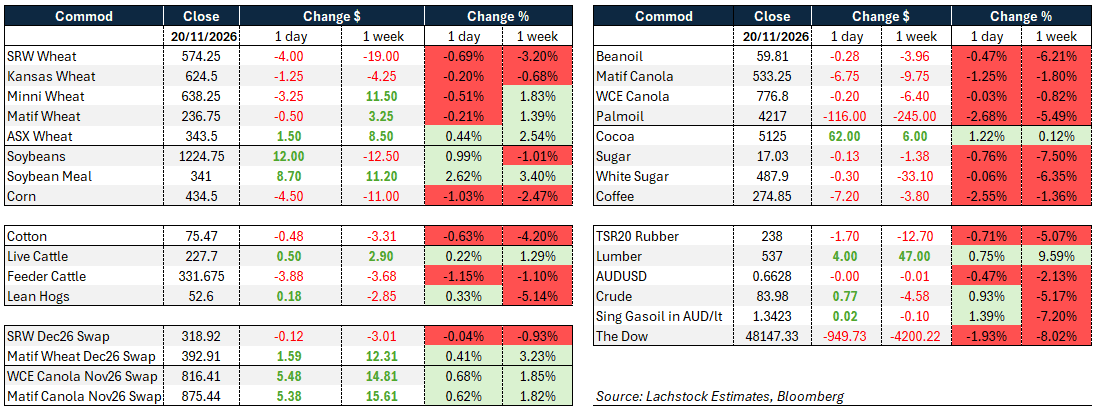
Wheat closed lower, but the quality trade drove the week, with Minneapolis and Kansas gaining on Chicago. Europe is setting the price, with Matif up 1.39Mt and the Dec26 Matif swap up 12.31 to 392.91. SRW still needs Chinese demand to turn, and APEC gave no sign of it.
The market is putting a price on neither the war spreading into the Baltic nor the strikes on Danube ports. The Sparta II attack and the earlier Ust-Luga strikes threaten the route that now handles almost two-thirds of Russia’s seaborne grain. ARC and Citi both note that grains carry little risk premium.
Meal led soybeans higher on the Spain sale and a Brazilian holiday, but Brazil’s ideal weather, a weak BRL and poor Chinese crush margins cap the upside. December corn hit a contract low as South American optimism builds. Canola is supported by strong Canadian exports and smaller AAFC ending stocks.
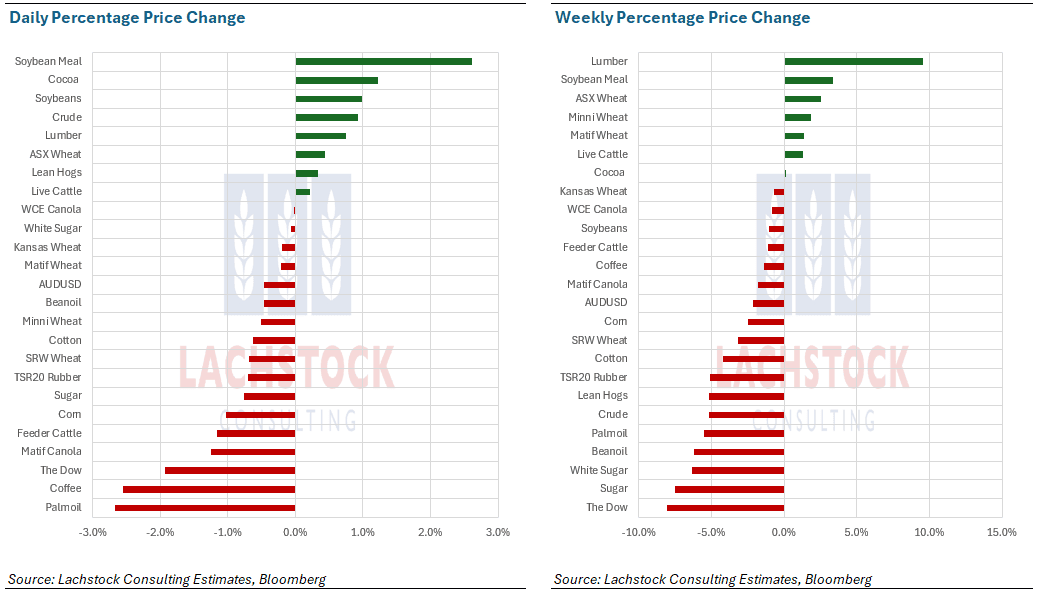
The equity rout and a stronger USD weighed on the whole complex, with the Dow down 8.02pc and the AUD down 2.13pc on the week. Crude fell 5.17pc on the week but rose 0.93pc on Friday on Iran risk. Thanksgiving week is shortened, and the USDA crop progress and export reports come first.
Day Ahead – Australia
This is now getting a little ridiculous. More rain is forecast for the entire belt in Vic, NSW and Qld.
AUD is doing a bunch of heavy lifting at the moment – the US is the driver with 3 rate increases baked in. With energy coming off globally, the rate outlook should temper slightly.
Its all about quality on the east coast – early harvest was showing high ASW1 but, as we got deeper quality was improving – not sure what happens from here.
 .
The market is paying no attention to the escalating war. Russian missiles landed in Poland, which Tusk called “an international provocation”. Drones set fire to the Russian cargo ship Sparta II in the Gulf of Finland, the second strike there this month after the Ust-Luga barrage on 11 November. That puts the Baltic route at risk at a time when it carried 65.3pc of Russia’s seaborne grain exports in October, with Ust-Luga the top port at 684kt. Russia also says it hit Kiliya port on the Danube and a cargo ship northeast of Odesa.
Exporters say the US is close to winning wheat business as competitors’ premiums have worn away, but Europe is where the real market is.
The Matif Dec26 swap rose 12.31 on the week to 392.91, while the SRW Dec26 swap fell 3.01 to 318.92.
Buyers will probably stay hand to mouth until more southern hemisphere harvest samples show the quality.
Brazil’s crop is a mess, expected down 33pc year on year on fewer acres and too much rain, so Brazil is relying on Argentine quality improving.
India’s wheat area is set for its biggest drop in 26 years, but large stocks mean that won’t worry anyone for a while.
The IGC raised 2026/27 wheat and coarse grains production by 1Mt to 2.428bt, with Turkey, Australia and Argentina up and the US down. It lifted ending stocks 7Mt to 626Mt, inflated by heavy Russian and Ukrainian inventories.
At APEC, Trump talked up US ag trade with Thailand and the Philippines but said nothing on China. For SRW, China is the only buyer that could turn the market. ASX wheat firmed 1.50 to 343.50.
Total US commitments are 1.152bn bu against the USDA’s annual export forecast of 3.275bn.
A turn would still need Ukraine out of the market and South American exports to slow. Instead, sentiment on South American new-crop corn is the most optimistic in years, and timely Brazilian soybean planting puts safrinha into an ideal growing window.
Seasonals offer some hope: Total Farm Marketing notes March corn has gained an average 32c between 20 November and year-end over the past 12 years. Citi sees the recent drawdown as a buying opportunity on El Niño and the Black Sea closure, while ARC says grains carry little to no risk premium.
Soybeans gained 12 on a 2.62pc meal rally to 341, helped by a Brazilian holiday and a USDA flash sale of 100kt of meal to Spain. That sale raises questions over EUDR, given the consensus that Brazil is compliant.
The bigger picture remains heavy: Chinese crush has big port stocks, poor margins and low hog prices, Brazilian weather is good enough for whispers of a record crop, and the BRL is sliding.
Soyoil fell 0.28 to 59.81 and is down 6.21pc on the week, and palm fell 116 to 4217.
ICE canola slipped 0.20 to 776.80 in another back-and-forth session.
Canadian canola exports are 2.66Mt year to date, about 830kt ahead of last year, and domestic use is up 260kt at 3.73Mt. AAFC cut 2026-27 ending stocks 100kt to 1.87Mt and kept exports at 7.7Mt, with StatCan’s production update due on 4 December.
The WCE Nov26 swap rose 5.48 to 816.41 and the Matif Nov26 swap rose 5.38 to 875.44.
Macro: The tech-led sell-off deepened. The S&P 500 fell 3.7pc for a seventh straight loss and is now in correction, and the Nasdaq fell 5.3pc as AI names were hit hard. The Dow fell less on the day but is down 8pc for the week.
The Euro Stoxx 50 lost 2.8pc and the FTSE 1.0pc. Investors moved into bonds, taking the US 10-year yield down 7bp to 4.94pc, while copper fell and gold edged up to 3,539.
Large derivative losses this week and tech failures have the market on edge.
Credit spreads are widening and moving more closely with equities, which matters because Chair Warsh has given financial conditions more weight in Fed decisions.
Michigan sentiment rose 0.5pts to 51.5 and 1-year inflation expectations eased to 3.7pc. WTI rose 0.9pc to 84.0 as geopolitics outweighed the risk-off mood.
The US and Israel are considering a new strike on Iran, and Trump says Iran fired more drones and missiles last week than at any time in over a year. Trump is also reported to want a Ukraine peace deal before January.
A stronger USD remains a strong headwind for commodities, and the AUD lost 2.13pc on the week.
In a week shortened by Thanksgiving, the USDA releases export inspections and crop progress on Monday, then cold storage on Tuesday, and EIA petroleum data comes on Wednesday.
Local: Bids in the west finished the week stronger, with canola at A$848/t, wheat $375 and barley $332 FIS Albany.
In the east, canola slipped back to $790, while wheat was $345 and barley $285 track Geelong.
It was a wet weekend across much of Vic. The Mallee missed the heavier falls, but the Wimmera, Goulburn Valley and Western Districts picked up 10–50 mm. Later wheat crops further south can still make some use of it, but for most growers the focus is now on grain quality. The week ahead doesn’t look much better for harvest across the east coast.
The AUD is now trading in the low US66¢ range, giving local bids some welcome support across all commodities as we get further into harvest.
HAVE YOUR SAY