

Weather:
The Corn Belt is carrying record September rain, with eastern Iowa, northeast Indiana and central Ohio already logging their wettest September to date and a band from southeast Minnesota through northeast Iowa collecting more than seven inches, while BAM Weather expects a split harvest of western delays, a drier east and a slow dry-out into October.
Rain has finally moved into the Plains forecast, with one to two inches expected through Thursday across eastern Colorado, western Kansas and the Oklahoma and Texas panhandles, timely with winter wheat planting at 17% nationally against a 21% average and Kansas at 10% versus 13%.
In South America DTN expects El Niño to deliver frequent rain to southern Brazil with some flood risk, while Mato Grosso and the northeast face a higher risk of prolonged dryness, just as soybean planting restrictions lift between 16 September and 1 October.
Markets
Grains are sitting ducks awaiting Trump/Xi on Thursday and Friday, with large fund length making the downside risk of a disappointing summit the bigger concern and Marex’s Charlie Sernatinger suggesting the easy money in grains is done.
The Black Sea remains the wheat swing factor, Russia rerouting exports, cutting duties to zero and stepping up state buying while plantings lag, leaving Matif increasingly competitive for both domestic feeders and world buyers if no BSEA shipping fix emerges.
Next week’s quarterly stocks and the 9 October WASDE follow the summit, with Cordonnier’s corn bias to the downside and harvest wetness now a quality question for beans and a supply problem for Iowa crushers.
Locally ASX wheat held its A$13 weekly gain at A$363 with Matif swaps carrying a A$23 premium to SRW, while canola swaps retreated with crude and the AUD steady at 0.7115 as El Niño spring dryness frames the southern crop.
Day Ahead – Australia
Given the lead up, we were always going to be trading headlines from the NY summit. Im amazed that crude has come off so hard but also understand that is the flow at the moment. The bit this misses is the gapping hole in the refining market. Crack spreads, or the revenue generated from taking crude and refining to whatever, ie diesel are wide open. The damage that has, and will continue to plague the refining capacity means that, even with a lower crude market, dont expect to be paying less for you diesel
The other constant at the moment is encouraging talk about alternative pathways for Black sea grain while simultaneously bombing the living suitcase out of one another.
Aussie values a genuine dogs breakfast at the moment. SA ports showing paper margins to Qld, frost, rain on the way, export margin…. First load taken in CBH – your harvest prep is already too late!
.
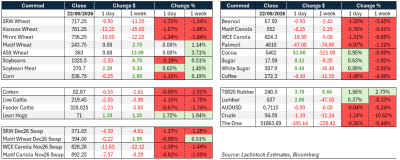
 Wheat: Sellers returned as WZ lost 9.5c, KWZ sank 13.25c and MWZ gave up 10c, spreads mostly weaker and WZ implied vol easing to 32.74% from 34.97% Monday.
The Chicago weakness was put down to optimism over a Hormuz shipping deal and Russia’s talk of rerouting grain away from the Black Sea, the Kremlin confirming further contacts on Turkey’s safe-passage proposal while pointing to alternatives through the Baltics and even the Arctic.
A UNGA breakthrough on vessel and infrastructure strikes looks a long shot with Putin absent, and the strikes carried on regardless: Russia hit two Odesa logistics centres and a dry-cargo ship in port and critically damaged a Naftogaz facility in Poltava, Ukraine lit up refineries in Ufa and Samara, and Macron floated a moratorium on deep energy strikes with Trump.
Matif Dec held at €243.75, March up €0.50, with Russian cash flat at $210 as Moscow works the supply lever from both ends: zero export duties on wheat, barley and corn through December, a 3mt intervention purchase program for 2026-27 covering grade 3 and 4 wheat and rye, and Patrushev urging every bit of logistics capacity be used to avoid excess inventory with harvests running above last year. Against that, shipments reportedly fell almost fourfold over 10–20 September and winter plantings are slipping further behind on diesel costs.
Ukraine wrapped wheat and barley at 33mt, wheat 25.3mt and up 11% on average yields of 4.7t/ha, while EU soft-wheat exports reached 6.3mt with barley down 41% at 1.8mt and corn imports up 27% at 4.5mt.
The buyer keeps kicking the can; Tunisia seeks 125kt wheat and 75kt feed barley for LH Nov/FH Dec with offers due Wednesday, Pakistan bought 365kt at $348.83, and Egypt remains the obvious short with one source suggesting cover may be down to a month.
Brian Grete of Commstock has grains in pause mode ahead of Trump/Xi, fund length keeping anyone from pressing higher into a possible liquidation.
Locally ASX was untraded at A$363 but A$13 firmer on the week, the SRW Dec26 swap slipping A$4.39 to A$371.03 and the Matif Dec26 swap A$0.22 to A$394.00, leaving Matif carrying a near A$23 premium.
Other grains/oilseeds: Corn met an offer after Monday’s 15c rally, CZ down 6.25c, the day’s standout instead Matif Nov maize surging €7.25 to €276, now €32 over Matif Dec wheat and inviting the question of when the French feeder switches.
The US market is tuned to Chinese optimism around the additional US$17b in ag purchases flagged at Trump/Xi I in May; Xi lands Wednesday evening with talks Thursday and Friday, though Sunday’s preliminary New York round failed to extend the tariff truce expiring in November.
Harvest is ahead of pace at 13% for corn and 12% for beans, 3 and 4 points ahead of last year.
Cordonnier held corn at 177.0 bu/ac with a neutral-to-lower bias, seeing a 175–177 finish and harvested area possibly 300–500k acres lower on silage, and beans at 51.5 bu/ac with seed quality a growing worry if the wet persists.
KOCPIA bought 55–60kt of corn, likely South American. Beans softened with meal holding its bid, SX down 2.5c, SMZ up $2.30 to 370.7 and BOZ off 93 pts to 67.92, Dec crush 2.5c lower at 237.25. Iowa is the problem child, crushers already idled in September now short the beans they expected at harvest, and meal has responded by pulling supply from the east and south at a cost.
Sinograin announced its second imported soybean auction of the month just days out from the summit.
ICE canola surrendered most of Monday’s gains, Nov down C$10.90 and Jan C$10.70 to 836.10, crude leading the selloff with soyoil, rapeseed and palm following, an analyst flagging technical selling as Nov held just above its 20-day average on 54,956 contracts.
Dry Prairie weather in the high teens to low 20s will help push an already delayed harvest, while the loonie eased to 71.07 US cents.
Matif canola gave up €4.25 to €552 and palm lost 47 to 4810, MPOC warning El Niño dryness across Indonesia and Malaysia since early August threatens output six to nine months out.
The WCE Nov26 swap fell A$11.63 to A$828.28 and Matif canola Nov26 A$7.37 to A$892.25, a Matif premium of roughly A$64.
Macro: Crude extended its slide, down more than 10% on the week, as Hormuz deal hopes built through a UNGA dominated by Iran; Trump threatened to annihilate Tehran from the podium then later described a great meeting between US officials and Iranian envoys in New York, Gulf states lobbied against escalation, and Houthi fighters pushed to cut off Yemen’s Red Sea coast after Trump reportedly called off strikes at the last minute.
Goldman’s David Mericle notes refined products have risen disproportionately to crude, keeping headline PCE near 3.5% through year-end before falling to 2.5% in March 2027 and 2.0% by May as base effects kick in.
The Dow shed 185 points and the Aussie sat flat at 0.7115. Xi’s first Washington visit since 2015 comes with low expectations on both sides and fault lines intact, from Beijing’s push to block a US$14b Taiwan arms package to rare-earth magnet exports to the US falling 21% in August even as China’s trade surplus with the US jumped 44% y/y to over US$29b; an AI dialogue has been agreed but little else signalled.
The EU and Philippines reached substantial agreement on a free trade deal. Ahead, EIA petroleum data Wednesday, then US export sales and the quarterly hogs and pigs report Thursday .
Local: Through the west of the country bids were stronger for canola yesterday, up $10 to $888, while wheat was steady at $386 and barley softened to $326 FIS Albany.
In the east canola was up $5 to $830, wheat was $356 and barley $296 track Melbourne.
Frost through southern NSW, with the epicentre around Griffith where rainfall has missed this season and crops are more susceptible, is seeing some wheat and barley now dropped for fodder. At this stage the damage appears to be largely localised, although the full extent will take some time to assess.
It is hard not to get bullish protein this year. Canadian harvest remains well behind the normal pace after significant rainfall events, which are likely to have had an adverse impact on wheat quality. Locally, it is difficult to see grades being much better than APW across much of SA and Victoria. Northern NSW and Queensland will produce some higher-protein wheat, although a Darling Downs feed market around $440/t will absorb a reasonable amount of grain. Current new-crop spreads are around +$15/t for H1 and +$10/t for H2 — not exceptionally wide, but about as strong as we have seen at this point of the season in recent years.
Fuel isn’t only affecting grain markets — rapidly rising diesel prices are also reshaping cattle flows. Freight rates are reportedly up around 20% over the past month, adding roughly $37–40/head, or 13c/kg, to a 2000km haul from northern Queensland into Victoria or SA. With diesel above $3/L in some regions, southern processors are pulling back from Queensland cattle, reducing competition at a time when dry conditions are already pushing more stock into saleyards and weighing on prices.
HAVE YOUR SAY