

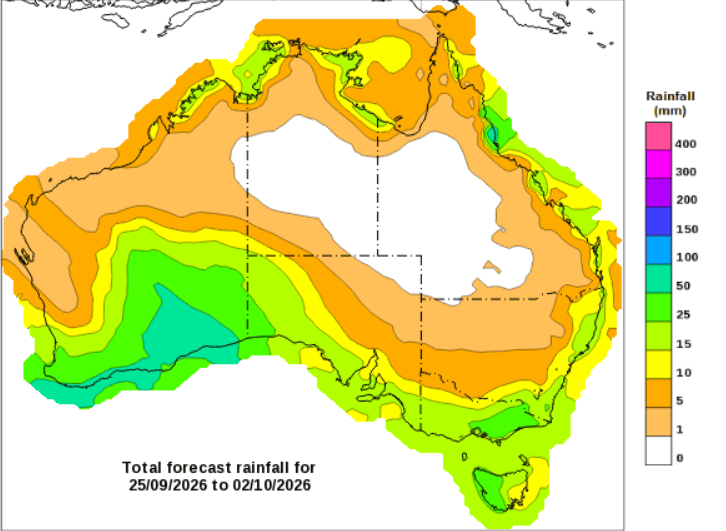
Weather:
Wet weather remains the main issue across Canada, with Prairie harvest well behind normal and quality downgrades increasingly likely across spring wheat, durum, barley and canola. Saskatchewan should stay mostly dry through the weekend, helping harvest progress, while rain is forecast for parts of southern Manitoba and central Alberta; the central US also remains wet, particularly through Iowa, slowing soybean harvest.
Markets
Grain markets were mostly softer overnight, with wheat and corn slipping as the US-China summit failed to deliver the additional agricultural purchase detail the market had hoped for. US wheat was weaker across all three classes, Matif fell €3/t and US export sales disappointed, while corn eased as harvest pressure, heavy fund length and cheaper South American supply weighed. Soybeans also finished slightly softer despite strength in meal, with export sales well below expectations, although a fresh 120kt US soybean sale to China provided some support.
Outside grains, crude oil rallied again as hopes for a quick US-Iran diplomatic breakthrough faded, keeping Strait of Hormuz supply risks elevated. Higher oil prices helped support ICE canola, while rising US bond yields and a firmer dollar remained broader headwinds for commodities. Black Sea logistics also remain a key underlying risk, with Ukrainian exports disrupted, Russian wheat destinations shrinking and renewed efforts to restore a grain corridor yet to translate into improved physical flows.
Day Ahead – Australia
Cereals are expected to open softer following the overnight sell-off in wheat, although a slightly weaker AUD should cushion some of the downside locally. Canola is likely to be softer to unchanged following the weaker Matif move, with firmer crude oil and ongoing Canadian harvest delays providing some underlying support. Some good rains forecast for WA and to a lesser degree Vic/SA over next few days.
A quiet day today with Victoria on holidays. Will Brissy make it three in a row, or will this Freo team become immortal? My money’s with Brissy. Have a good weekend!
.
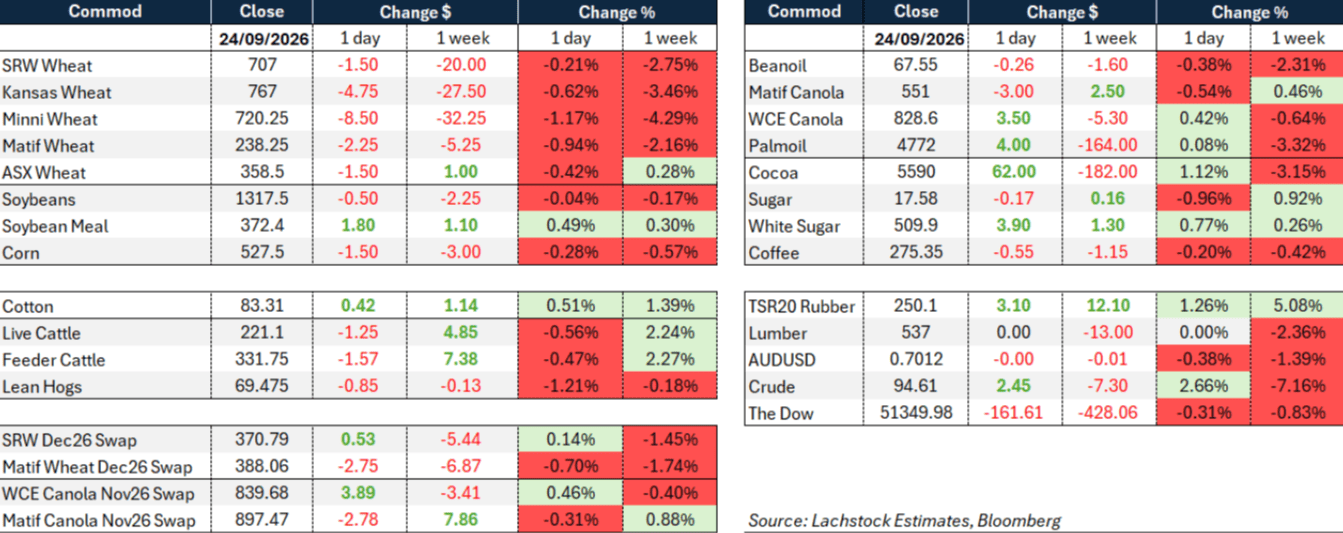
 Wheat: US wheat finished weaker with WZ down 1.5c, KWZ down 4.75c and MWZ down 8.5c. Matif was also under pressure, with Dec and Mar both €3/t lower, while Russian cash wheat was unchanged around US$213/t.
Matif continues to be the major drag on the wheat complex. Despite a recently harvested French crop, constrained Black Sea flows, cheaper wheat relative to corn and a softer euro, European wheat has struggled to find support, leaving US wheat expensive against the world market.
US weekly wheat sales were disappointing at 268kt, below trade expectations around 475kt and the roughly 320kt/week required to meet USDA projections. Mexico, Japan and Vietnam were the leading buyers.
Black Sea logistics remain a significant underlying risk despite futures increasingly discounting the issue. Russia and Ukraine have both suffered major disruption to Black Sea grain movements, forcing Russia to redirect some tonnes through Baltic and Arctic ports.
Canadian spring wheat harvest remains historically slow. Saskatchewan was only 32 percent complete versus 73pc last year and an 83pc five-year average, increasing the likelihood of quality downgrades. High-quality CWRS supply is tightening and west coast values are strengthening, although country basis remains weak.
Durum quality is also becoming a concern, with slow Saskatchewan harvest progress, reduced EU production expectations and smaller-than-earlier-expected North African crops pointing towards increased import requirements.
Other grains/oilseeds: Corn eased 1.5c overnight, with Monday’s China-driven rally now largely unwound. US export sales of 838kt were below expectations as cheaper South American corn continues to limit US competitiveness.
Funds remain heavily long corn heading into harvest, leaving the market exposed to profit-taking as physical selling builds. China continues to import relatively small volumes of corn, largely from South America, while US corn remains expensive relative to other Prairie feed grains.
Canadian barley exports have started strongly, with CGC exports of 269kt through week seven. Saskatchewan barley harvest is only 61pc complete and wet conditions are affecting quality, tightening malt supply and pushing malting premiums sharply higher.
Oats also remain tight, with Saskatchewan harvest just 33pc complete. Cash bids have strengthened but failed to keep pace with the futures rally, leaving basis unusually wide, while rye bids have firmed across western Canada and North Dakota.
Soybeans finished slightly softer despite strength in meal. US soybean export sales were poor at just 582kt versus expectations around 1.75 million tonnes (Mt), while meal and soybean oil sales also disappointed. The US did report a further 120kt soybean sale to China.
Chinese soybean buying from Brazil has slowed sharply as high Brazilian prices squeeze crush margins, while ICE canola remained firm on stronger crude oil and a weaker Canadian dollar. Canadian harvest delays remain supportive, with Manitoba canola only 43pc harvested as of September 21 and wet Prairie conditions continuing to raise quality concerns.
Macro: The US-China trade truce has been extended through January 10, 2027, but agricultural markets were left looking for more detail around the previously discussed US$17bn of additional US agricultural and related purchases. The lack of a fresh purchase announcement weighed on grains and increasingly looked like a “buy the rumour, sell the fact” reaction.
Black Sea risks remain elevated, with attacks on ports, vessels and logistics infrastructure continuing to disrupt trade. Diplomatic discussion around restoring a grain corridor is ongoing, but physical export flows remain constrained, while Ukrainian exports are well behind potential and Russia has seen fewer destinations taking its wheat.
Polish restrictions on storing Ukrainian transit grain in customs warehouses add another potential constraint to alternative export routes out of Ukraine.
Bond yields pushed higher overnight and equities softened, with the US 10-year yield moving above 5.2pc. The US dollar also firmed, adding another headwind for agricultural commodities.
Crude oil rallied strongly again, with Brent around US$105/bbl and WTI around US$94–95/bbl as hopes for a rapid US-Iran diplomatic breakthrough faded. The Strait of Hormuz remains the key energy risk, while uncertainty around US diesel exports is adding to concerns around refined product supply.
Higher energy prices are feeding back into inflation expectations and interest-rate markets, increasing the risk that central banks keep policy tighter for longer. US August new home sales rose 6.4pc month-on-month, while markets now turn towards next week’s US labour data.
Local: Stronger through the west yesterday, with canola up A$10/t to $890, wheat at $386 and barley $329 FIS Albany.
In the east, canola was also $10 stronger at $820, while wheat was $356 and barley $295 track Geelong.
Oats continue to strengthen, with new-season Kwinana trading at $385 yesterday. Quality concerns remain one of the key drivers behind the recent move.
Some big rainfall totals are forecast across WA over the next few days, while southern Victoria is also likely to see 10–20mm, which will be welcome and increasingly important in maintaining yield potential across some of the larger crops.
HAVE YOUR SAY