

Weather:
Hotter weather is forecast across parts of the US Midwest and Plains, adding support to corn and soybeans, while dry conditions in South America are starting to raise concerns around planting and early-season crop development.
Markets
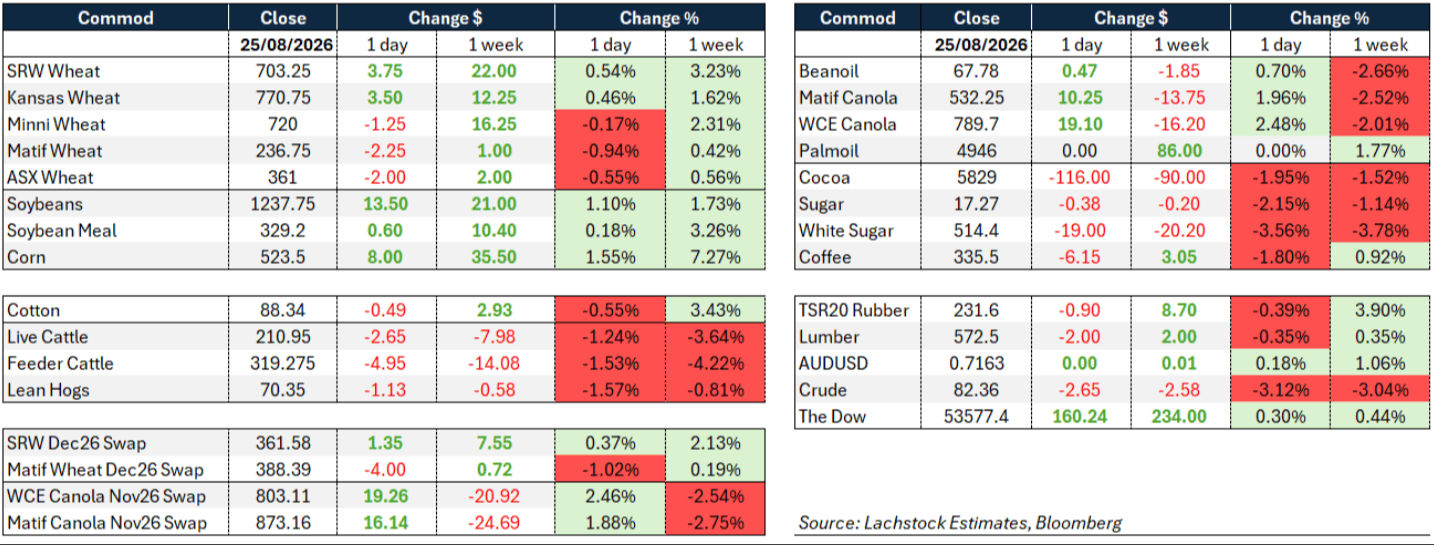
Markets were broadly firmer overnight, with wheat recovering from early losses, corn pushing to a new contract-high close and soybeans reversing higher on fund buying, tighter crop expectations and hotter US weather. Canola also bounced as firmer soyoil and rapeseed offset weaker crude, while oil eased on signs of improving Middle East diplomacy.
Day Ahead – Australia
Cereals are likely to be largely unchanged today, while canola should claw back some of yesterday’s losses. Useful falls of 15–25mm through NNSW and SQLD should take some heat out of domestic markets and pressure values lower.
Dowerin Field Days kick off today, so expect a slower day for the trade in the west. If you’re attending, drop in and say g’day to Matt and Dougal.
 .
.
Wheat: Wheat shook off an early sell-off, with Chicago Dec +3.75c and Kansas +3.5c, as buyers stepped in on weakness despite talk of a Russian export-tax removal and renewed ceasefire chatter.
The underlying story remains Black Sea export disruption, with Russian and Ukrainian flows impaired and little confidence that a lasting agreement is close.
Wheat is also getting support from strength in corn, where tightening US balance-sheet expectations are increasing the broader feed-grain risk premium.
Russian cash wheat was unchanged around US$215/t, while Matif Dec eased €2.25/t, showing physical wheat remains relatively subdued despite firmer US futures.
For Australian wheat, the continued disruption to Black Sea supply keeps the door open for Asian demand to shift toward WA and Victoria, particularly for October coverage.
Other grains and oilseeds: Corn remains the strongest story. December futures reversed early weakness to close 8c higher at US$5.23½/bu, a new contract-high close, as funds and end users bought the break. US crop ratings fell 3pts to 57% good/excellent, adding to expectations USDA yields will eventually need to come lower.
Lower production estimates are quickly tightening the US corn balance sheet; even a modest yield reduction could push stocks-to-use below 10%, while some private scenarios are already showing very tight ending stocks.
Soybeans also rejected early weakness, with November up 13.5c. Chinese buying interest, another flash export sale, hotter US weather and a recovery in global vegetable oils all helped.
Canola rebounded strongly after Monday’s sell-off, moving back above its 50- and 100-day averages. Firmer Chicago soyoil and European rapeseed supported the move, although a US$2+ fall in crude capped the upside.
The main near-term risk to oilseeds is crude: improving Middle East diplomacy and any reopening of the Strait of Hormuz would remove some of the energy premium that has supported vegetable oils.
Macro: Risk sentiment improved modestly, with the S&P 500 +0.3%, while US 10-year yields fell 8bp to 4.62% as oil prices eased.
Oil fell toward US$81/bbl as diplomatic efforts around Iran and the Strait of Hormuz reduced immediate supply fears. Reports of increased vessel traffic and possible mine-clearing/navigation arrangements added pressure.
US consumer confidence slipped to a seven-month low, driven by weaker expectations for business conditions, employment and household incomes.
The USD eased ahead of US inflation data, while industrial metals were firmer, led by copper amid tight concentrate supply and strong physical demand.
Canada announced retaliatory tariffs of 15–50% on roughly US$20bn of US goods, adding another layer of trade uncertainty.
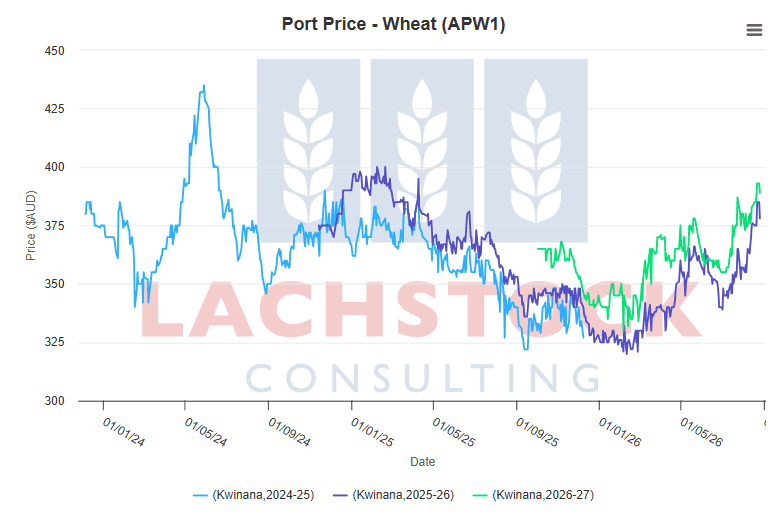
Local: Through the west, canola was sharply softer, down $20 to $845, while wheat eased $4 to $386. Barley bucked the trend, edging higher to $335 FIS Albany.
In the east, canola also lost ground with bids back to $780, while wheat was steady around $357 and barley $306 track Geelong.
We continue to see October demand from Asian consumers shift toward Australian wheat in place of Black Sea supply, predominantly out of WA and Victoria.
HAVE YOUR SAY