

Weather:
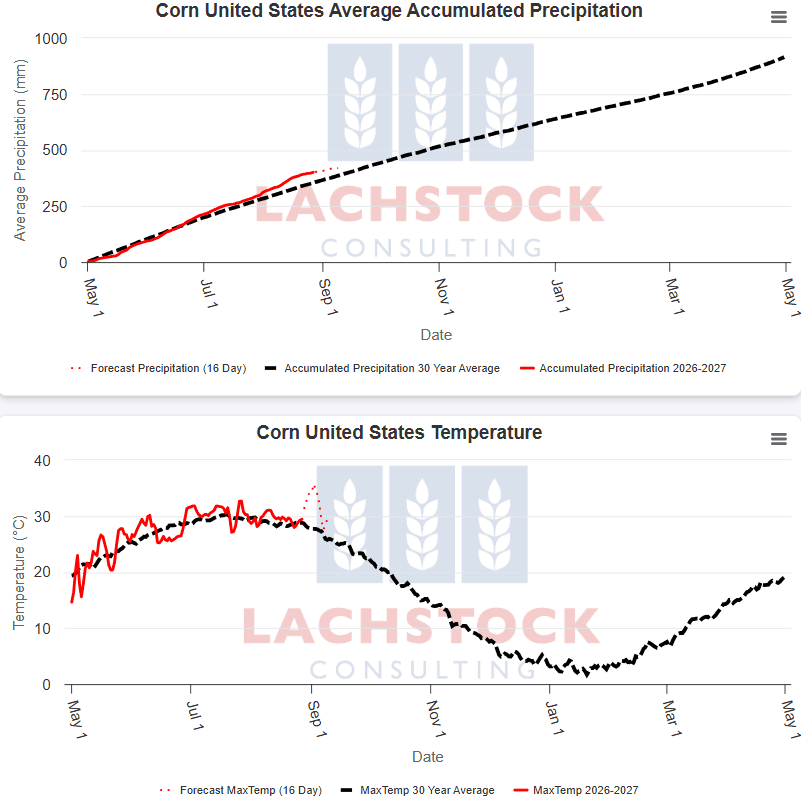
Hot and wet conditions across key Chinese corn and soybean areas are threatening quality and yields, while another burst of roughly 38°C heat is forecast across parts of the US soybean belt next week
Markets
Wheat went again. Chicago Dec added another 1.7% to a three-year high as traders continued pricing the loss of reliable Black Sea exports. Importantly, this isn’t just futures getting excited — Baltic and French export activity is picking up as buyers physically shift demand west.
Corn finally stopped for a drink after six straight rallies, while beans edged higher and canola clawed back above C$800/t. Oil’s 2.7% jump added another tailwind for oilseeds. After two big wheat sessions, some Friday profit-taking wouldn’t surprise.
Day Ahead – Australia
Wheat should open steady to slightly firmer, with yesterday’s rally reportedly well sold into across the trade and many books closed early. Southern Australia has a very good crop coming, which should keep some pressure on local basis.
Canola should have a firmer bias after ICE recovered above C$800/t, with European rapeseed, soyoil and crude all stronger. Barley should remain fairly steady, although renewed chatter around Chinese buying is encouraging, with Australian barley specifically mentioned overnight.
The setup remains favourable for Australian exporters, with Black Sea disruption forcing buyers to diversify origins just as Australia’s crop continues to improve. The counterweight is that 30–32mmt of wheat is still a lot of grain to place, so selling into offshore-driven rallies still looks prudent rather than assuming every geopolitical spike will keep running
.
 .
.
Wheat: Chicago Dec wheat rallied 12.5c / 1.7% to US$7.60¾/bu, a fresh three-year high, while Kansas gained 13.25c and Minneapolis 9.75c.
Black Sea disruption remains the key driver, with Russia and Ukraine continuing to target ports, grain storage and other infrastructure.
The disruption is now shifting real trade flows, with Baltic wheat bookings around 1mmt in August, up 50% y/y, while France is picking up business into Egypt and Sudan.
Ukraine’s August grain exports have fallen to just 574kmt, down 60% from July, with congestion building through the Danube as exporters look for alternative routes.
AgResource estimates prolonged Black Sea disruption could shift around 15mmt of wheat demand toward alternative exporters, with Australia becoming increasingly important from late October/November.
Australia is well placed to fill some of that gap, although improved rainfall has lifted local production estimates to 30–32mmt, which should keep a lid on basis even if offshore futures remain firm.
Other grains and oilseeds: Corn eased 0.6% to US$5.33½/bu, snapping six straight higher sessions after reaching three-year highs.
The broader corn story remains supportive, with declining US yield expectations and Black Sea exports heavily restricted, although the market looks overbought in the short term.
US corn export sales were around 1.1mmt, while Chinese buying interest in Brazilian corn appears to be increasing.
There was also more chatter around Chinese interest in Australian barley, which is encouraging given how quiet export demand has been locally.
Soybeans edged 0.2% higher to US$12.68/bu, supported by strong export sales and renewed heat risk across parts of the US soybean belt.
Canola recovered from early losses, with November ICE finishing back above C$800/t, helped by firmer soyoil, European rapeseed and crude oil.
Saskatchewan harvest is still early, with 11% of total crop harvested and just 1% of canola, so meaningful harvest pressure is yet to arrive.
Macro: US equities were firmer, with the S&P 500 up around 0.7%, while US 10-year yields rose about 2bp to 4.67%.
The US goods trade deficit widened sharply to US$118.8bn in July, the largest since March 2025.
WTI crude rallied around 2.7% to US$83.60/bbl as hopes faded for a reopening of the Strait of Hormuz and the US confirmed it is not currently negotiating with Iran.
Higher crude remains supportive for the vegetable-oil complex and therefore canola.
ECB July minutes pointed toward a likely September rate hike, with some policymakers already favouring a mildly restrictive stance.
Markets are now waiting on Fed Chair Warsh, although for agricultural markets geopolitics remains the dominant driver rather than monetary policy.
Local: A busy day for domestic wheat traders yesterday, with growers actively engaging in new-crop sales. Through Victoria, around $8/t of the offshore move was passed through, with slightly more finding its way into WA bids. The follow-through in the Port Lincoln zone was more subdued, speaking to the size of the crop and its relatively “captive” export market.
Encouraging to hear of renewed Chinese interest in Australian barley over recent days. Hot and wet weather across parts of China could be the catalyst needed to bring buyers back to the market in a more meaningful way.
HAVE YOUR SAY