
 Weather:
US Corn Belt trending dry through the weekend (30-40 percent rain chance), CPC favouring above-normal heat across most of the country including the western Midwest.
Prairies seasonally warm and dry, no fresh heat event, but Burnett (Glacier FarmMedia) now has canola acreage losses tracking near 5pc vs the usual 1pc on cumulative heat/flood damage.
Ukraine soil moisture still deteriorating, pressuring corn/sunflower in the south and centre; Coceral cut EU+UK corn 4.5 million tonnes (Mt) to 52.7Mt and soft wheat 3Mt to 140.8Mt on the same theme.
Markets
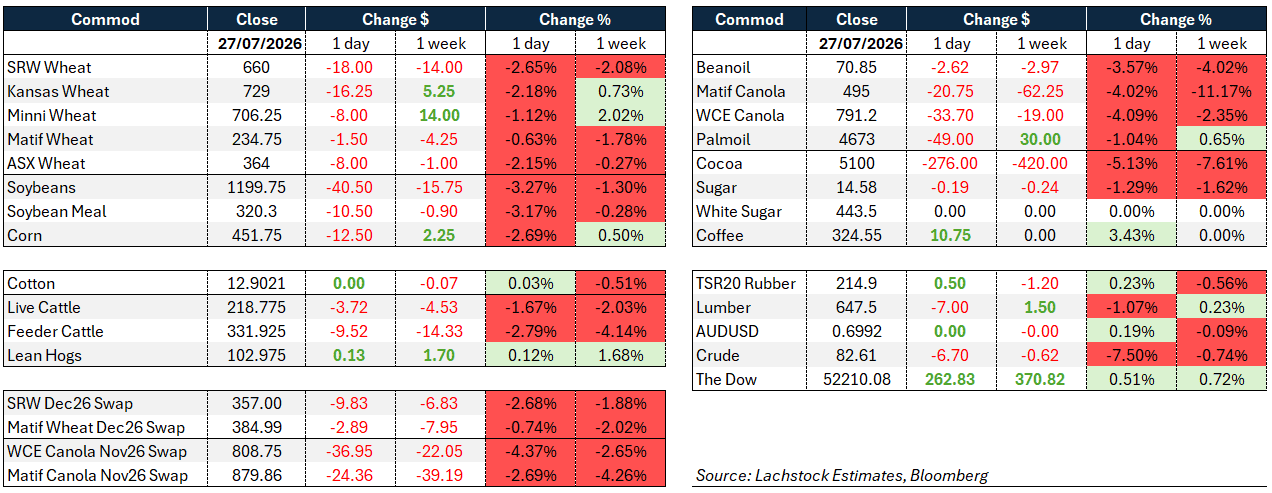
Wheat: Broad-based selloff across SRW/Kansas/Minneapolis/Matif/ASX as crude collapsed on the Iran ceasefire pause, despite no actual improvement in Black Sea loadings (Taman/Azov idle, Novo ~50pc); Australian production raised to 31Mt (USDA attaché), Russian exports cut to 1.85Mt (SovEcon).
Oilseeds/canola: Beans, meal, corn and bean oil sold off in sympathy with energy despite fresh China flash sales (132kt+126kt); canola broke below C$800/t technically on profit-taking, though Prairie heat/flood damage keeps the fundamental floor supportive.
Softs/livestock: Cocoa the standout mover, down over 5pc on the day and 7.6pc on the week; limited fresh wire drivers elsewhere in the complex today.
Macro: Iran-US pause (Trump citing a “good chance” of a deal) pulled Brent down ~7.5pc, lifting the Dow; Hormuz traffic remains negligible and Putin’s army-size decree adds a longer-run geopolitical overhang without an immediate price effect.
Day Ahead – Australia
The debate on July-Sep wheat demand hasn’t changed, despite markets puking on a Donald sound bite. Got to say, history suggests if he says things are going well and the Iranians are saying there isn’t any negotiations going on, chances are, the Iranians are closer to the truth. Add to this the Houthis letting rip and it’s hard to see what has really changed.
Russia/Ukraine is getting worse, not better with more infrastructure hits overnight.
Despite all of this, markets took some money off the table which is prudent.
Local trade will pull back bids – a combination of offshore sentiment and the GTA AGIC grains conference removing incentive.
 Wheat: Wheat unravelled with everything else Monday as crude collapsed on the Iran ceasefire pause, even though nothing actually improved on the ground in the Black Sea: Taman and Azov still aren’t loading, Novorossiysk is running around half capacity, and finding a vessel remains costly and complex. Russia continued striking Ukrainian ag infrastructure near Odesa, framing the sites as weapons storage, while Kyiv hit back with strikes on a Russian export terminal in Rostov and oil facilities in Yaroslavl and Udmurtia.
The bulk carrier Golden Leo sank off Odesa over the weekend, a week after being struck, killing nine crew. Matif briefly traded flat at the US open on hopes a UN sit-down or Trump-Zelensky meeting might buy a pause, but couldn’t hold it, and finished the session down.
Elsewhere the USDA attaché lifted Australian production to 31Mt from 29Mt, well above ABARES’ own June call of 26.7Mt, on good autumn rain, though flagged a strengthening El Niño as a later risk.
SovEcon pegged Russian July grain exports (wheat, barley, corn) at 1.85Mt, down sharply from 2.65Mt in June.
US crop progress was mixed: winter wheat harvest at 81pc trailed both the 83pc expected and last year’s 80pc, while spring wheat conditions held steady at 53pc, ahead of the 51pc expected and 49pc a year ago.
In Europe, MARS trimmed the EU wheat yield outlook 2pc, with France cut 4pc and now 8pc below last year after heat cut short the grain-fill window; the Rhine’s falling water levels are adding to European logistics costs into the back half of the year.
The fade case: if the world eventually has to backfill BSEA-sized volumes, wheat looks cheap here — but Morocco, Egypt and Türkiye are all off the buy button for now, so the squeeze is a matter of timing, not certainty.
Other grains and oilseeds: Beans, meal, corn and bean oil all sold off with crude as the Iran pause pulled risk premium out of the complex; November beans fell US40.5c/bu to $12.11 1/2, corn dropped 2.9pc to $4.73 1/4.
Fresh flash sales of 132,000t new-crop to China plus another 126,000t to an unknown destination — often a China proxy — did nothing to slow the slide, nor did reports of aggressive Chinese buying through the session.
Crop conditions gave the bulls something to work with into month-end: bean ratings fell 3 points to 63pc against 65pc expected and 70pc a year ago, corn dropped 4 points to 63pc versus 65pc expected and 73pc last year, with the sharpest state-level damage in North Dakota (-11) and Kansas (-10) as the west-to-east heat bias bites.
Argentina’s fob edge remains wide, roughly $13-15 under the Gulf and $8 better than the PNW into Asia.
Trade friction added a bearish overlay Monday as China’s Commerce Ministry publicly pushed back on the new US Section 301 investigation and tariffs tied to forced-labor concerns, even as Chinese crush demand stayed active.
Canola sold off in outright sympathy with crude, soy, rapeseed and palm oil, with November WCE breaking below C$800 — a technically bearish level that triggered speculative profit-taking after the market was seen as overbought.
Underlying fundamentals are still constructive: Phil Franz-Warkentin (Commodity News Service Canada) flagged heat stress across southern Prairie canola fields and lost acres elsewhere from flooding.
MARS trimmed the EU rapeseed forecast a modest 1%, in line with the smaller cuts across European oilseeds relative to corn and wheat.
Palm oil eased back from a 15-week high as crude and Chinese vegetable oil prices fell, though robust Chinese demand limited the pullback.
Macro: The Iran-US pause did the heavy lifting across the whole grain and energy complex. Trump said there’s a “good chance” of a deal, telling reporters “very deep talks” were underway but that both sides return to fighting without one; the US has now held off strikes for three straight days and Iran halted retaliation against Gulf bases in kind.
Tehran maintains no formal negotiations are taking place and says it still controls the Strait of Hormuz, with traffic through the strait remaining negligible and the US blockade on Iranian ports still in place.
Oman is trying to broker a deal with Iran to restart Hormuz shipping, which would be the precondition for any resumption of US-Iran talks.
Risk hasn’t disappeared: Houthi forces claimed drone strikes on Saudi oil facilities, and Saudi Arabia said it intercepted drones launched from Iraq.
Crude gave back last week’s spike hard, with Brent down as much as 9pc intraday Monday before settling roughly 7.5pc lower on the day, still only modestly negative for the week given how far it ran previously.
The Dow caught a bid on the de-escalation relief and cheaper energy input costs.
Putin signed a decree Monday raising Russia’s authorised armed forces strength to 2,426,130 posts (1,535,000 military) effective August 1 — the sixth such increase since the invasion and the third change in six months, despite recruitment running below battlefield losses even after sharply higher sign-up bonuses; more a signal of a war with no near-term end than an immediate market mover.
Separately, Europe heads into winter with LNG and heating oil inventories already tight as the Middle East and Ukraine conflicts squeeze global energy markets.
Local: A softer start to the week through the west, with Friday night’s global sell-off weighing on markets. Canola eased A$22/t to $874, GM canola was bid $860, wheat $375 and barley $331 FIS Albany.
In the east, canola was back $25 to $832, GM canola $786, wheat $370 and barley $313 track Geelong.
Despite the rally over the past 2–3 weeks, new crop selling remains slow, particularly in NSW. Growers have sold some canola but remain hesitant to get too heavily committed given the uncertain spring forecast.
Delivered wheat markets continue to hold firm, with new crop bids $340 at Murray Bridge, $370 at Hanwood, $440 on the Darling Downs and $380 into Geelong/Melbourne.
HAVE YOUR SAY