
 Weather: Persistent dryness in Western Europe through September and October had fuelled talk of a much smaller 2026-27 winter crop, but a run of large late-October storms is expected to improve establishment before dormancy while temperatures stay mild, and US Hard Red Winter areas have also had recent rain that has improved emergence relative to a few weeks ago.
Weekend falls of 30-50mm through the SA and Victorian Mallee have halted harvest and raised some barley quality concerns, while southern Queensland and northern NSW remain wet with questionable grain quality expected when harvest resumes; ABARES warns further rain through 29 October will extend harvest delays and lift the risk of moisture-related downgrades.
South American weather is drawing more attention, with excessive rain in southern Brazil and dryness further north raising planting and crop development concerns, while in Argentina persistent rain, low temperatures and limited sunlight are slowing fieldwork and raising disease risk, and BAGE held its wheat estimate at 23.4 million tonnes (Mt), despite late frosts affecting up to 15 percent of wheat in some areas.
The broader driver is a strengthening El Niño, with positive Indian Ocean Dipole conditions forecast for October to December and below-average rainfall likely across most of India, and the USDA has already cut its estimates for Indonesian palm oil, EU maize and Mexican wheat on adverse weather. Meanwhile, cold, snowy conditions are closing out the Canadian Prairie harvest.
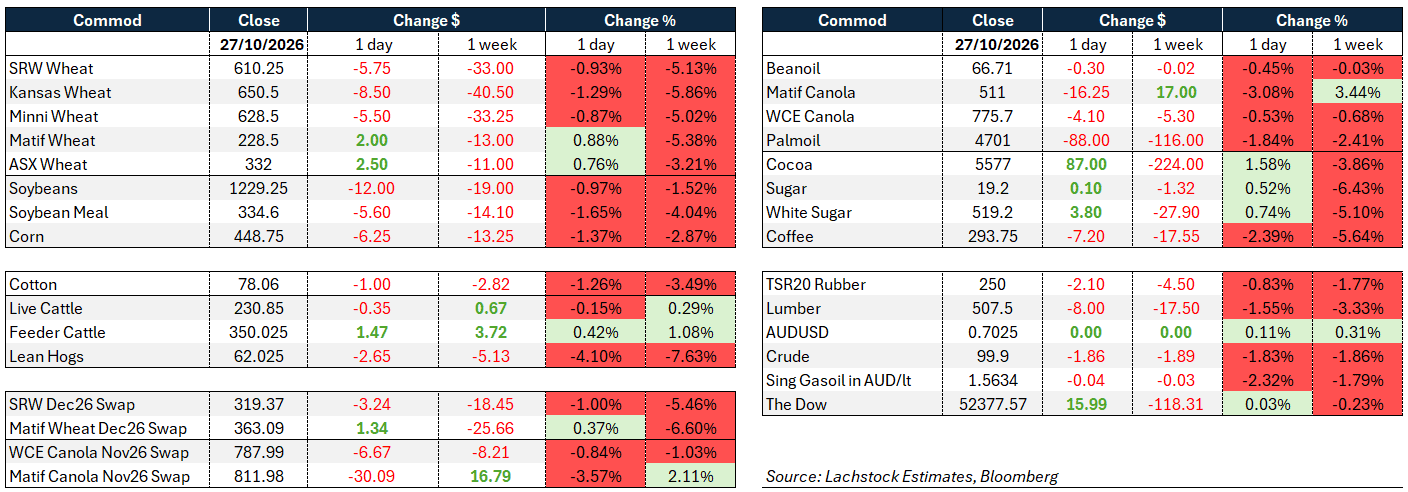
Markets: Wheat lost 5-6pc across all three US contracts and MATIF on the week as Black Sea peace hopes stripped out risk premium, with improving rainfall across Europe, the US Plains, Argentina and Australia reinforcing the bearish supply narrative.
Australian wheat is holding up better than offshore markets, with ASX down 3.2pc on the week against 5pc plus losses elsewhere. Harvest delays and quality risk across the east and south should keep grower selling light and support nearby basis, although wet-weather downgrades could widen grade spreads.
Oilseeds are being driven by energy and positioning, with crude down nearly 2pc on Iran talk hopes, MATIF rapeseed giving back 3pc in a session and fund liquidation in ICE canola. MATIF still finished the week up 3.4pc, keeping Australian new-crop canola pricing ahead of Canadian parity.
Macro risk is tilted toward volatility in the next fortnight, with central bank meetings, the US mid-terms, possible renewed strikes on Iran, Israeli coalition talks and the weaker Brazilian real all capable of moving crude, freight and the AUD (steady at 0.7025) and, through them, grain and oilseed pricing.
Day ahead – Australia: A local inflation print, increasing noise into the mid terms in the US, Brazil change of govt and an Israel possible change of govt. Is that enough? Despite rainfall, harvesters are rolling and, generally, things are going well.
Wheat: US wheat extended its slide as planned Russia–Ukraine peace talks raised the prospect of easing Black Sea tensions. ADM Investor Services said the market has reached most downside objectives but cannot generate bullish momentum, leaving the bears in control. Kansas led the week’s losses, down nearly 6pc.
MATIF and ASX found a small footing overnight, with the SRW Dec26 swap at A$319.37 (down 3.24) and the Matif Dec26 swap at A$363.09 (up 1.34), keeping Europe firmly the stronger of the two benchmarks for local pricing.
The USDA expects Australia to ship its third-highest wheat exports on record in 2026-27. Locally, repeated rain across the east and south is stalling harvest and raising quality risk, which should limit grower selling in the near term.
Corn and oilseeds: Corn fell under harvest pressure, with 60% of the crop harvested by Sunday. Commstock’s Brian Grete pointed to 40% of the crop still to come and on-farm storage filling, which is pushing more bushels into commercial channels. StoneX noted that soybeans have been prioritised at the expense of corn, leaving the corn harvest on its slowest start since 2019.
Soybeans briefly recovered from Monday’s selloff, which was driven by a weaker real after Brazil’s election, but sellers returned. Soybean harvest reached 79%, up from 64% and ahead of the 77% average.
Weekly ethanol output is expected to have edged up to 1.097m bpd, with stocks near 24.6m barrels.
Canola was pressured by funds trimming an overextended long, Prairie farmers being largely sold up, and weaker crude dragging on the vegetable oil complex. The WCE Nov26 swap sits at A$787.99, down 6.67, while the Matif Nov26 swap fell A$30.09 to A$811.98 but is still up A$16.79 on the week.
Cold, wet and snowy Prairie weather will limit the remaining Canadian harvest.
Macro: Crude slipped on rising hopes that the US and Iran return to negotiations. Against that, Trump has flagged renewed bombing after next week’s midterms, Israel’s election was inconclusive and Netanyahu remains caretaker, and US diesel sits near record highs. The Iran war is now weighing on Republican prospects, and a Democratic House or Senate would constrain Trump’s agenda on fiscal policy, tariffs, energy and the dollar, although the CBO still sees deficits around 6pc of GDP.
Local: Bids were slightly stronger for canola in the west, with non-GM at $847 and GM at $843. Wheat was bid $373 and barley $319 FIS Albany. In the east, canola was up $5 to $788, while wheat was softer at $335 and barley was bid $286 track Geelong. Harvest continues to ramp up in the west. Lachstock Consulting estimates Western Australia’s canola harvest is 17.7pc complete, with receivals at 666,000. Barley harvest is estimated to be 6pc complete, while wheat is only 2.3pc complete. In South Australia, barley harvest is estimated to be 7.5pc complete, with 173,000t received so far. Wheat bids continue to be wound back as global markets lose ground, with risk premium being eroded and the potential for Black Sea wheat to flow weighing on prices. Unfortunately, this is lining up with local harvest. The risk of Black Sea wheat flowing more freely has always been hanging over the market, but the reaction has been sharper than many expected.
HAVE YOUR SAY