
 Weather: Australia: Over October 22–29, rain was forecast across much of the eastern two-thirds of Australia, with 15-50mm for Victoria, South Australia and central and southern NSW. After last week’s rain in the north-east, these falls are likely to further delay winter-crop harvest and lift the risk of quality downgrades from excess moisture. WA cropping regions are forecast to receive 5-10mm.
US Plains: Winter wheat planting is 76 percent complete nationally, one point behind the five-year average, with Kansas at 80pc. Weekend falls gave the High Plains some relief from dryness, but Oklahoma, northern Texas, South Dakota and eastern Montana still need more rain for good establishment.
Brazil: Rain is moving back into central Brazil and out of the south over the coming week, which should help soybean planting and early establishment. Mato Grosso is well ahead of normal planting pace, though forecast amounts there are around 80pc of normal for this point in October, while the south is slightly behind after excessive rain.
Europe: The EU MARS unit has flagged persistently low soil moisture hampering rapeseed establishment. Earlier MARS commentary warned that dry weather forecast for central and south-eastern Europe could further constrain winter crop establishment.
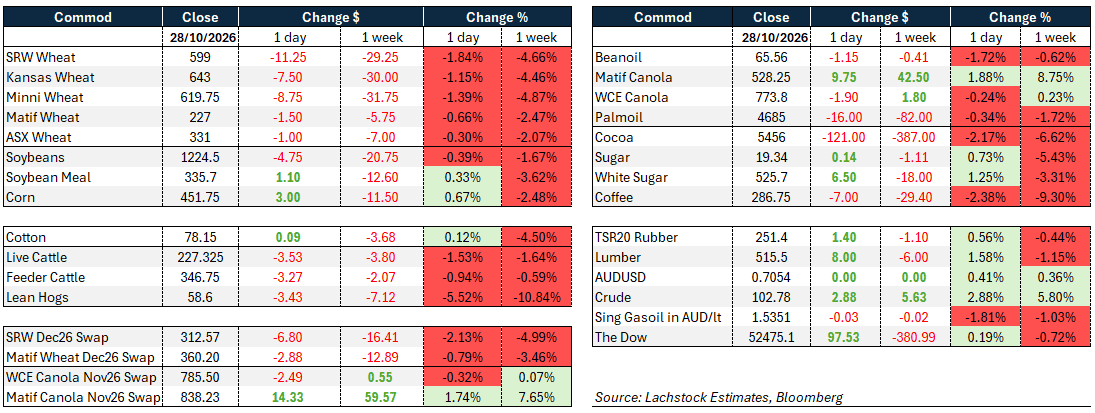
Markets: US wheat broke below 600 for a fresh low of 593.25 in SRW before settling at 599. The losses came on an Azov port clearance headline and talk of Russia-Ukraine talks. US contracts are down 4.5-4.9pc on the week, while MATIF (-2.47pc) and ASX (-2.07pc) continue to hold up better.
MATIF canola rose €9.75 to 528.25 and is up 8.75pc on the week. That lifted the Nov26 swap A$14.33 to A$838.23, while WCE eased under fund liquidation.
Corn snapped a four-session losing streak, settling 3c higher at 451.75 while wheat sold off. Soybeans fell for a third session ahead of FND.
Crude rose 2.88pc to 102.78 on Iran strike risk after the midterms and tight distillate markets. The AUD was steady at 0.7054.
Day ahead – Australia: If the futures markets were the only barometer for what’s happening, you would be excused for assuming conditions and supply chains are absolutely fine. The confidence around some sort of resolution is growing, but, meanwhile another vessel was struck.
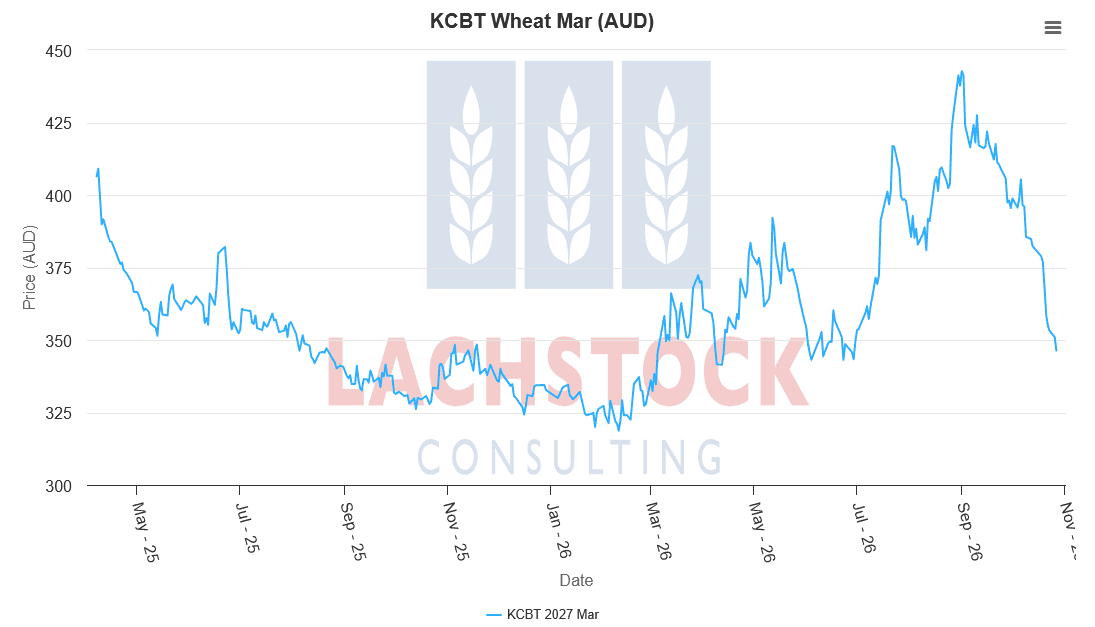
Wheat: Wheat found another reason to fall overnight. The latest was word that Azov Sea port authorities had granted temporary clearance for grain vessels to leave Temryuk and Kavkaz. The market traded it as though the Black Sea were reopening, but the consensus is that the window simply lets stranded vessels with crews in place sail out.
The 600 level in Dec SRW then produced messy order flow and a run of stops, taking the market to a fresh low of 593.25 before it settled at 599.
The peace narrative is still doing the heavy lifting. Zelenskyy flagged possible trilateral talks with Russia and the US in Abu Dhabi early next month, with technical teams expected to meet 6–10 November. Lavrov is also heading to Atlanta for the G-20 foreign ministers’ meeting this week.
Strikes continue, though, including a Russian hit on a dry-cargo ship sailing to Odesa, and Europe is drifting further from Moscow as EU leaders commit more military and financial support to Kyiv.
The bigger problem for the bulls is that Russia keeps finding ways to ship. Exports reached 240,000t on 27 October, Murmansk has started loading its first grain cargo, possibly for Morocco, and the agriculture minister has held the crop forecast at 140mt with 135mt already harvested.
Jordan is back with a 120,000t optional-origin tender closing 3 November. US export sales tonight are expected around 350,000t within a 200,000–500,000t range, and the question is whether the US has finally picked up business on this break.
Locally, the ASX is still holding up better than offshore markets, with harvest delays and quality risk in the east keeping grower selling light.
Corn and oilseeds: Corn was the standout, holding steady while wheat fell through 600 and settling back above $4.50 to snap a four-session losing streak. RCM Alternatives described the late selling to the lows as having a capitulation feel, with funds having cut their length heavily at values the balance sheets suggest are cheap. The trade is now treating 450 as fair value for the time being. On FOB values, Brazil and the Gulf are roughly level, Argentina is the cheapest origin and the PNW is cheapest landed into Asia. Ethanol output rose 25,000 b/d to 1.118m b/d, the highest since late July.
South African farmers intend to plant just 2.4M hectares m ha of corn in 2027, down 12.4pc and the smallest area since 2019, on input costs and El Niño drought expectations.
Corn sales tonight are expected around 1.2Mt.
Soybeans fell for a third straight session, again failing to hold early gains as longs exited ahead of FND. Meal found a domestic end-user bid, while beanoil fell on the threat of imports despite firmer energy.
USDA flagged a 120,000t flash sale to unknown destinations.
China still has 30–35pc of its 25Mt new-crop commitment left to buy, and AgMarket.net expects it to return.
Bean sales tonight are expected around 2.4mt within a 1.3–2.8mt range, below the previous week’s 2.84mt.
India’s soybean imports reached a record 1.1mt in 2025/26, while its meal exports halved to 1mt. Brazil is also concerned that the EUDR could hand EU meal market share to Argentina.
MATIF canola again moved away from the rest of the oilseed complex.
Low soil moisture is hampering EU rapeseed establishment, which put a weather premium into European values and pushed the Nov26 swap above A$838.
WCE went the other way: funds kept selling down their long, the January contract gave back an early C$8.30 gain, and Prairie farmers are largely sold up.
Canadian exports are well ahead of last year at 1.62mt after 11 weeks.
Palm also fell as Malaysian stocks are straining storage in the main producing state.
For Australian growers, European-priced canola remains well ahead of Canadian parity heading into harvest.
Macro: The distillate market remains extremely tight. Phillips 66 said around 7m b/d of refining capacity is offline across Russia, the Middle East and Asia. It described the Russian diesel deal as a drop in the bucket and said it has no plans to buy those cargoes, with US diesel margins running above $100/bbl. Russian refiners have used a pause in Ukrainian drone strikes to restore run rates.
European farmers are also cutting fertiliser purchases on high prices, which could put yields at risk.
In Brazil, Brazilian stocks and the real sold off sharply after Lula’s weekend election win. A weaker real would encourage farmer selling as the new soybean crop goes in.
Coming up: US export sales and Bunge results tonight, then the Agricultural Prices report and COT on Friday.
Local: Through the west of the country canola was back $7 to $836, wheat was steady at $373 and barley $318 FIS Albany. In the east canola was $5 softer at $781, wheat was $335 and barley $285 track Geelong. Harvest has slowly started to kick back into gear across Qld, with wheat still making SFW1 so far. BAR1 barley is proving a little harder to find, although there is still plenty of water to go under the bridge before the full extent of quality issues becomes clear. Delivered markets remain well supported, with barley bid around $405 and wheat $435 Jan+, while sorghum is sitting around $345 Mar-Apr.
A cool, damp week across much of SA and Vic is beginning to raise quality concerns through the more northern cropping regions, particularly for barley. Further south, however, the combination of cooler temperatures and ample moisture should provide a near-ideal finish for later crops, provided conditions begin to dry out as harvest approaches.
HAVE YOUR SAY