

Weather:
In the US, the Plains got heavy rain that has stalled wheat planting, and the Midwest rain threat has eased.
The eastern Corn Belt’s coming harvest interruption looks less severe than earlier outlooks suggested, and CPC’s second week leans cooler and drier. The western row now carries WPC’s Upper Midwest flood risk, so the length of the drying period after the rain is the signal to watch.
The impact on US row crops looks to be a temporary slowdown in harvest and deliveries. Cash markets could find local support where supplies pause, though a successful weekend drying trend would let harvest pressure rebuild, which squares with the 10-15 day maps showing clearing.
Western Australia’s south received as much as 100mm over the weekend, and Kalgoorlie-Boulder recorded four times its normal September rainfall. This follows one of the driest Julys on record.
France is in its worst soil drought on record, and forecast rain may arrive too late to complete sowing.
Expana sees French rapeseed area falling 10-15 percent. It also cut its EU 2026/27 rapeseed harvest estimate to 19.8 million tonnes (Mt) from 20Mt on weaker yields in Germany and Poland.
Markets
Fund liquidation into month and quarter end, rising rates and Wednesday’s USDA stocks report drove broad losses across CBOT, leaving all three US wheat classes down more than 5pc on the week and meal the weakest of the oilseeds.
China cut tariffs on US corn and wheat to 1pc but left soybeans at 10pc and made no new purchase commitments, so the summit read as a disappointment despite improved access for grain.
Black Sea disruption has no diplomatic end in sight, and importers are diversifying origin through French cargoes to Yemen, Egypt’s sourcing shift and a competitive Pakistan tender at US$339.36/t.
The US 10-year at a 19-year high of 5.25pc and three further Fed hikes priced are weighing on risk, while ANZ expects the RBA to hike 25bp today with another to follow in November.
Day Ahead – Australia
Rates up, diesel up, international markets down.
I can’t help but have a sense of foreboding when it comes to the fiscal management of both Australia and the US. The fact we have 2.7 rate increases baked in locally and, according to the rate curve, 3.8 rate increases in the US means things will unavoidably change.
The Pakistan tender was also a big deal – since the last tender which was only earlier this month values fell USD$9.50. However, levels still reflect export margin from the main exporting ports in Australia.
Canola futures fell despite increased noise around acreage cuts in France and wider EU along with production cuts in palmoil.
Everything softer today.
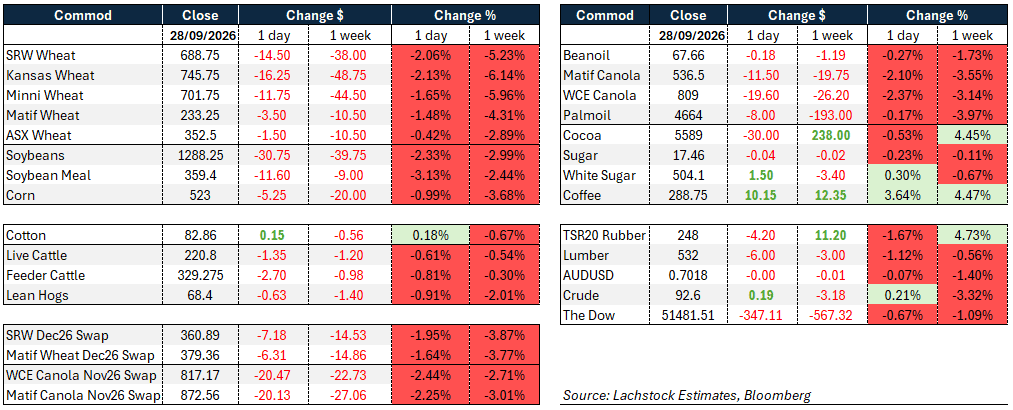
 Wheat: Ags traded higher briefly in Sunday’s session then turned south and never looked back, WZ shedding 14.5c, KWZ 16.25c and MWZ 11.75c.
Winter wheat spreads were flat to narrowly mixed, Minneapolis calendars sold off, and WZ implied vol eased to 30.62% from 31.50%. Matif Dec lost €3.50 and March €2.50 while Russian cash held at $213, confirming this was a US-led liquidation rather than a shift in origin economics.
The China summit was the catalyst: Beijing cut tariffs on US corn and wheat to 1% but left soybeans at 10%, and with no purchase commitments attached the market had nothing to hold onto.
Structure, month and quarter end, rising rates and Wednesday’s stocks report did the rest.
Fundamentally nothing has changed. Ukraine’s agriculture minister Taras Vysotskyi sees no prospect of a Black Sea grain ceasefire in the coming months, Russia struck a Palau-flagged vessel off Odesa, Ukraine hit oil facilities in Krasnodar, and Berlin described its first direct talks with Moscow as leaving the two sides miles apart.
Importers are adapting with workarounds. France is loading 60k t for Yemen, the first such cargo in four years, Egypt is diversifying origins, and Pakistan’s TCP tender drew 12-plus participants with Bunge lowest at $339.36/t for 60k t, ahead of Olam at $341.88 and Ameropa at $343.47. Most significantly, this reflects a drop of USD$9.50 from the last tender earlier this month.
Ukraine’s weekly grain exports rose 40% to 372.2k t on wheat of 273.7k t, moved increasingly via land borders as Danube volumes fell.
US wheat inspections of 311k matched estimates, with the pace down 16% yoy.
Locally ASX held up well, off just $1.50, while the SRW Dec26 swap fell $7.18 to A$360.89 and the Matif Wheat Dec26 swap $6.31 to A$379.36.
Other grains/oilseeds: CZ clawed back through the session to finish 5.25c lower, with heavy fund length and the pull of beans doing most of the damage.
The forward story remains constructive: Brazilian offers are thinning, US yields are disappointing, Brazil’s ethanol demand is holding corn at home, and Ukrainian corn exports, which have topped 3 mil t in past Novembers, will be constrained by the same Black Sea bottleneck.
Inspections of 1.566 mil were at the high end, leaving shipments up 16% a few weeks in. Conditions held at 57% good/excellent against 66% a year ago and a 59% average, with harvest 18% complete versus 19% expected.
Oilseeds took the brunt, meal leading. SX lost 30.75c, SMV $12.20, SMZ $11.80 and BOZ 18 points, leaving Dec crush 3.25c firmer at 246.75.
The exclusion of beans from China’s tariff list stung, though the 25 mmt already agreed looks to be proceeding and further buying likely needs a South American weather scare, real or perceived, plausible in an El Niño year.
Sinograin sold 191,699 t of imported beans, 37.3% of volume offered. Bean inspections of 1.153 mil beat all estimates, pace up 26%, with conditions steady at 58% and harvest 17% against 20% expected. Brazil’s soy planting reached 3.4% per AgRural, ahead of 3.2% last year.
Nov canola fell C$19.60 to C$809, slipping below its 20-day moving average to sit just above the 50-day, after AAFC lifted its 2026-27 carryout to 1.979 mil t from 1.504 mil. The WCE Canola Nov26 swap fell $20.47 to A$817.17 and Matif Canola Nov26 $20.13 to A$872.56.
Expana sees EU rapeseed area down 2% next season on a potential collapse in France.
Palm was steady at midday but is down 4.5% for the month on a surprise surge in Malaysian output, with Paramalingam Supramaniam flagging stocks building towards 3.3 mil t. India’s cumulative monsoon rain sits 12% below normal.
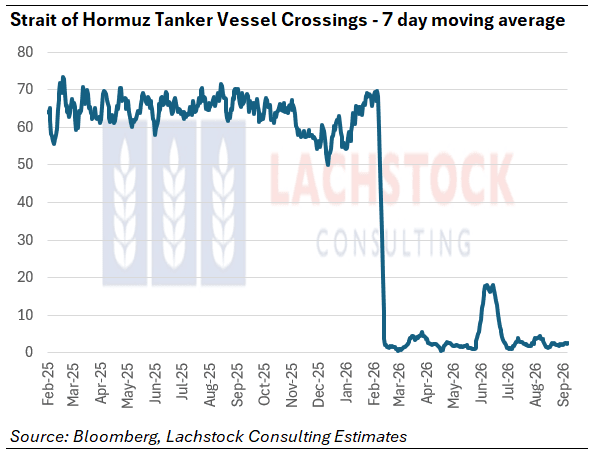
Macro: The Treasury rout deepened after Trump rejected Iran’s latest proposal to reopen the Strait of Hormuz.
The 10-year rose 9bp to 5.25%, a 19-year high, and the 30-year hit 5.57%, the highest since 2004, with swaps now fully pricing at least three more quarter-point Fed hikes over 12 months following the Warsh Fed’s first increase since 2023 this month.
The 2s10s spread narrowed to 17bp last week, raising inversion risk. Crude jumped on Iran’s refusal to soften its terms, eased on a report of US sanctions relief that Trump later denied, and closed marginally higher, while Saudi Arabia resumed exports through its repaired cross-country pipeline.
Trump is still weighing a diesel export ban, and with diesel and fertiliser costs elevated, farm sentiment has soured heading into November’s midterms.
The AUD was flat at 0.7018.
The RBA meets today, and ANZ expects 25bp hikes both today and in November, taking the cash rate to 4.85%, the highest since 2008.
ANZ anticipates a split board given its preference for moving at Statement on Monetary Policy meetings, but sees the RBA treating oil as an inflation shock rather than a growth shock and expects Q3 trimmed mean to overshoot the August forecast.
Local: A Monday public holiday in the west gave Freo fans an extra day to wipe away the tears, while the week started steady in the east with canola at A$817/t, wheat $353 and barley $290 track Geelong.
A few old crop lentil shorts are popping up for October at around $620 delivered Geelong/Melbourne, while new crop remains around $590.
Northern markets remain firm, with barley bid $410 and wheat $435 delivered Downs for Jan+.
The rainfall outlook is conducive to a good finish through SA, Vic and SNSW, with 15–25mm forecast for most cropping regions over the next week.
Barley remains a laggard in the south, with Chinese demand virtually non-existent, local homes either full or waiting for harvest, and good pasture growth limiting feed demand. This time last year China was very active buying new crop, but a combination of comfortable stock levels and competitive alternative feed grains has kept buyers out of the market so far.
HAVE YOUR SAY