

Weather:
Weather remains another layer of support. Oppressive heat across the US Midwest is keeping corn and soybean yield expectations under pressure immediately ahead of harvest, while earlier excessive moisture has also created concerns around nutrient loss and pollination. India’s cumulative monsoon rainfall was reported 13% below normal as of September 2, while a strengthening El Niño is creating broader concerns for South American crops and other global agricultural production into 2027
Markets
A proper two-way session rather than the runaway market we saw through late August. Wheat and corn both made fresh contract highs during the session before profit taking, hedge pressure and an overbought technical setup eventually dragged them lower. Importantly, buyers were still prepared to step into the initial break, suggesting the underlying bull story has not disappeared — the market is simply trying to shake out some length.
The fundamental backdrop remains supportive: Black Sea grain exports are barely moving, US crop expectations are easing, China continues buying beans and Middle East fighting has pushed energy risk firmly back onto the table. After August’s extraordinary rally, however, markets probably need some air taken out before making another sustained push higher.
Day Ahead – Australia
Locally I’d expect wheat to open softer, following the US close, although the offshore move itself understates how volatile the session was. Black Sea disruption continues to strengthen Australia’s relative position in world trade, so exporters should remain interested — but with SA and Victoria staring at very large crops, local basis will continue doing a lot of the work.
Canola softer, following after the weakness in soyoil and Winnipeg. Higher crude is a useful buffer, however, and continued Middle East escalation limits the chance of a major washout unless harvest selling really starts to build.
 .
.
Wheat: Chicago Dec finished 8.5c lower at 774c, Kansas lost 11c, while Minneapolis gained 5.25c.
It was a wild session, with Chicago trading from 764.5c to a fresh contract high of 795c before selling off again.
The weakness looked more like profit taking and hedge pressure after August’s huge rally than any major change in fundamentals.
Buyers still stepped into the break, suggesting there remains plenty of underlying support after the recent run.
Black Sea disruption remains the key bullish driver. Ukraine shipped only around one-third of its potential agricultural export volume in August, while Russia says there are no grounds to restart the grain corridor.
Russia has suspended grain export duties through year-end, but cheaper Russian wheat means little while export logistics remain heavily constrained.
The market probably needs some further correction after August’s rally, but it remains difficult to turn bearish until meaningful Black Sea export flows resume .
Other grains and oilseeds: Corn followed a similar path, touching a fresh contract high at 549.75c before finishing 2.5c lower at 543.5c.
US yield expectations continue to drift lower as heat hits the Midwest, with Allendale estimating corn yield at 178.7 bu/ac, around 2 bu/ac below USDA.
EU corn imports are expected to rise 37 percent to more than 26 million tonnes (Mt), while disrupted Ukrainian exports continue to tighten the global feedgrain picture.
Soybeans finished 7.5c lower at 1310.25c, but China continues to provide strong demand, purchasing another 202kt of US beans.
South American weather is increasingly important, with a strong El Niño creating production risk heading into the next growing season.
Canola struggled above C$840/t and moved lower alongside weaker soyoil and European rapeseed.
ICE support is seen around C$810/t, while C$800 could come into play if crude weakens materially and Canadian harvest pressure accelerates.
For now, high crude prices, slow harvest pressure and positive 2026/27 demand expectations continue to provide some support .
Macro: US private payroll growth slowed to just 38k in August, the weakest since January, helping pressure the USD and push the AUD higher.
The Bank of Canada left rates unchanged at 2.25pc, while Fed commentary suggested underlying inflation continues to ease gradually.
Middle East tensions remain the major inflationary risk, with renewed US-Iran strikes pushing Brent to US$95.63/bbl and WTI to US$91.01/bbl.
Physical flows through the Strait of Hormuz remain heavily disrupted, keeping significant risk premium in energy and freight markets.
The broader agricultural inflation story is building, with the Bloomberg Agriculture Spot Index rising more than 13pc in August, its strongest monthly gain since 2012.
Higher grain, energy, freight and potentially fertiliser costs are increasingly raising concerns around global food inflation.
For Australia today, the firmer AUD is a slight headwind, while offshore grain markets look more likely to consolidate after the recent rally than immediately push sharply higher.
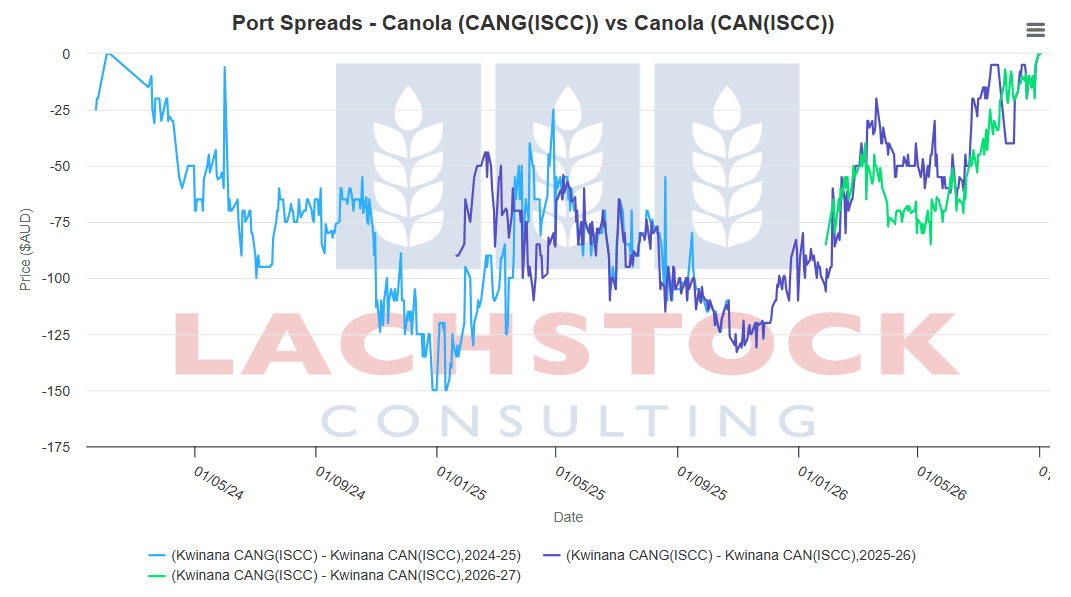
Local: Canola was firmer through the west, with bids up A$5/t to $880 and GM at evens. Wheat also strengthened to $395, while barley was $334 FIS Albany.
In the east, canola improved to $830, with GM at a $25 discount. Wheat was $369 and barley $298 track Geelong.
A busy day locally for the trade, with growers becoming more engaged on new-crop sales and many books closing early, predominately canola. There are still around 3–4 weeks left in the frost window for much of the south, but as we move toward the back end of this period, expect forward selling to accelerate further.
HAVE YOUR SAY