

Weather:
DTN’s John Baranick calls it a third straight wet week for the middle of the country, with Hurricane Polo remnants and a front delivering widespread 2-4 inches across the Central and Southern Plains, disrupting harvest and wheat planting but easing the Plains drought and proving a net positive for winter wheat, though fieldwork in the wettest pockets will lag clearing skies.
Beyond this week the Midwest forecast turns dry for most areas, which should accelerate harvest and help western crushers source beans, with the near-term outlook showing little or no rain from Illinois through Ohio.
In Europe MARS says rain returned too late to undo summer heat and drought damage to maize and sugar beet, the Rhine has hit another low that is hampering transport and production, and mixed Prairie weather is keeping Canadian harvest progress uneven.
The BoM shows a broad October dry signal, with below average rainfall likely for much of south-east Australia, while October to December leans above average across most of WA and SA outside the south-east, with above average maximums likely across most of the country.
Markets
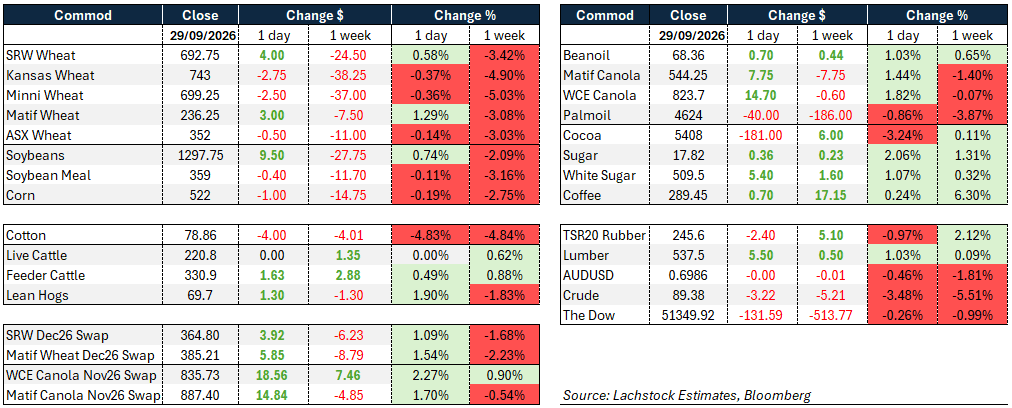
Report day. September 1 stocks and the US wheat production update land Wednesday, with the broker below trade on wheat and corn and above on beans, and month and quarter end are set to amplify order flow into the close.
Corn is the likeliest swing factor for the complex. Talk of an overstated 2025 crop, a higher feed number and weak early yields point to downside risk on stocks, while EU corn losses and closed BSEA lanes give Brussels reason to revisit Ukraine quotas.
In wheat, the Chicago short and the KC and Minneapolis length are unwinding into the event. Poor HRW export sales and Plains rain weigh on KC, and Matif keeps finding support from the EU’s 262 million tonnes (Mt) grain estimate and Black Sea strikes on shipping.
Locally, the RBA’s hike to 4.6 percent failed to hold the Aussie, which dropped below 0.70 and lifted every swap.
The WCE Nov26 swap gained A$18.56 to A$835.73 while ASX wheat held A$352, still A$11 lower on the week.
.
 Wheat: Order flow drove it: funds are short Chicago and long KC and Minneapolis, so ahead of the report Chicago saw short covering while the other two were unwound.
HRW selling was fed by heavy rain heading for the southern Plains and an export pace the broker called atrocious given where world fobs sit, with HRW carryout drifting toward 350.
Matif Dec gained €3.00/t and March €1.75, while Russian cash was unchanged at US$213/t fob.
BSEA exports are running at roughly 40-45 percent of normal and buyers are waiting it out.
Russia struck two foreign-flagged vessels in the Odesa region and a dry-cargo ship in the northwest Black Sea, and Zelenskiy says another 10,000 North Korean troops are being readied on top of the 8,000 already in Russia.
The European Commission says it has no plans to renegotiate Ukraine’s DCFTA quotas and calls current flows fair and balanced, though a poor EU corn crop could force a rethink if the BSEA stays shut. Brussels cut 2026-27 EU grain production to 262Mt, down 9.6pc from 289.8Mt and 4.7pc below the five-year average. It lifted durum 4.1pc to 7.7Mt and barley 1.3pc to 53.6Mt. EU soft wheat exports reached 6.8Mt since 1 July, led by Saudi Arabia, Algeria and Nigeria, while barley exports fell 39pc to 1.9Mt.
Ukraine has harvested 34.3Mt from 7.1mha (61pc) and Kazakhstan sees a crop above 23Mt. Wednesday’s September 1 wheat stocks are expected at 1.872b bu (range 1.771-2.342), with the broker at 1.856.
All-wheat production is expected at 1.524b bu against 1.531 previously, other spring at 0.471 against 0.474, and HRW at 0.462.
On the local side, ASX slipped A$0.50/t to A$352. The SRW Dec26 swap rose A$3.92 to A$364.80 and the Matif Dec26 swap rose A$5.85 to A$385.21, a Matif premium of A$20.41, with both lifted by the weaker Aussie.
Other grains/oilseeds: Corn traded both ways before a 1c loss, a placeholder ahead of the report. Our guess sits at 1.858b bu for September 1 stocks against 1.918 expected. Last year’s crop may have been overstated and runs a higher feed number, and trade expects 2025 production trimmed to 17.003b bu from 17.021.
The early harvest has been widely described as disappointing, with the 9 October WASDE the next production test.
The Crop Progress report showed corn 18pc harvested (17pc last year) and beans 17pc (18pc). Both are on the five-year average but behind trade expectations, which gave early support before 10-year Treasury yields hit their highest since 2007 and weighed through the morning.
Europe’s corn problem deepened. MARS cut EU maize yield to 6.50 t/ha, 9pc below 2025 and 8pc under the five-year average, and the Commission lowered its corn estimate 3.6pc to 48.3Mt.
South Africa, by contrast, is heading for a record 17.5Mt. Argentina is the cheapest origin into most destinations, and the PNW is now competitive with Brazil into Asia.
There has been nothing new from China since Trump/Xi II, with traders still weighing how fast the tariff cuts become grain demand while Beijing is on holiday for the rest of the week.
Beans led the complex. SX rose 9.5c and BOZ 70 pts, while SMZ lost $0.40 and SMV $1.60, and the Dec crush slipped 2.75c to 244.
Support came from reported Chinese interest and, per AgResource, high energy prices lifting biofuel crush demand. Bean yields are not drawing the same complaints as corn. Stocks are expected at 324m bu (range 304-349), with the some higher at 332 on a lower crush.
ICE canola bounced back after Monday’s losses as Turnaround Tuesday took hold. Nov closed above its 50-day average of C$809.30/t but just short of the 20-day at C$827.80, with Jan at C$837.10 on 80,273 contracts.
Spillover from soyoil, beans and rapeseed helped, though mixed Prairie harvest weather kept some caution in the market.
WCE is closed Wednesday for the National Day for Truth and Reconciliation.
Matif canola gained €7.75/t. Palm fell 40, touching four-month lows overnight on Malaysian stock build and soft exports, although one industry official sees palm at a premium to soyoil in 2027 as El Niño and Indonesian biodiesel tighten supply.
The WCE Nov26 swap jumped A$18.56 to A$835.73 and Matif canola Nov26 rose A$14.84 to A$887.40, a Matif premium of A$51.67.
Macro: The RBA board unanimously lifted the cash rate to 4.6pc, a 15-year high.
Bullock rejected Chalmers’ line that the Middle East drives inflation, pointing instead to domestic excess demand and stalled productivity, and flagged further hikes if expectations slip.
Markets are fully priced for 4.85pc by February, with roughly a 40pc chance of a move on 2-3 November.
HSBC’s Paul Bloxham expects November, while CBA’s Ashwin Clarke expects a hold.
The Aussie still fell 32 pts below 0.70, with the market reading the press conference as short of its hawkish bar, and underlying inflation of 3.6pc leaves Australia an advanced-economy outlier.
In the US, Conference Board confidence dropped 6.7 to 81.9, its lowest since early 2014 and well below the 89.0 consensus, as the labour differential narrowed to 1.7. JOLTS openings fell 256k to 7.079m, a five-month low, in a low-hire, low-fire market.
Bonds kept selling off, with the 30-year at a 24-year high of 5.612pc and the dollar firm.
Crude shed 3.5pc despite Iranian officials privately doubting a Hormuz deal before the midterms and Trump denying he had offered Tehran any sanctions relief.
The Dow lost 132 points. Brazil votes on 4 October with Lula and Flávio Bolsonaro tied in runoff polling.
Ahead are EIA petroleum data and USDA quarterly stocks at noon ET Wednesday, with month-and-quarter-end adding weight to the close.
HAVE YOUR SAY