

Weather:
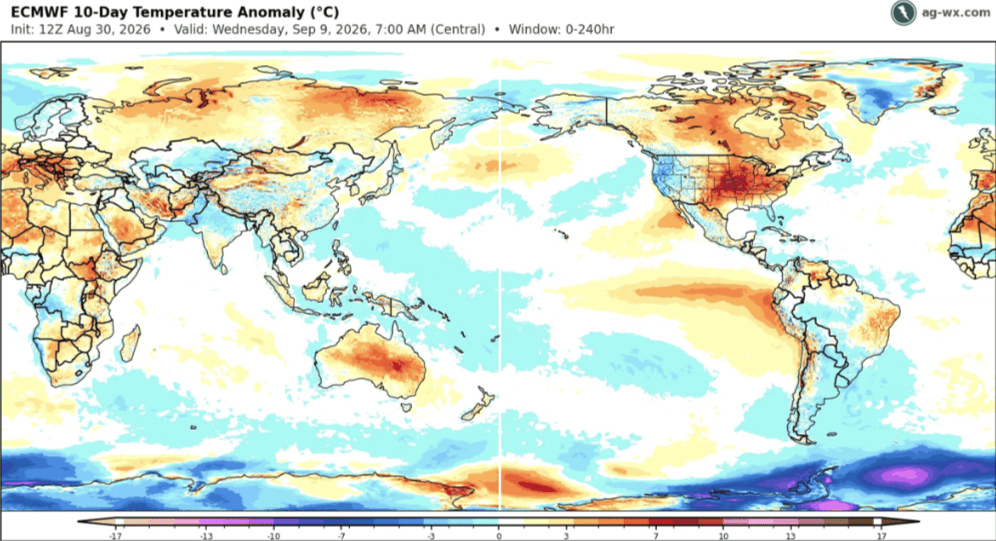
US weather remains supportive price, with heat returning to the Midwest following excessive rainfall and increasing disease pressure in corn and soybeans. Europe remains the bigger concern, with prolonged heat and drought hammering corn and wheat crops. India’s monsoon rainfall was 13 percent below normal as of August 28, while El Niño is emerging as a longer-term threat to Indonesian palm production.
Markets
Friday night saw wheat extends its sharp rally as Black Sea export disruptions intensified. Chicago Dec gained another 23.25c, taking the weekly move to nearly 85c, with buyers increasingly turning to alternative sources as Russian and Ukrainian grain struggles to reach world markets.
Corn also pushed higher Friday night as concerns built around US yield potential, disease pressure and weaker European production. Oilseeds joined the move, with soybeans, meal and soyoil all firmer, while canola was supported by stronger vegetable oils and growing concern that Black Sea canola exports could also be disrupted.
Day Ahead – Australia
Australian wheat should start the week with a strong offshore tailwind, although the key question remains how much of the rally exporters pass through locally given the size of the coming crop. Old-crop wheat remains well positioned as consumers search for Black Sea alternatives, while sustained disruption should increasingly support new-crop values.
Canola should also carry a firmer bias given stronger vegetable oils and growing recognition that Black Sea oilseed disruption could redirect EU demand toward Australia. Barley remains the laggard unless Chinese buying becomes more meaningful.
 .
.
Wheat: Wheat exploded higher again, with Chicago Dec up 23.25c Friday and 84.75c for the week, while Kansas gained 71.75c and Minneapolis 44.75c. Chicago wheat recorded its biggest weekly gain since March 2022 and traded at three-year highs.
The move is being driven by genuine Black Sea export disruption. Continued attacks on Russian and Ukrainian ports, vessels and logistics infrastructure are restricting flows and making freight and insurance increasingly difficult.
Consumers are actively looking elsewhere, with French and Baltic wheat emerging as key alternatives. Argentine quality is questionable, Canada has limits, Australia has export capacity constraints and US wheat is increasingly the expensive residual supplier.
The concern is moving beyond nearby supply. Ukrainian farmers are expected to cut 2027 winter wheat area, while Russian growers are also questioning plantings as grain backs up inland and domestic prices collapse.
European weather is adding another layer of support, with heat and drought reducing wheat production, while the poor European corn crop could also see more wheat retained domestically for feed.
Unless Black Sea exports begin flowing again, the market increasingly looks to be dealing with a multi-season supply issue rather than a short-term logistics problem.
Other grains and oilseeds: Corn continues to build its own bullish story, gaining around 28c for the week and reaching its highest level since 2023 as confidence in the US crop deteriorates.
USDA cut its US corn yield estimate to 180.7bu/ac, while Pro Farmer found heat damage and excessive rainfall has increased disease pressure across parts of the Corn Belt.
Global corn supplies were already tight due to weak European production and restricted Ukrainian exports. French maize conditions have fallen to just 28pc good/excellent, the lowest in records dating back to 2011.
Soybeans, meal and soyoil all finished strongly, supported by returning Midwest heat, European meal demand, fresh Chinese soybean purchases and expectations of larger US biofuel quotas.
Canola finished firmer alongside stronger global vegetable oils. Canadian demand remains strong, with July crush hitting a record 1.322 million tonnes (Mt) and 2025/26 annual crush also reaching a record.
The canola market may still be underpricing the Black Sea problem. Russia and Ukraine account for roughly one-fifth of global canola exports, while Ukrainian July exports collapsed to 19kt versus 143kt last year.
Restricted Ukrainian exports could shift additional EU demand toward Australia and Canada, while higher crude prices and stronger biofuel economics provide another supportive layer for vegetable oils.
Indonesia is also warning severe El Niño conditions could cut palm oil production by as much as 3Mt next year, potentially tightening the broader vegetable oil complex further.
Macro: Fed Chair Warsh delivered a hawkish Jackson Hole message, reiterating his determination to return inflation to the 2pc target and pushing expectations of a September rate hike higher.
US rates reacted sharply, with the 2-year Treasury yield up 11bp to 4.34pc and the 10-year up 4bp to 4.72pc. US equities softened while gold fell 2.6pc.
US consumer sentiment edged higher to 51.7, while one-year inflation expectations eased from 4.3pc to 4.0pc, although markets remain focused on the Fed’s inflation fight.
Energy markets remain heavily influenced by the Iran conflict and restrictions through the Strait of Hormuz, although increasing tanker movements have reduced some immediate crude supply fears.
European gas remains tight, with inventories around 64pc full versus an 81pc seasonal average, while continued Qatari LNG force majeure is restricting supply.
Attention turns to the G20, where the US is pushing for reduced trade imbalances and tougher action against Iran. Other members remain more focused on US tariffs, rising Treasury yields and growing US government debt.
Local: The week ended steadily for canola in the west, with bids around A$865/t and the discount to GM narrowing to just $5. Wheat was a little softer at $392, while barley finished at $333 FIS Albany.
In the east, markets were largely unchanged to end the week, with canola at $811, wheat $368 and barley $300 track Geelong.
Bids should be well supported today following Friday’s strong move higher offshore. Basis is already soft, particularly through SA and Victoria, with growers increasingly turning to derivative alternatives to hedge price exposure rather than selling physical grain.
HAVE YOUR SAY