
 Weather:
Canadian Prairie outlook describes isolated showers and above-normal temperatures across Alberta, Saskatchewan and Manitoba, favourable for crop development overall though southwestern areas are running hot and dry enough to cause stress.
Has been running pretty warm through Argy wheat areas – i personally dont see much in the way of moisture deficits in isolation but the warmer temps will be tightening things a little.
Indian monsoon last week was mixed – still watching UP and MP – everyone telling me there is more than enough time to catch up, but interesting to see the wheat cash price starting to move a little.
Markets
War news is good for 24-48 hours – then its generally given back (and then some) – thats what i have learnt since Vlad rolled the first tank over the Ukrainian border. If there was some sort of index of infrustructure damage in the Black sea that directly effects Ags – its been a straight line for the last month – but markets are not.
The next data point that will drive price direction will be official (as close as we can get to “Official”) export pace data. SovEcon has pegged Russian July wheat/barley and corn exports at 1.85mmt! – for context, the 5 yr Wheat only average is 2.7mmt
Day Ahead – Australia
Mixed day – with every Russian conflict escalation comes the question – what does the Asian buyer do if Russian is harder to get.
I expect values to stay flat to firm today.
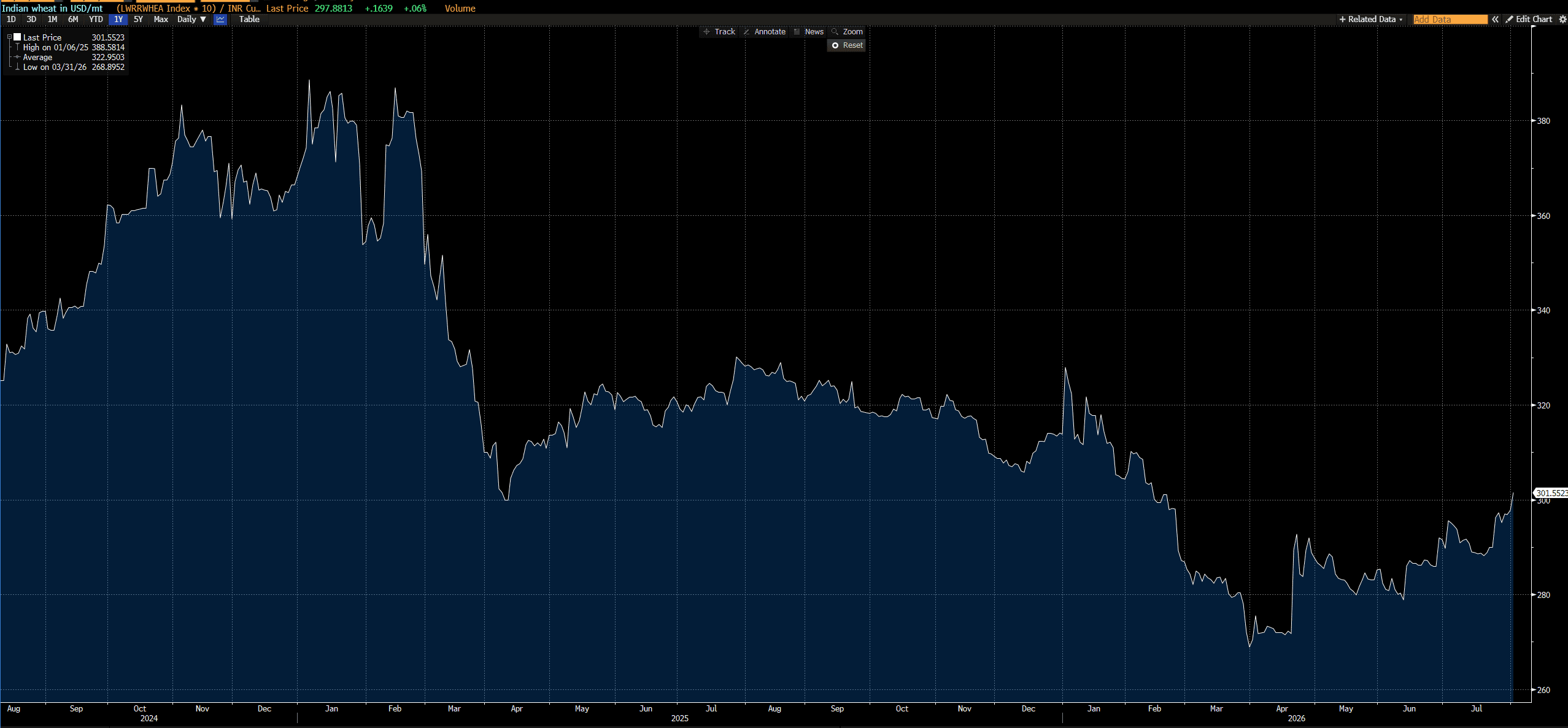
Indian Domestic Wheat in USD/t. Source: Bloomberg
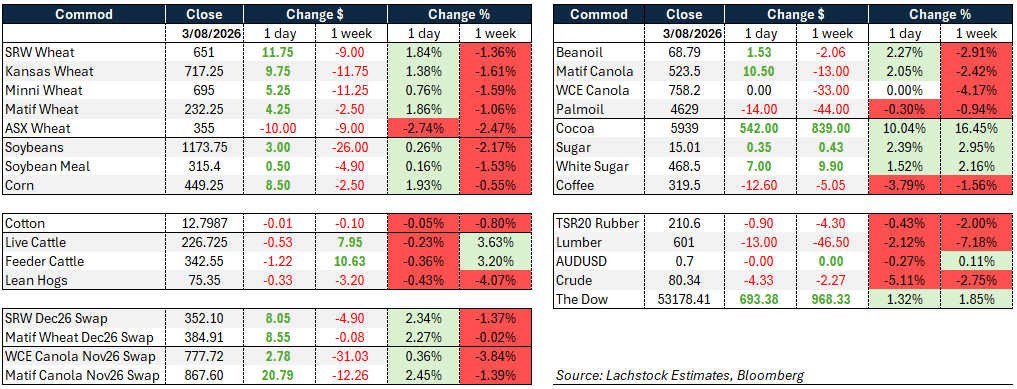
Wheat: Wheat futures rallied hard as Russia and Ukraine continued trading strikes on shipping and port infrastructure, with Russia’s defence ministry reporting it hit four vessels serving Ukrainian ports overnight, including three dry-cargo ships in the Black Sea and one at Mykolaiv.
Charlie Sernatinger of Marex noted the market dipped overnight before recovering “on realisations that the Black Sea problems are getting worse, not better.”
SovEcon data show Russian wheat, barley and corn exports for July at just 1.85mmt, down from 2.65mmt in June, while low water levels on the Danube are compounding the logistics squeeze — Romanian consultancy AGRIColumn said only ports closest to the Black Sea remain operational for barge traffic.
Spring wheat conditions improved 2 points to 55% good-to-excellent, ahead of the 53% expected and above last year’s 48% at this stage.
Rabobank’s Stephen Nicholson flagged that tight economic conditions for US farmers, initially expected to ease in 2027, may now stretch into 2028 given the compounding effects of Middle East and Black Sea conflict on a supply-heavy market.
Demand-side support was limited to a South Korean milling wheat tender for 50,000t sourced exclusively from the US.
ASX wheat lagged the offshore rally, still weighed by the weekly downtrend.
Other grains and oilseeds: Corn reversed a 5-6c intraday loss to finish 8.5c higher after weekend rains covered the bulk of the Corn Belt as expected, though conditions still slipped 2 points to 61% good-to-excellent against trade ideas of 63%, well below last year’s 73% and the roughly 64% average for the date.
A closely-watched private forecaster’s 189 bu/acre yield estimate drew scrutiny given last year’s record 186.5 bu/acre came with conditions scoring 12% higher year-on-year.
Corn export inspections were strong at 1.885mmt, led by Mexico.
Soybeans firmed as Chinese demand continued to build: the USDA confirmed a fresh 488,000t flash sale to China for 2026/27 plus 136,150t to unknown destinations, following Friday reports that Chinese state traders bought 14-16 cargoes of US beans ahead of Xi Jinping’s expected US visit next month.
Bean oil led products higher after the EPA granted only one of six sought biofuel exemptions in full, with three denied outright and two at 50% — read as friendly by removing overhang from an already-long market.
Canola diverged: Matif and the WCE Nov26 swap firmed while WCE spot canola was closed for Terry Fox day, but remains down over 4% on the week.
Malaysian palm oil eased for a second session on anticipated rising output, though a bullish July demand picture is expected to carry some momentum into August.
Cocoa’s extraordinary 16.45% weekly surge stands out against an otherwise mixed softs complex; sugar continued firming on India tightness concerns while coffee gave back ground on the day.
Macro: Crude extended its slide as Iran signalled progress on negotiations to reopen shipping through the Strait of Hormuz, with Tehran’s foreign minister saying talks with Oman over the strait’s management are in their final stages and Trump saying a deal “may be close.”
Politico noted Trump’s ability to jawbone oil prices lower — via repeated promises of imminent de-escalation — may be losing potency given supplies are tightening, the Strategic Petroleum Reserve is at its lowest level since 1983, and refiners are short of spare capacity; GasBuddy’s Patrick De Haan said Trump’s credibility “has been a little bit shot” by the on-again-off-again conflict rhetoric, though it hasn’t fully dissipated.
Equities pushed higher regardless, with the Dow adding another strong session.
On the local front, analysts see Australia’s housing downturn extending, with three RBA hikes, the Iran-driven confidence shock and investor tax changes all weighing on demand; further price falls are expected, and while sticky inflation keeps the RBA sidelined for now, mounting growth risks are seen prompting rate cuts as soon as later this year should a peak-rates signal emerge.
Local: Through the west of the country, bids were softer to start the week, with canola back A$20/t to $820 and GM at $810. Wheat was $6 softer at $369, while barley was bid at $324 FIS Albany.
In the east, canola eased to $774, wheat was $358 and barley $305 track Geelong.
Lentil demand remains sluggish, with bids around $630 delivered to southern ports and an inverse of approximately $30 to new-crop values. – Chinese barley demand is relatively subdued, with buyers currently holding sufficient stocks. However, concerns surrounding this year’s global corn crop should see China return to the market at some stage.
HAVE YOUR SAY