

Weather:
Locally, some rainfall is forecast for SA and Victoria over the next few days before warmer temperatures arrive late next week. The warmth will be welcomed through the south, helping crop development while also providing some relief to areas suffering from waterlogging. In the US, corn is still carrying damage from excessive rain and disease in eastern areas and heat and dryness further west, keeping expectations for a lower yield alive.
Markets
Wheat finally took a breather after a strong run, with tentative Black Sea peace talk giving traders the excuse to take some profit. The physical story, however, remains supportive. Asian consumers are still turning to Australian wheat as delays and uncertainty around Black Sea shipments continue to build.
Oilseeds were considerably more resilient. Soybeans rallied on demand, canola clawed its way higher and crude stayed elevated, while corn took a breather alongside wheat. The broader agricultural complex looks less like a trend reversal and more like markets stopping to catch their breath.
Day Ahead – Australia
For Australian wheat, I’d expect most of the offshore move to be passed through locally today. With the size of the crop coming, the local trade has generally been much quicker to reflect downside moves close to 1:1 than it has been to pass on rallies.
For canola, the bias remains reasonably constructive. Offshore oilseeds are mixed rather than outright bullish, but elevated crude, Canadian harvest uncertainty and the broader tight vegetable-oil balance sheet should make it difficult for values to fall away aggressively.
 .
.
Wheat: Wheat took a breather, with US futures 16–20c lower across the three classes as traders banked profits after Wednesday’s contract highs. Tentative comments from Putin around a possible Ukraine peace deal provided the excuse to strip some war premium from the market.
The important point is that this still looks more like profit-taking than a fundamental change in the story. Even the analyst quoted in the article gives a lasting peace deal only a slim chance, while the recent correction has done little technical damage to the broader wheat rally.
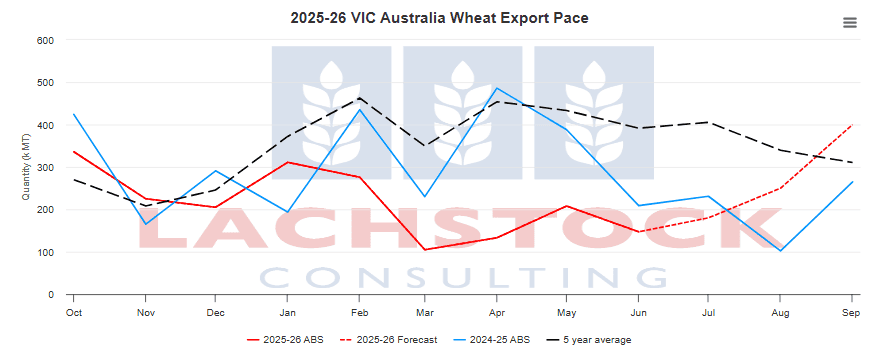
Meanwhile, the physical market remains very different from the futures screen. Asian buyers have reportedly shifted at least 500kmt of demand into Australian and Argentine wheat as Black Sea shipments are delayed and reliability becomes more important than price.
Australian APW at roughly US$315–330/t CFR is being bought despite being materially dearer than the US$260–280/t Black Sea wheat available before the disruptions. That is a very strong signal that buyers are covering risk rather than simply chasing the cheapest origin.
With Asian importers still holding 2.0–2.5 million tonnes (Mt) of Black Sea wheat bookings for Jul–Sep, there is potentially more replacement demand to come if shipping disruptions persist .
Other grains and oilseeds: Corn also eased with wheat as traders took profits ahead of WASDE, although the underlying production story remains supportive. The crop is broadly expected to shrink from USDA’s August estimate, with excess moisture and disease in the east and heat/drought through parts of the west.
Funds continue to buy corn breaks, and the correction has so far done little technical damage. That remains broadly supportive for the wider feedgrain complex.
Soybeans reversed early weakness and finished stronger as export demand continues to impress. New-crop US sales are already running at more than double last year’s pace, with a large portion of USDA’s annual target already booked.
Canola also recovered from early weakness to finish positive, helped by crude oil and stronger soybeans/meal despite weaker soyoil, palm and parts of Matif rapeseed.
The Canadian harvest remains the swing factor. AAFC is carrying a healthy 21.6Mt crop, but Saskatchewan canola harvest is only 4 percent complete and early yields are averaging around 38bu/ac. StatsCan’s September 16 production update will therefore matter.
Longer term, the vegetable-oil story remains constructive. Soybean-oil stocks are historically tight, Black Sea sunflower-oil flows remain threatened and palm production risks are building. Even with a decent Canadian crop, there is a credible argument that global veg-oil availability remains tight enough to keep a floor under canola.
Macro: US data were broadly solid, with ISM services rising to 55.4, but the employment component remained below 50 and labour-cost growth continues to look reasonably benign.
Fed Governor Waller leaned dovish, saying he would favour holding rates steady if August inflation continues to cool. That helped reduce expectations for a September rate hike.
The result was a softer USD and lower US yields, while equities rallied — generally a constructive macro backdrop for commodities.
The big event tonight is US nonfarm payrolls. Consensus is around +55k jobs with unemployment steady at 4.1pc. A genuinely dovish market reaction probably requires a very weak print or a noticeable jump in unemployment.
Crude remained firm around US$92/bbl, with ongoing US/Iran attacks keeping Strait of Hormuz supply risk firmly in the market.
That stronger energy complex matters particularly for oilseeds through the biofuel and vegetable-oil linkage.
Local: Through the west, canola was a little softer at A$875/t with GM at evens, while wheat was $393 and barley $334 FIS Albany.
In the east, canola was $818, wheat eased to $367 and barley was $296 track Geelong.
Reports suggest some further protein wheat business has been done out of Kembla around the $390–400 track level for October shipment. For buyers chasing protein, NSW remains one of the few areas where supply is currently available. With crops through SA and Victoria looking more geared towards yield than protein, there may not be a great deal more high-protein wheat coming from the south either.
HAVE YOUR SAY