
 Weather:
US Plains/eastern Corn Belt: rainfall and cooler temps moving through, easing dryness stress on corn and soybeans.
Midwest: cut-off low brought widespread showers over the weekend into Monday, soil moisture improved.
River levels – Rhine at Kaub: fell to a record low of 21cm overnight, easing slightly Tuesday but forecast to drop to 17cm by Saturday, threatening barge trade.
Southeast Asia: El Niño pointing to a drier, warmer Aug-Oct outlook – seems most of the models have a much drier palmoil belt vs Australia.
Markets
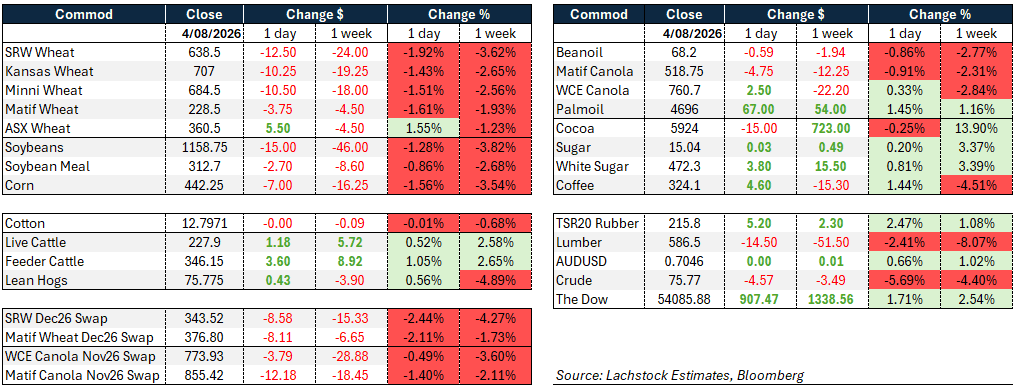
Wheat sold off across all classes as US weather turned wetter and milder, removing row crop risk premium. Additionally, Wednesday’s Algerian tender is looking challenging for the longs.
Corn and beans fell on improved weather; FC Stone’s 184.8bu/ac corn yield seen as the high end, China bought another 132kt of beans.
Canola outperformed on strong US crush data (+24 percent m/m) before fading with the broader complex.
Crude dropped over 5pc on rising odds of a Hormuz de-escalation deal, lifting equities broadly.
At one point, the crude market will be right and there will be an agreement forged in the Middle East – however, we have seen this movie before.
Day Ahead – Australia
Rainfall through NSW is, dare I say, getting better on the forecast.
Still missing Qld but, given that Downs is already pricing as far south as Parkes/Forbes this rain event matters for Australia’s most expensive feed market.
Energy coming off is an interesting input today, as well, as the Downs market will be fed by road freight.
Slightly softer across the board today.
 Wheat: Wheat’s brief start-of-month bounce is gone, every class now negative for August.
A wetter, milder outlook across the Plains and eastern Corn Belt removed the last of the weather premium, and with no support from corn, beans or a macro bid, wheat had nothing to lean on.
Matif led the move lower into Wednesday’s Algerian tender, where France is again shut out — the sell-off reads as an admission it won’t be competing for the business.
Focus shifts to how much and at what price Algeria buys; a smaller take amid thin liquidity would be a telling signal on consumer appetite.
Elsewhere, Jordan cancelled and re-tendered (Aug 11 deadline, Sep/Oct shipment), EU soft wheat exports are running at 703,513 tonnes for the season with barley down 82pc y/y, and Ukraine’s harvest is 34pc complete, wheat 53pc done at 12.5 million tonnes (Mt) gathered — in line with last year but logistics remain the constraint, with Kyiv adjusting minimum export prices and rail operator Ukrzaliznytsia chasing alternate corridors via the Danube, Constanta, Slovakia and Hungary as Black Sea shipping stays disrupted.
Other grains and oilseeds: Corn turned on a dime as cooler, wetter forecasts spoiled the month’s strong open.
StoneX pegged US yield at 184.8bu/ac after the close, digested as the high end of a 180-184 range ahead of today’s S&P estimate; Cordonnier held at 181.0 with a neutral-to-lower bias.
Beans copped better weather, a weak macro tape and no fresh product support, though China demand stayed a floor — the USDA confirmed another 132kt of new-crop beans sold, Cordonnier’s 52.0bu/ac yield unchanged.
Canola diverged, rallying on US crush data showing June volumes up 24pc m/m and 23pc y/y, with WCE briefly outperforming before fading back with the wider complex; Brent’s bounce added support given the biofuel feedstock link.
Matif Sep canola remains in delivery — no directional signal to draw from that alone.
Palm oil firmed on a weaker ringgit and firmer Dalian/Chicago oils.
ADM lifted FY26 guidance to US$5.15-5.60/share on biofuels momentum and beat Q2 estimates, shares up as much as 5pc premarket.
Macro: Crude fell over 5pc and back below $80 as optimism builds around an interim Hormuz deal — Qatar says a proposal is circulating, Bessent floated a possible agreement within a day or two, and Iran is reportedly weighing letting Europe clear mines from the strait.
Nothing is signed yet and prior ceasefires have collapsed inside a month, but equities and bonds rallied on the prospect regardless; the Dow added over 900 points.
Trump separately criticised Exxon and Chevron over Q2 profits, pushing them to cut retail prices.
The yen’s rally stalled despite Bessent reaffirming US support after last week’s joint intervention, with 155/USD still the level markets are watching for a structural shift; positioning shows net shorts on yen at their highest since 2024.
NZ unemployment rose to an 11-year high of 5.6pc on the energy shock, though wage growth accelerated for the first time in three years.
On the ag-specific macro read, the Purdue/CME sentiment index jumped 13 points to 126 in July, with 46pc of producers still citing input costs as the main obstacle.
Local: Bids were stronger through the west of the country, with canola up A$20/t to $840, wheat at $376 and barley at $324 FIS Albany.
In the east, canola was $791, wheat $360 and barley $310 track Geelong.
The next eight days look wet for SA and Victoria, with most cropping regions forecast to receive around 50mm. Hard to believe, but it may be too much for some; the more pleasing development is that the rainfall is now pushing well into NSW.
For those with trucks, there may be plenty of long-haul work available, with northern markets pricing deep into NSW for both wheat and barley. At reasonable freight rates, Loxton (SA) barley can currently be delivered onto the Darling Downs for January onwards.
HAVE YOUR SAY