
 Weather:
US Corn Belt: cold front moving west to east this week bringing cooler temps and scattered rain, easing the recent hot/dry stretch that had knocked crop ratings; Plains and Delta stay mostly dry with drought persisting.
Europe: hot, dry conditions across France and other producing regions behind Stratégie Grains’ 4.6 million tonnes (Mt) cut to its EU maize forecast; soft wheat outlook also trimmed.
Black Sea: no major weather signal, but daily Russian strikes on Odesa-area ports and shipping continue to be the dominant disruption to grain movement out of the region.
Markets
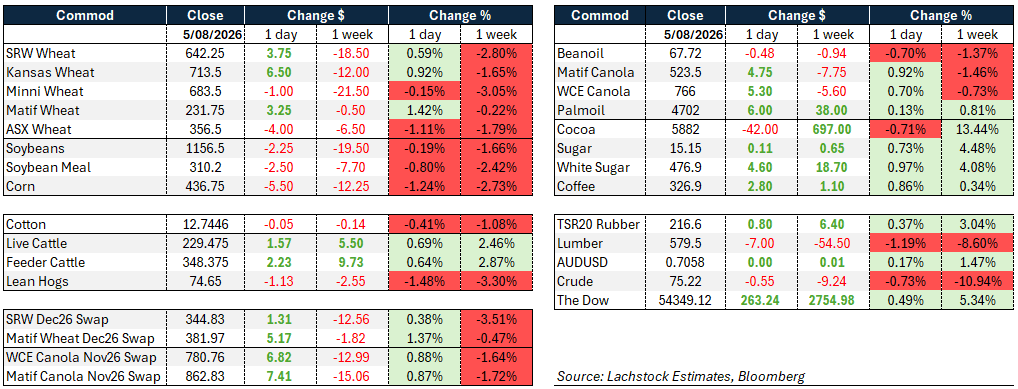
Corn and soybean export sales both fell week-on-week (1.14Mt from 1.43Mt corn; 936.1kt from 1.64Mt beans) even as wheat sales ticked up marginally, underscoring the divergence between the bullish Black Sea narrative and actual US demand pickup.
SovEcon’s July Russian wheat export estimate at 1.6Mt, weakest since 2017/18 vs the 5yr avg of 2.7Mt.
Canola and Matif rapeseed traded with crude rather than their own fundamentals Thursday, both catching a bid on the Hormuz-driven energy rally.
China’s soybean buying remains the standout demand thread across the complex — daily cargo activity, a fresh 122kt flash sale, and USSEC guidance toward 25Mt of annual purchases through 2028.
Day Ahead – Australia
The northern and southern markets have been running their own race but, as of this week, one now watches the other. Full import parity from the south (deep south) means values in both markets will start to correlate. We have seen this movie before – there is a period where there is lots of discussion that “it works on paper” but takes a while until we see either a) the north weakens b) the south rallies c) a bit of both.
The kicker for the southern market is that, every car heading to the Speed field days in Vic have increased their production number with every km driven.
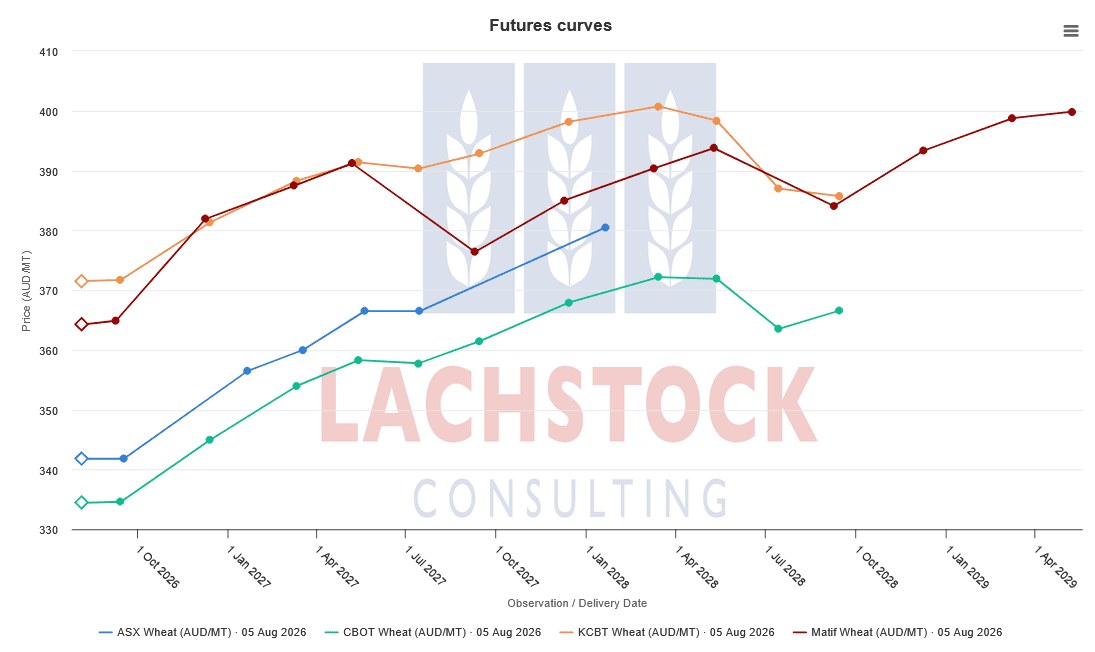 Wheat: CBOT wheat gave back Wednesday’s gains despite no letup in Black Sea disruption, a move AgResource put down to the US simply not capturing incremental demand from the war-reduced trade — end users are still working through alternate-origin options rather than defaulting to US supply.
Export sales did little to help, at 296.4kt against a 350kt expectation and short of the 320kt needed to hold USDA’s pace.
It feels like the market is pricing an assumption that BSEA logistics improve before consumers panic, even as the picture on the ground deteriorates by the day: the Russian Navy has shut Novo, Azov is unavailable, Kerch is off limits, and Odesa-area ports and shipping are hit daily.
A Russian strike overnight damaged the Guinea Bissau-flagged Mera Queen, a wheat-laden vessel in Ukraine’s Black Sea zone, killing one crew member.
Kyiv’s agriculture ministry is now working on support mechanisms for farmers as exports slump.
Rouen loadings fell to 154.6kt for the week to Wednesday from 187.8kt prior, split across Madagascar, Spain, Senegal, Ivory Coast and Ireland.
SovEcon’s Sizov pegged July Russian wheat exports at just 1.6Mt, the weakest July since 2017/18, and argued the market continues to underestimate the compounding risk to both Russian and Ukrainian export routes.
RCM’s Bergman offered the bull counter-case — short US and EU crops, El Niño risk to Australia, and tight Middle East fertiliser availability layered on top of the export restrictions.
Russian wheat exports are tracking well below the roughly 5mt five-year average for the month; contacts closest to the BSEA see no near-term relief – but what moves first here? Does Matif wheat have to do the work?.
Other grains and oilseeds: Corn firmed into the report vigil after an early dip below the 50-day drew buyers, helped by a recovery in crude; trade was otherwise thin as the market waits on Hormuz detail and next week’s WASDE.
Sales disappointed both legs — old crop 116.7kt against 400kt expected, new crop 1.03Mt against 950kt — with South Korea and an undisclosed buyer the largest takers.
Stratégie Grains cut its EU maize forecast to 49.1Mt, down 4.6Mt on the month on heat and drought damage; StoneX’s Castle flagged USDA’s July EU corn number at 53.78Mt as vulnerable to further downgrades on next week’s WASDE.
Argentine corn harvest reached 73.7 percent (+3.9pc week), with Argentina still the world’s cheapest origin.
Beans were firm on a persistent Chinese bid and the crude tailwind, crush little changed.
USDA confirmed a 122kt tonne flash sale to China for 26/27, on top of 12-15 cargoes reportedly done Wednesday; weekly sales were soft in old crop (32.2kt vs 250kt expected) but new crop beat at 904kt against 1.25Mt, China taking 330kt of it plus 498kt booked to an undisclosed buyer.
AgMarket’s Bratland pointed to the China bid plus higher EPA blending targets as underpinning demand, and USSEC’s Sutter told the Soy Connext conference China is working toward 25mt of annual US purchases through 2028, having already met its initial 12Mt commitment.
Macro: Energy and equities were whipsawed by competing Hormuz headlines.
Iran said an agreement with Oman on shipping lanes through the strait is in its final stages, with terms on entry/exit routes largely settled and any arrangement potentially valid two to four months — though Tehran was explicit that a bilateral Oman deal doesn’t equate to a full reopening, and wants Washington to lift its own port blockade first.
A separate report on the draft text said Iran would seek to bar US- and Israeli-linked shipping and impose fees on “hostile” nations, terms the Atlantic Council’s Warrick called unlikely to land well in Washington; Fars also reported an Iranian naval strike on unspecified “hostile targets” near the strait’s entrance.
Approval still needs to clear Supreme Leader Khamenei, who has been difficult to reach since February.
Added regional noise came from a large Houthi attack on Saudi-aligned forces in Yemen and two Israeli soldiers killed in southern Lebanon, the first breach of the truce since June.
Crude swung on the mix of headlines to close firmer on the day but remains sharply lower on the week; equities gave back some ground Thursday but are still up solidly week-on-week, and AUD/USD was little changed.
Local: Through the west of the country, bids were stronger yesterday, with canola up A$10/t to $841 and GM at $820. Wheat was $370 and barley $321 FIS Albany for 2026/27.
In the east, canola was $795 and GM $755, while wheat was $360 and barley $306 track Geelong.
Delivered markets were softer across the south yesterday, with many leaving the Speed Field Days spruiking the prospect of a record crop across Victoria and South Australia.
HAVE YOUR SAY