

Weather:
Pakistan, North India and Bangladesh sit under scattered showers with temperatures near normal through the six-day window, while Gujarat, west Madhya Pradesh and the Maharashtra cotton/groundnut/soybean belt see only isolated showers and near-normal temperatures, leaving filling conditions patchy rather than broadly stressed.
US Corn Belt soybeans are getting mixed rain coverage into fill, the Delta is swinging back hot and dry to push the crop toward maturity, and central/northeast China conditions remain favourable for maturing beans.
Australian wheat areas turn mostly dry again across WA, southern SA, Victoria and southern NSW with temperatures near to above normal, while northern NSW and southern Queensland trend above to well above normal over days four to six
Globally, central Russian harvest and maturation conditions are favourable, the Northern Plains and Canadian Prairies see showery weather working against harvest progress, Argentina stays dry against winter wheat needs, and southern Brazil gets frequent rain that continues to support reproductive winter wheat.
Markets
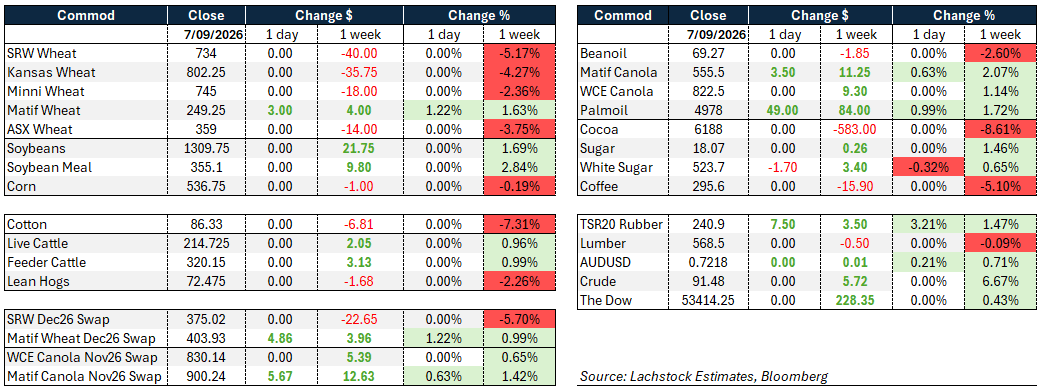
Pricing today is thinned by the US holiday
Canola continues its run, with Matif canola up 2.07% and WCE canola up 1.14% on the week, underpinned by old-crop demand, the biofuel/crude linkage and ongoing Prairie weather risk.
Crude firmed sharply, up 6.67% on the week as Iran signalled a Hormuz transit deal with Oman was close, even as fresh Iran-US tanker exchanges and a new strike on Saudi Aramco’s Jazan facility kept a geopolitical premium in the market.
The AUD firmed modestly against the USD (+0.71% week) and equities (Dow +0.43%) held a mild bid.
Day Ahead – Australia
We will wait to see how the US markets open up – SA and Vic production estimates are firming but export parity is also sneaking a little higher
.
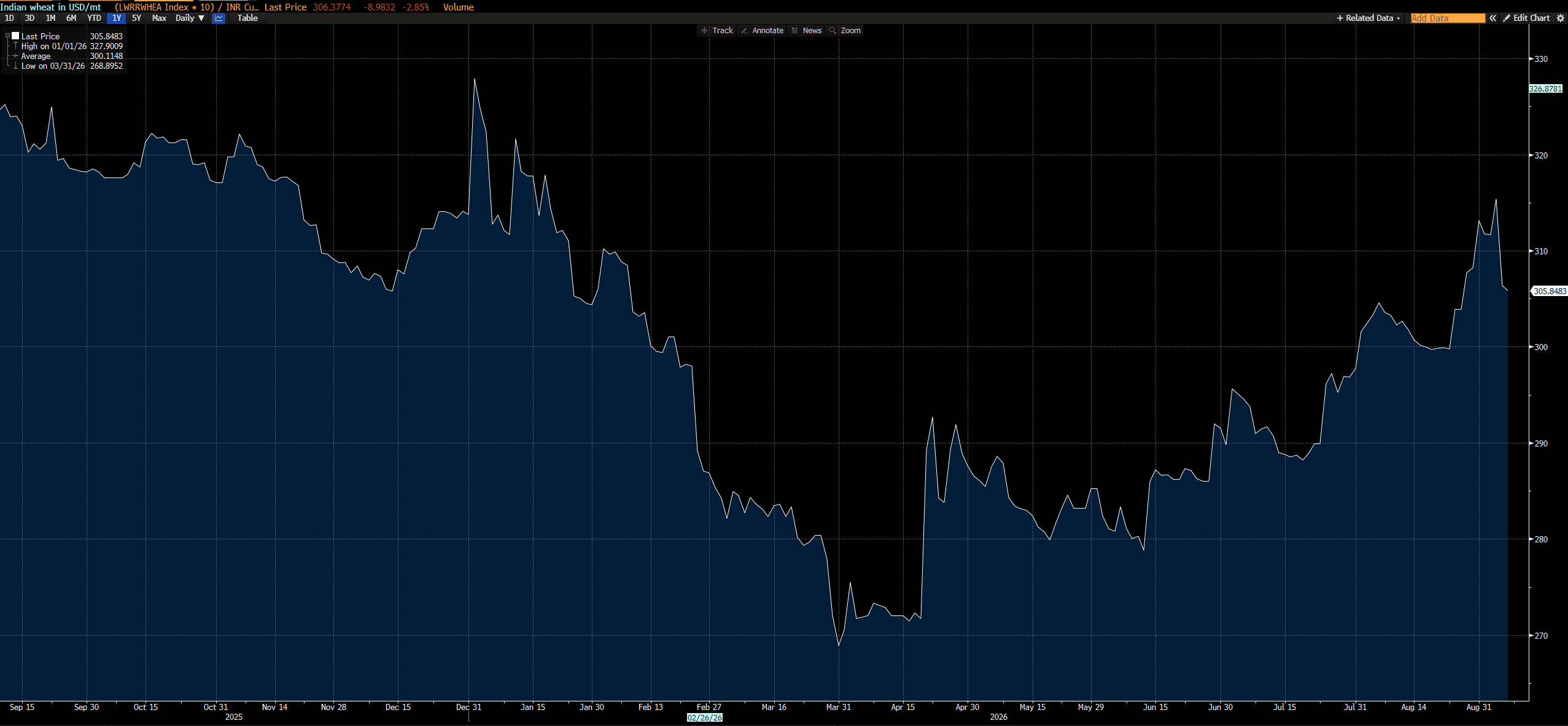
Indian Domestic Wheat in USD/mt
Source: Bloomberg
.
Markets: Wheat’s weekly pullback across the US complex and ASX contrasts with Matif’s resilience, and with no fresh Black Sea headlines in today’s flow we will wait to see how the US night market opens up.
DTN’s global wheat weather keeps two threads live: Russian harvest is progressing under favourable conditions, reinforcing supply, while showery conditions across the Northern Plains and Canadian Prairies are slowing harvest logistics in North America. Argentina’s dryness against winter wheat and the improving Brazilian rainfall profile are the two watch items for South American production framing heading into their key development windows.
Canola’s advance remains the standout in oilseeds, extending a run that’s now being driven by the combination of old-crop tightness, the crude-linked biofuel demand story and Prairie weather risk — the latter reinforced today by DTN’s showery Canadian Prairie forecast, which cuts both ways as a harvest-delay risk rather than a crop-establishment one at this point in the season.
Soybeans and soybean meal both firmed on the week, with US Belt conditions mixed into fill and China’s crush demand for maturing northeast/central beans holding steady; Indian soybean areas are seeing only scattered to isolated rain, not enough yet to flag a production concern but consistent with the erratic monsoon narrative already circulating around Indian soy output.
Crude’s 6.67% weekly rally is the dominant macro cross-current into agriculture this week. Iran’s signal that a Hormuz safe-passage arrangement with Oman is in its final stages initially read as de-escalatory, but the follow-through US strikes on Iranian tankers over the weekend and the fresh attack on Aramco’s Jazan facility undercut that read — flows through the strait remain roughly a third of pre-war levels per Macquarie’s client conversations, and the market is pricing continued disruption risk rather than resolution. This keeps upward pressure on freight and biofuel-linked oilseed pricing, canola included.
On trade policy, Canada’s move to impose tariffs of 15-50% on a wide range of US goods — steel duties doubling to 50%, plus levies on autos-adjacent and consumer categories — adds a fresh source of North American trade friction, with exposure concentrated in Midwest manufacturing states rather than directly in grain trade flows for now, but it’s a reminder the US-Canada relationship remains unsettled heading into any further WCE/Prairie-specific trade discussion.
Separately, the Kyiv meetings between Zelenskyy, Witkoff and Kushner — alongside UK, German and French officials — produced no concrete breakthrough; Kyiv sources remain pessimistic on near-term progress despite Moscow calling the preceding Witkoff-Putin talks “highly useful.” No immediate Black Sea grain-flow implications from the talks themselves, but the drone exchanges continuing overnight, including a strike on a Russian refinery, keep the underlying disruption risk to BSEA logistics live.
Local: The week started softer for cereals in the west, with wheat back $3 to $382 and barley at $328. Canola was steady to slightly firmer at $880 FIS Albany.
In the east, wheat was back $6 to $355, barley was $297 and canola $818 track Geelong.
Northern markets remain steady, with wheat around $415 for September and $430 Jan+ delivered Darling Downs. Barley is bid around $405 for Jan+.
HAVE YOUR SAY