

Weather: In the week ending 4 November, low-pressure systems brought rain and storms to large areas of eastern and central Australia. Queensland and northern New South Wales cropping regions received 5-100mm, while Western Australia and southern NSW recorded limited rain. For 5-12 November, rain is forecast mostly for the north and east, with only 1-10mm for WA and South Australian cropping regions, which suits the southern harvest.
For November 2026 to January 2027, the World Meteorological Organization says multi-model forecasts point to El Niño strengthening further. The BOM still sees below-average rainfall confined to parts of the far south-east and the northern tropics.
AgRural reports Brazil’s 2026-27 soybean planting reached 53 percent at 29 October, up from 40pc a week earlier and 47pc a year ago. Returning rain in central Brazil sped up planting, but falls were uneven, and wet soils slowed fieldwork in parts of the south.
The Rosario Grain Exchange forecasts Argentina’s 2026-27 wheat crop at 23.8 million tonnes (Mt), the second-largest on record, with harvest starting in November. However, persistent rain, low temperatures and limited sunlight have been slowing fieldwork and raising disease risk, and the Buenos Aires Grain Exchange expects yields in parts of central Argentina to fall 10-30pc because of tiller abortion and frost damage.
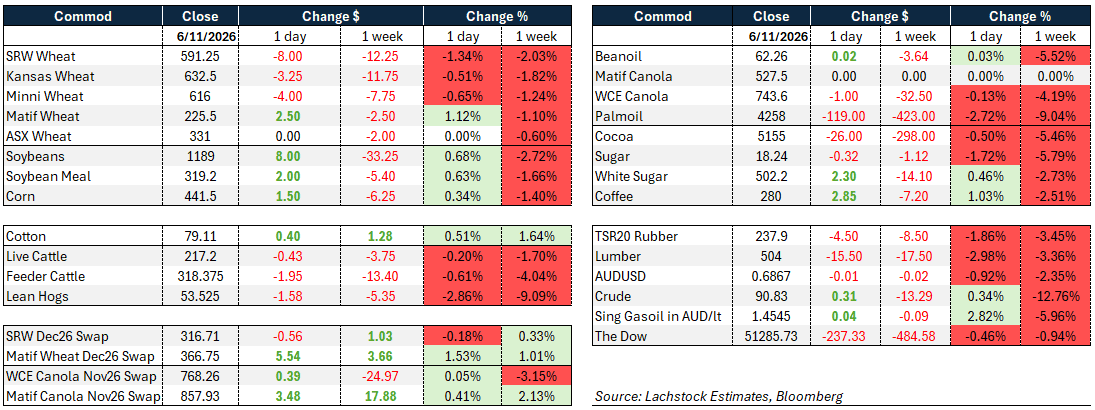
Markets: Trump’s Russia-Ukraine comments pushed US wheat to new lows, while MATIF and the AUD-denominated swaps held up much better.
Tuesday’s WASDE, out about 0330 Wednesday Adelaide time, is the key risk: trade estimates point to a lower corn yield and a higher soybean yield.
Vegetable oils are under broad pressure: palm oil is down 9pc for the week, soyoil 5.5pc and WCE canola 4.2pc. The MATIF canola swap is the only exception.
Talk of de-escalation pushed crude down 12.8pc for the week, and the AUD is weak as a risk proxy while markets price RBA cuts. Both ease input costs and support local grain prices in AUD terms.
Day ahead – Australia: A new week but the same back and forth filling the wires. Trump has seemingly taken his foot off the pedal with Iran and is making more noise around a ceasefire in the Black Sea. He needs a win for sure but the path to a ceasefire feels difficult, as does the Iran conflict: what would the agreement look like? the US pulls out and the boats flow, but would that mean they walk away from a nuclear program?
Harvest rolls along and the balance between the weight of grower selling and the export bid continues. The weakness in the AUD will help things kick the week off.
Wheat: US wheat fell to new lows on Friday after Trump said he expects a Russia-Ukraine deal soon, possibly one that also involves Europe more broadly. The comments revived expectations that Black Sea export constraints will ease.
Chicago December lost 8 cents to $5.91 1/4. RCM Alternatives noted the break to new lows came after a week of consolidation, but sees limited downside from here. MATIF went the other way, up €2.50, and the MATIF Dec26 swap rose A$5.54 to A$366.75. The SRW Dec26 swap slipped only A$0.56 to A$316.71, as the weaker AUD absorbed most of the US loss.
The FAO cereal price index fell 4.5pc in October, with wheat weighed down by soft import demand and a better Argentine production outlook.
ASX was unchanged at A$331. Monday brings US export inspections and Crop Progress, then the November WASDE on Tuesday at noon ET.
Corn and oilseeds: Soybeans and corn recovered a little after a heavy week. January beans rose 0.5pc to $11.93 3/4 and December corn gained 0.3pc to $4.41 1/2.
USDA flash sales of 136,000t of soybeans to China and 101,000t of corn to unknown destinations, both for 2026-27, gave support. Marex’s Charlie Sernatinger sees bearish risk in Tuesday’s WASDE: trade estimates put the corn yield below USDA’s October figure, but soybean yields are expected to rise.
Citi takes the opposite view, calling recent losses a buying opportunity given El Niño weather risk, biofuel demand and Chinese imports.
ICE canola recovered from an intraday low of C$743.79, and January settled C$1.00 lower at C$752.20.
Early soyoil losses, weaker European rapeseed and palm oil at eight-month lows pulled it down, while a half-cent drop in the CAD helped it recover.
The Canadian Grain Commission reported farmer deliveries of 458,700t for the week to 1 November, taking the year-to-date total to 5.9Mt, 1.3Mt ahead of last year.
Exports of 284,900t for the week were up 20pc, and the year-to-date total of 2.2Mt is up 57pc.
The WCE Nov26 swap edged up A$0.39 to A$768.26 but is A$24.97 lower for the week.
The MATIF canola Nov26 swap rose A$3.48 to A$857.93 and is up A$17.88 for the week, so the European premium keeps widening.
Local: The week finished slightly firmer for cereals in the west, with wheat at $372/t and barley at $325/t. Canola was steady at $822/t FIS Albany.
In the east, canola held around $750/t, with wheat at $335/t and barley at $280/t track Geelong.
The wheat harvest is pushing ahead on the Eyre Peninsula, with some big yields coming off in the north. Growers are reporting around 7t/ha, with most of it making ASW. At around $280/t at port, it’s some of the cheapest wheat in the country.
Early canola yields are still underwhelming in parts of SA where growers had been expecting records. Disease pressure looks to have played a part. Warmer weather and a dry outlook should see harvest ratchet up across SA and Victoria over the next week. It’ll be interesting to see whether the extra grain coming off is enough to push bids south.
HAVE YOUR SAY