
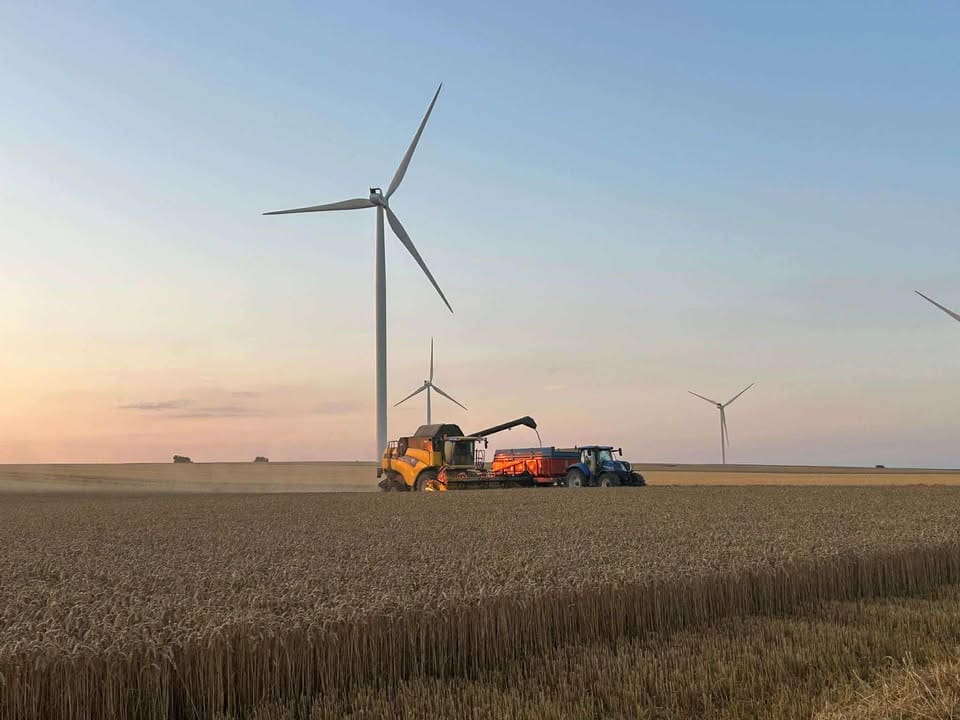
Harvest in the Vaux-Champagne region of France. Photo: Vivescia
EXPECTATIONS of vastly improved grain output across European Union member states this year are coming to fruition, with harvests proceeding at a rapid pace across much of the continent, although rain delays have played havoc in some regions.
Winter crops have reportedly performed well in the Baltic states, Nordic countries, and the Black Sea states of Romania and Bulgaria, as well as in France, Spain and Ireland, primarily due to excellent soil-moisture availability throughout much of the growing season. However, Germany, Poland, and Hungary expect average yields, with water deficits causing production issues, compounded in Germany by disease pressure. Heat and water-stressed crops are likely to manifest in below-average yields through much of Italy.
Fast pace in France
Harvest of the soft wheat crop in France, the European Union’s biggest producer, remained well ahead of average by the close of last week. FranceAgriMer reported that farmers had harvested 86 percent of the crop, compared with 71pc a week earlier, 37pc at the same point last year, and the five-year average of 59pc.
Crop ratings were unchanged from a week earlier, with 69pc of the soft wheat crop rated in good or excellent condition, well ahead of the 50pc rating at the same stage in 2024. According to the French farm ministry, France’s wheat crop had faced excessive winter rains and mixed spring weather. Despite improved rainfall in May and favourable sunlight during flowering, grain filling was constrained in some regions by hot weather in June.
France AgriMer reported that the spring barley harvest across France was 89pc complete by the end of last week, compared with 64pc a week earlier, 28pc on the same date last year, and 51pc on the five-year average. Farmers completed their winter barley harvest earlier in July.
Meanwhile, the German harvest has again ground to a halt on the back of persistent rainfall over the weekend. The unwelcome weather, especially after such a dry growing season, is forecast to continue into this week, further hampering efforts to catch up, and raising concerns that quality issues may surface as the campaign progresses.
Crop up on last year
According to the latest European Commission’s production data, the EU-27 will produce 278.4 million tonnes (Mt) of winter, spring and summer cereal grains in 2025, 9.1pc more than the 2024 harvest of 255.2Mt, and 2.1pc higher than the five-year average of 272.6Mt.
Soft wheat production is expected to be 127.3Mt, an increase of 14pc on the 2024 crop of 111.7Mt and 4.3pc more than the 122Mt average over the past five years. This is off a harvested area that is estimated to be just 0.5pc higher at 21Mha, meaning yield did most of the work, improving by 9.6pc from 5.53 tonnes per hectare to 6.06t/ha.
The soft wheat harvest in France is expected to be 32.3Mt, 27pc higher than the 2024 crop of 25.4Mt, and 2.4pc above the five-year average of 31.6Mt. This is fractionally lower than the French farm ministry’s forecast of 32.6Mt. The production rebound in Germany is forecast to be almost as impressive, jumping 16.8pc from 18.1Mt to 21.1Mt. But this is still below the five-year average of 22Mt and the National Association of Agricultural Co-operatives forecast which was adjusted slightly higher last week to 21.6Mt. Poland is the third-largest soft wheat producer in the EU-27, with output expected to be 3.5pc higher than in 2024 at 12.7Mt.
Elsewhere in the EU, Bulgaria is on track for its largest soft wheat crop on record, with a forecast of 7.1Mt surpassing the 2021/22 benchmark of 7Mt. In Spain, the wheat harvest is already winding down, but the 7.1Mt estimate will make it the second-biggest on record behind the bumper 2021-22 crop. Big wheat crops in the Baltic neighbours of Latvia and Lithuania, 2.7Mt and 4.3Mt respectively, are at or near record levels, and the 3.4Mt wheat harvest estimate for Sweden is second only to 2019-20 when 3.5Mt was reaped.
Maize area down
Maize is the second-largest cereal crop in the EU each season, with the 2025 harvest currently projected to generate 60.1Mt, an increase of 0.9pc over 2024, but 4.4pc below the five-year average of 62.9Mt. The harvested area is anticipated to be 8.4Mha, down from 8.8Mha in 2024, while the average yield is forecast to increase season-on-season from 6.76t/ha to 7.18t/ha.
France leads the way with projected output of 14Mt, down from 14.8Mt on the back of a slightly smaller area and a 4.3pc decrease in yield. Poland is the second-biggest producer this year on 8.7Mt, down from 9.4Mt in 2024, followed by the Black Sea state of Romania, where the harvest forecast of 8.1Mt is 26.1pc higher than last year’s 6.4Mt crop. Interestingly, in the five years to 2021-22, Romanian maize production averaged 15Mt, with a high of 18.6Mt in the 2018-19 season when it relegated France to the second step on the podium.
Bumper barley, rapeseed crops coming in
Barley is the last of the three major cereal crops, which collectively make up 86.5pc of total cereal production. Output this year is forecast to finish up at 53.6Mt, 9.1pc higher than the 2024 crop of 49.1Mt and 5.9pc more than the 50.6Mt average for the past five campaigns. The EC’s harvested area of 10.2Mha is down a tad from 10.3Mha in 2024, but the average yield is expected to be 10.2pc higher at 5.26t/ha.
France is expected to regain its position atop the production table in 2025, after Germany assumed the mantle last year. The French crop, winter and spring varieties combined, is forecast to be 19.4pc higher than in 2024 on 11.7Mt, despite a slight reduction in the harvested area. Yield is the saviour, increasing 20.7pc compared to last harvest to 6.52t/ha. Germany comfortably holds second position on 10.3Mt, but 2pc lower than 2024, followed by Spain where production has increased by 22.6pc this year to 9Mt.
Rapeseed is the main oilseed crop in the EU each season, making up an average of almost 60pc of the bloc’s total oilseed output over the past five seasons. Production in 2025 is expected to increase by 1.1pc, or 1.9Mt year on year to 18.5Mt, 3.3pc above the five-year average of 17.9Mt. The harvested area of 5.8Mha is 2.2pc higher than in 2024 and the average yield has jumped by 8.7pc to 3.19t/ha.
Like soft wheat, the big three rapeseed growers are France, Germany and Poland, with this season’s production expected to be 4.2Mt, 3.9Mt and 3.2Mt, respectively. Together they have accounted for an average of 61.7pc of total EU-27 rapeseed output since 2020-21, with the crop size slowly decreasing in both France and Germany, but trending higher in Poland.
HAVE YOUR SAY