
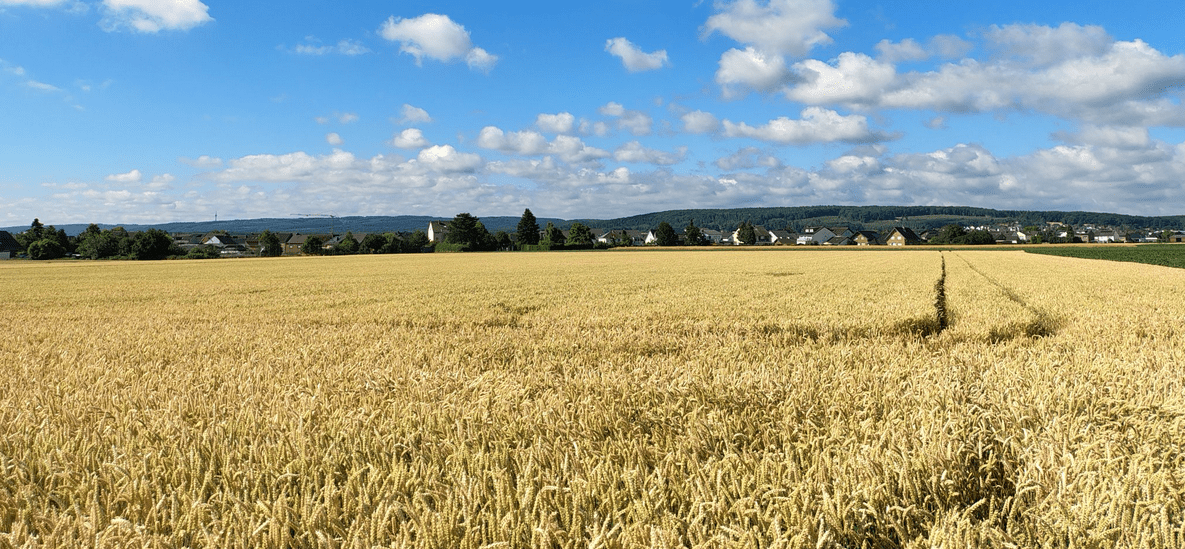
A ripening crop in western Germany’s Rhineland in July last year. Photo: Leeve Jong
AMPLE global wheat supplies, combined with increased competition for sales into traditional export markets, have forced the European Commission to reduce its soft wheat export forecast for the European Union for the 2025-26 marketing year, which commenced 1 July 2025.
In last Thursday’s update from the commission, exports of the bloc’s main cereal grain were pegged at 29.5 million tonnes (Mt), against its December forecast of 31Mt. The lower export estimate drove an increase in the commission’s projection for EU soft wheat stocks at the end of the 2025-26 season on June 30 to 13Mt, up from the 11.7Mt forecast last month.
However, buoyant export demand for barley in the first half of the marketing year saw the commission increase its outlook for EU barley exports this season from its December forecast of 10.1Mt to 11Mt last week. This led to a more than proportional cut in the 2025-26 carry-out projection from 6.1Mt to 4.2Mt.
Wheat exports slow
The lower wheat export estimate from the EC came a couple of weeks after consultancy Expana cited sluggish shipments from northern EU countries and Romania as the primary reasons for adjusting its EU soft wheat export forecast 1.2Mt lower to 28.8Mt. The reduced estimate reflects generally weaker demand and slower shipments to non-EU countries, as pressure builds on higher-priced western European origins, with France remaining the only major exporting country among member states with an unchanged outlook.
The Expana revision coincided with the French farm office FranceAgriMer trimming its forecast for French soft wheat exports to destinations outside the EU in 2025-26 from 7.6Mt to 7.5Mt, but still more than double the volume shipped a season earlier. Conversely, the government agency raised its forecast for intra-EU shipments of French soft wheat in the 2025-26 marketing year from 7.39Mt to 7.51Mt, up from 6.8Mt in 2024-25.
The increase mainly reflects higher projected sales to Germany, Ireland, Spain, and The Netherlands, according to FranceAgriMer grain analyst Habasse Diagouraga. FranceAgriMer raised its outlook for 2025-26 soft wheat ending stocks from 2.74Mt to 2.8Mt, 12.7 percent higher than that carried into this season.
FranceAgriMer pegged 2025-26 barley ending stocks at 1.55Mt, up from last month’s projection of 1.46Mt, and 34.3pc higher season on season. After large shipments to China in the summer, France continues to export significant volumes of barley to Saudi Arabia, Diagouraga stated.
Competition from Argentina
Exports of French wheat to traditional destinations such as Morocco have been buoyant in the first half of 2025-26, but the pace is expected to slow in the first quarter of 2026 as export competition from Argentina intensifies. With a record exportable surplus to clear, Argentina is currently offering wheat at very competitive prices, putting pressure on higher-priced western European exporters.
Offers from Argentina and the Black Sea region appear to be setting the tone for many international tenders at the moment, a dynamic that has tightened margins for EU exporters who are struggling to clear stocks without heavy discounts. The European growers’ reluctance to extend sales at current price levels only compounds the challenge.
The results of the Algerian and Saudi Arabian tenders in late January have further sharpened concerns for European wheat export volumes in the second half of the marketing year, with Argentina and Black Sea origins the primary suppliers. This reinforces a shift that narrows the EU’s export options just as it tries to lean harder on Morocco and Algeria concentrates on Black Sea supplies.
There is hope that French sellers will pick up some Egyptian wheat demand as the price spread to Russian, Ukrainian and Romanian supply narrows following a recent increase in Black Sea shipping costs. The exceptionally high demand for barley has also increased the competitiveness of EU wheat as a feed grain option versus barley.
More barley shipped this year
EU countries exported a total of 21.98Mt of grain and grain products in the first 30 weeks of the 2025-26 marketing year. This is up from 21.56Mt a week earlier and 16.1pc higher than the 18.93Mt shipped in the same period in 2024-25, with increased barley volumes the primary contributor.
Soft wheat exports to January 23 totalled 12.38Mt, fractionally lower than the 12.44Mt shipped in the same period a season earlier, but substantially lower than the 19.35Mt exported in the 2023-24 marketing year. However, shipments of durum wheat are significantly higher at 1.1Mt, compared to 330,000t for the same period in 2024-25. Add the grain equivalent of flour and durum meal exports, and that pushes total EU wheat exports to 13.88Mt, compared to 13.24Mt in the previous corresponding period.
France and Romania share top billing for soft wheat export volumes at the end of week 30 with 3.85Mt, or 31pc apiece of the total volume. Lithuania is the second-largest exporter with 1.62Mt, or 13pc, followed by Germany on 990,000t, Latvia with 750,000t and Poland on 520,000t.
Morocco is the leading soft wheat destination on 2.26Mt, or 18.2pc of the total volume. Saudi Arabia is the second-largest destination with 960,000t, followed by Egypt, Nigeria and Algeria with 900,000t, 670,000t and 660,000t respectively. Nigeria held top spot a season earlier, with 1.96Mt, or 15.7pc of the total. Morocco held down second spot with 1.38Mt, or 11.1pc of the total, followed by Algeria, Egypt and Saudi Arabia.
Barley exports to January 23 totalled 5.65Mt, a 210pc increase on the 2.7Mt shipped in the first 30 weeks of 2024-25, and 162pc more than the 3.49Mt exported over the same period in 2023-24. In fact, exports season-to-date already exceed those for the entire 2024-25 season. Saudi Arabia is the leading buyer of EU barley, with imports of 1.33Mt, up from 700,000t in 2024-25 and accounting for 23.5pc of the total export volume. China holds second spot with 890,000t, or 15.7pc of the total, followed by Jordan, Algeria and Turkey.
France shades Romania on the EU’s barley export table to January 23 with 2.09Mt and 1.96Mt respectively. Together they account for 71.6pc of barley exports so far this season, with Germany the only other exporter of significance on 900,000t, or 15.8pc, of the total.
HAVE YOUR SAY