
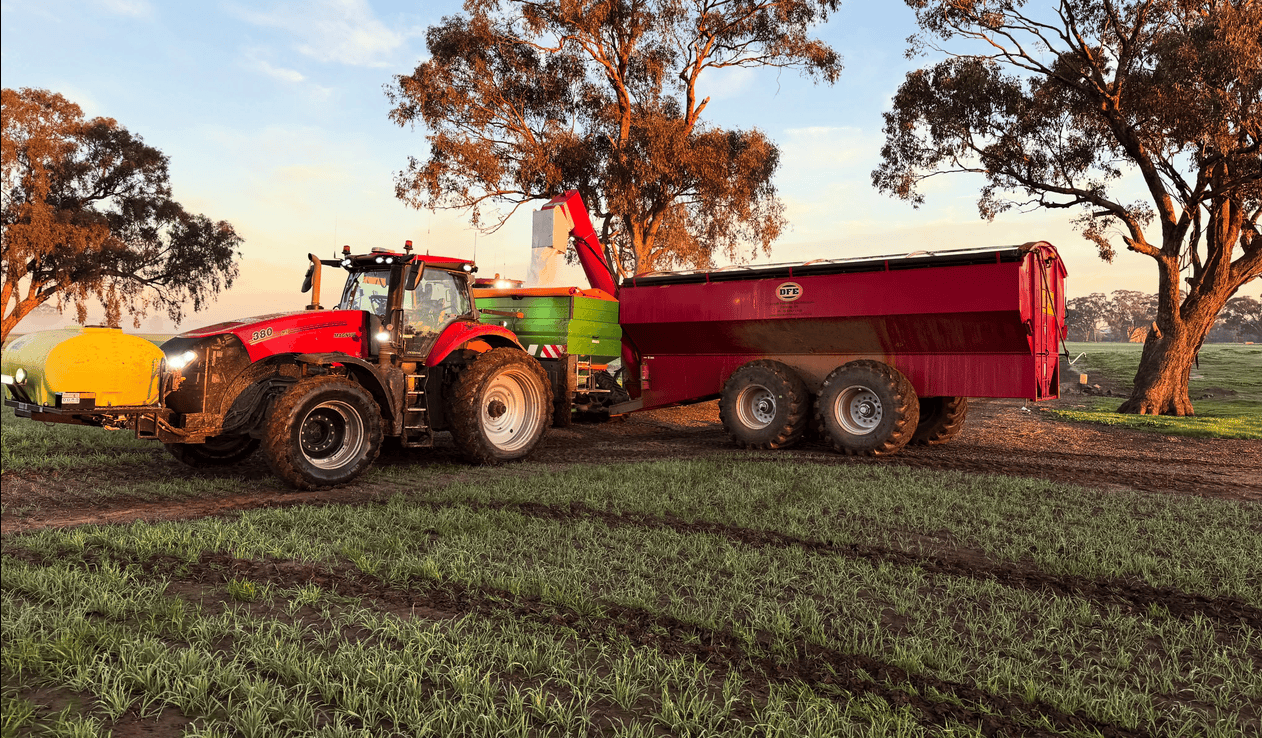
Spreading urea this week in the Oaklands district of southern NSW. Photo: Narrain Grain
VALUES have softened a little in the north, and firmed in the south amid subdued consumer demand, and limited interest in wheat for export.
In the south, export demand for barley, and sales into the northern feedlot market are supporting prices.
More substantial rain fell in South Australia in the past week, but conditions across eastern Australia’s grain-growing areas have been mostly dry, allowing more urea to be spread ahead of the next rain forecast for south-eastern Australia.
| July 2 | Today | |
| Downs barley | $380 | $380 |
| Downs SFW | $378 | $375 |
| Downs sorghum | $360 | $355 |
| Mel barley | $332 | $335 |
| Mel ASW | $345 | $350 |
Table 1: Indicative prices in Australian dollars per tonne for prompt delivery.
Dry week in north
Just one week of dry weather in Queenslandd and northern New South Wales and growers are once again clamming up on selling as concerns about El Niño conditions kick in.
“Southern Queensland growers might be sitting out for the next six weeks if we don’t get any rain,” one trader said.
A small amount of new-crop business is being done, with wheat at $390-$393/t delivered Downs in the January slot, and barley at $368-$375/t.
Barley’s discount to wheat reflects the usual trend in the harvest and post-harvest window, and will be magnified late this year because many growers ran out of time and/or moisture to plant all their intended wheat area.
In Central Qld, conditions are drier than ideal for wheat, but chickpeas on most farms are faring well with their feet in subsoil moisture as the region’s sorghum harvest continues.
“It’s just so much drier here in Queensland than it is in the rest of the nation,” Knight Commodities Goondiwindi-based broker Gerard Doherty said.
“From Talwood to Dirranbandi to Surat, I’d say only 10 percent of the intended winter-crop area has been planted.”
However, conditions are generally better in the area bordered roughly by Goondwindi, Dulacca and Dalby.
“Wheat area is definitely down; everything’s down in Queensland.”
Mr Doherty said barley as a percentage of Qld’s total winter crop was up, with it being the first to be planted after it started raining in late May.
He said conditions over much of the western and Darling Downs are good, but some crops are sitting on a less than full subsoil-moisture profile.
“You could ring 50 different growers and get 50 different stories about how their crops are going.”
Mr Doherty estimates at least 30pc of southern Qld’s winter crop has not been planted because it was either too dry early in the piece, or too wet later on.
“I’d say 30pc of what’s gone in is on marginal moisture.”
Mr Doherty said consumers were “extremely comfortable” at present, although that may change if fronts that for weeks have been bringing regular rain stop.
If rain to wet the topsoil falls by mid-August, growers are likely to start putting in an expanded sorghum area, and new-crop has recently traded at $350 delivered Downs for Feburary-March.
“Our sorghum area has the potential to be up markedly on last year.”
Barley being sold ex-farm Downs is mostly going to the Burnett or coastal regions, and western Downs feedlots are continuing to source barley from as far away as south-central NSW.
“That’s what will keep a lid on the market.”
Cottonseed is trading at around $525/t delivered Downs, and making its way into some specialist rations, although most feedlots do not see current rates as good value compared with canola meal.
Considerable stocks are said to be sitting in ginners’ hands, with Australian cottonseed still trading well over export parity.
Light frost slows south
Some light frosts in south-eastern Australian cropping regions in the past week have been welcome to slow the rapid development of cereals in what has been an unusually mild and wet winter so far.
In northern Victoria and southern NSW, barley is selling at around $330/t delivered up-country consumer, and the trade is looking to build some coverage.
“We’re starting to get trade offers at $10-$15/t over where the consumer sees it,” one consumer said.
Barley continues to be exported at pace out of southern Australian ports, which is supporting the domestic market.
However, wheat is finding little love on the bulk or containerised export front, despite plenty of parcels being over 11pc in protein.
“Most wheat coming into us…is the H2 type,” the consumer said.
In the week to today, pockets of the Mallee and Wimmera had mostly single-digit rainfall, if any, with St Arnaud on 13mm topping the regions’ registrations.
Top-dressing is taking place across Vic, and southern and central NSW, but more substantial rain across much of SA will keep its growers off the paddocks this week.
Grain Central: Get our free news straight to your inbox – Click here
HAVE YOUR SAY