
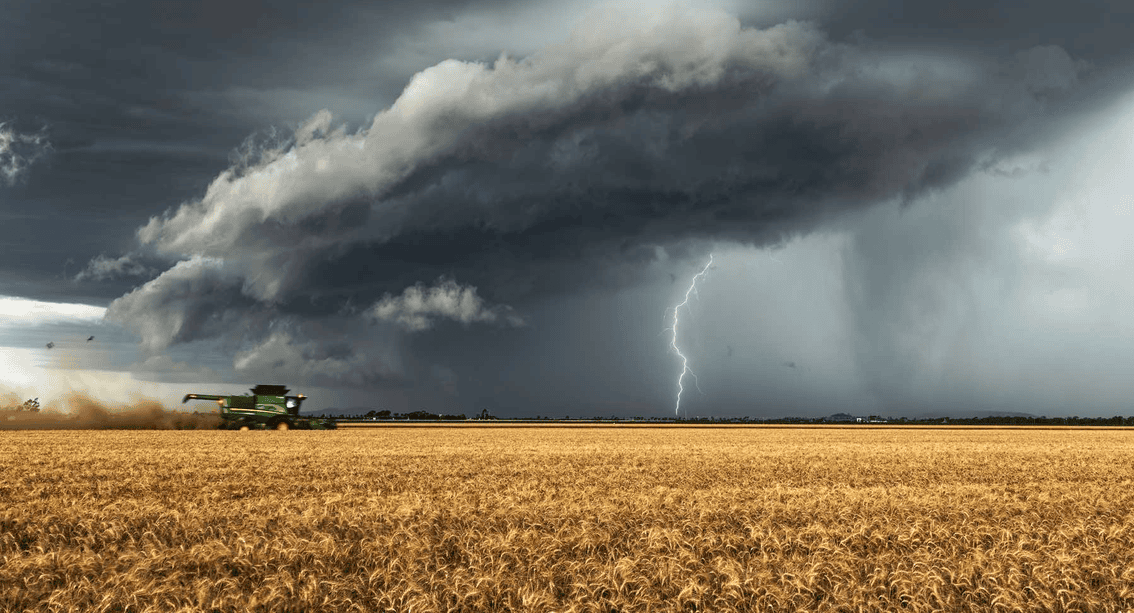
Harvesting at Jondaryan on Tuesday amid storms. Photo: Chris McFerran, SE Qld Weather Photography
MARKETS have gone quiet as growers and consumers ingest the impact of a soggy northern harvest, and a low-protein profile for southern cereals.
In the north, old-crop grain is filling nearby needs for the local feed market, which is loath to overbook off-spec grain available harvested after rain and humidity arrived late last month.
In the south, hopes remain high for high cereal yields and testweights.
For some, those hopes were dashed by a storm on Monday which brought rain, wind, and hail to a small part of the Victorian Mallee.
Harvest remains slow to gather pace, and quality in the bin to date is variable, with high screenings and low testweights seen in a number of crops in New South Wales.
| Oct 29 for prompt | Today for prompt | Oct 29 for Jan | Today for Jan | |
| Downs barley | $400 | $400 | $400 | $403 |
| Downs SFW | $425 | $420 | $428 | $423 |
| Downs sorghum | $375 | $380 | $358 Mar-Apr | $360 M-A |
| Mel barley | $310 | $295 | $310 | $305 |
| Mel ASW | $380 | $345 | $350 | $350 |
Table 1: Indicative prices in Australian dollars per tonne.
Slow going in north
Growers in southern Qld and northern NSW are having mixed success with harvesting, with humidity, showers, and boggy ground slowing progress.
In southern Qld, higher registrations in the week to 9am today include: Felton 48mm; Jondaryan 17mm; Oakey 23mm; Miles 36mm, and Roma 11mm.
In northern and central NSW, higher registrations included: Dunedoo and Quambone 25mm; Manildra 12mm; Mungindi 13mm; Quirindi 24mm, Trangie 20mm, and Warialda 15mm.,
Off-spec grades are appearing at bulk-handling sites, accommodating SFW1, AGP1, HPS1, FED1 wheat, and BAR2 barley.
However, harvest deliveries are slow, and so is trade.
Sunrise Commodities managing director Scott Merson said rain in the north has washed around 5kg per hectolitre out of wheat and barley.
“We were coming from a high-quality base and… in most cases, barley’s stlll making BAR1 and wheat is making SFW no problem at all.”
Mr Merson said plenty of wheat and barley is weighing in at 76kg/hectolitre or more; with 65kg the cut-off for BAR1, and 62kg/ha for SFW.
However, plenty of grain is shot and sprung, an unattractive proposition for feedlot, pig and poultry nutritionists, but an appeal-booster on price to its commodity buyers.
Traders say BAR2, which as with SFW has no minimum falling number as a measure of sprouting, is trading at a $30/t discount to BAR1, with BAR3 a further $20/t below BAR2.
On the plains and outer slopes of southern and central NSW, some crops are showing the impact of a dry finish, and Mr Merson said up to 90-100pc screenings, while others are of sound quality.
The bright side of the north’s rain is its potential to enable a big summer-crop planting.
Mr Merson said feedlots may become sorghum customers if their nutritionists are supportive, and if the price relativity works in March, which is when new crop should become available locally.
“A lot of people are talking about whether the feedlots step in for sorghum.”
The rule of thumb on price is that sorghum needs to be 76pc the price of wheat, well below the current March spread of around 85pc.
Northern consumers are seen as comfortable for now, but would not be if old-crop grain was not being offered by the grower.
“The feedlot is probably comfortable on the amount it has purchased, but is not so comfortable on the quality of what’s being delivered.”
South needs heat
Victoria’s harvest is yet to start in earnest, with showers and storms delaying the ripening of Mallee crops.
Some in the eastern Mallee were hit by hail, wind and up to 25mm of rain, although official registrations in the Mallee are below that.
Rainfall figures for the week to today in Vic growing areas include: Dimboola 12mm; Nhill 15mm; Longerenong 18mm; St Arnaud 26mm, and Woomelang 7mm.
Mygrain broker Andy Brown said he had head of Monday’s storm significantly damaging all of one grower’s crops, and a patchier impact on others.
“The storm hit a strip through the north of Hopetoun, and across to Wycheproof and Sea Lake, and back to Quambatook,” Mr Brown said.
Growers are hoping rain stops now, and concerned about cool conditions, not what the crop needs to ripen.
“A few guys are playing around with harvest, but if you had 3-5mm on Monday, the crop’s not ready; it’s too green.”
The mild and prolonged finish is boosting expectations of a low-protein harvest, and the premium for APH over ASW has blown out to around $60/t in the north, and is showing signs of following suit in the south as millers chase preferred grades.
“In Horsham, we’re supposed to have a top temperature of 16 degrees on Saturday, when what we need is three or four days above 30 to bake the grain; we’ve only had one day above 30 so far this spring.”
Some receival sites are indicating a moisture tolerance of up to 12.5-13 percent for ASW wheat, above the normal 12pc, to help growers out and get tonnes through the gate.
Mr Brown said growers have mostly been cautious on forward selling, with some yet to commit a tonne ahead of harvest, while others are more than half sold on barley.
Old-crop barley from southern NSW continues to make its way north by road to supply the domestic market as consumers wait for sound-quality southern loads to be offered.
Indications are that the southern market will find support from northern and local buyers at more than $250/t ex farm in Vic and southern NSW.
“With yields down here at 7-8t, $250 can still make a decent margin; if the yields were 3-4t, it would be a disaster for the grower,” a trader said.
Grain Central: Get our free news straight to your inbox – Click here
HAVE YOUR SAY