
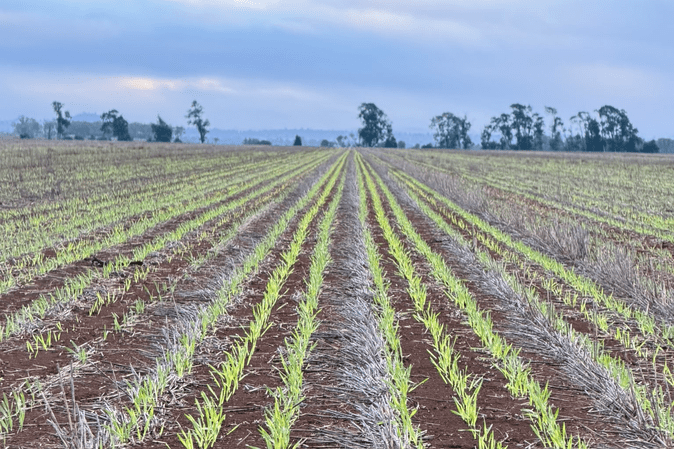
Barley planted June 5 on the Darling Downs shows the benefit of recent rain and the mild winter to date. Photo: Lance Wise
A CONSOLIDATING start to the season in northern New South Wales and southern Queensland has encouraged some growers to sell wheat into a market which has softened further in the past week.
Across all of eastern Australia, the June 30 end to free warehousing for grain delivered in the 2025-26 harvest is also encouraging some growers to let go of volume.
Liquidity in the north’s new-crop market is starting to pick up, but is mostly confined to trade rather than grower business, while in the south, growers are top-dressing where it is not too wet to
| June 11 | Today | |
| Downs barley | $390 | $388 |
| Downs SFW | $383 | $380 |
| Downs sorghum | $365 | $360 |
| Mel barley | $335 | $335 |
| Mel ASW | $355 | $351 |
Table 1: Indicative prices in Australian dollars per tonne.
North
Barley from central NSW continues to make its way into southern Qld feedlots to supplement limited volume available locally.
Wheat is being sourced from the Downs and far northern NSW, where the trade is confident that carry-out into new crop will exceed 700,000t in on-farm and bulk-handling sites combined.
“There’s a bit of consumptive demand for July to October,” one trader said.
“With the lateness of the winter plant, you probably want to get covered until at least late October.”
Growers in the north are planting wheat, barley and chickpeas, and are not expected to do any forward selling until they see winter cereals established.
“They’re waiting for new financial year to kick in, and to see how the current crop progresses before they commit anything.”
The Bureau of Meteorology on Tuesday announced the arrival of an El Niño event, which is giving growers a reason to be cautious about forward selling if they do not have current-crop stocks as back-up.
Some southern Qld crops got rain in the week to 9am today, with Dalby on 26mm, Felton on 17mm, and Pratten on 55mm among the higher registrations.
Falls in NSW were light and patchy in the week to today, which produced 18mm at Pallamallawa, 10mm at Parkes, and 16mm at Grenfell as three of its highest totals.
In north-central NSW, some growers are selling barley ex farm at around $310/t.
Cottonseed continues to be either out of feedlot rations, or at minimum inclusion, due to its expense relative to alternatives.
For most feedlots, that means canola meal, which is available at around $570/t delivered Downs versus cottonseed at $545-$560/t.
Woodside Commodities managing director Hamish Steele-Park said cottonseed values are range bound, with any demand still domestic focused.
“There have been no exports of cottonseed since the end of last year due to high price of seed in Australia compared to USA and other origins such as Argentina and Brazil,” Mr Steele-Park said.
In NSW, ex-gin cottonseed values are sitting at around $510-$515 in the Gwydir Valley, $490/t in the Macquarie Valley, and $540 in the Riverina.
Recent heavy rain has dampened grazier demand for cottonseed for supplementary feed after a dry late summer and autumn, and market talk is that prices will have to come down.
“Ginners’ sheds are going to fill up at these values,” a trader said.
More rain in south
Wet weather is limiting the ability of some growers to top-dress crops in South Australia and Victoria, and some are turning to aerial applications to get over wet ground.
“There’s water lying everywhere around the place,” independent Horsham-based broker Andy Brown, Mygrain, said.
Urea prices are said to be falling by roughly $20/t per day, although many growers and retailers have locked in at higher prices.
Mr Brown said canola and barley were getting the most top-dressing attention, and growers looking for a cash sale were opting for lentils, based on its yield prospects being high, and them wanting to catch that market at more than $600/t delivered Wimmera.
In the week to today, higher registrations in the Vic grainbelt include: Nhill 29mm; Horsham 30mm; Rupanyup 15mm; Werrimull 14mm, and Woomelang 10mm.
In SA, rain was heavier and more widespread, and registrations include: Buckleboo 50mm; Bute 32mm; Lock 87mm; Lucindale 55mm; Minlaton 62mm; Paskeville 43mm; Penong 57mm, and Pinnaroo 27mm.
Grain Central: Get our free news straight to your inbox – Click here
HAVE YOUR SAY