
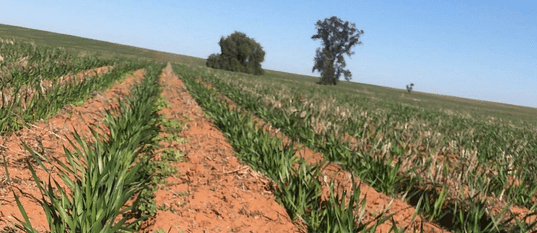
Cereals are off to a flying start in the Mallee. Photo: Matt Witney, Dodgshun Medlin
WHEAT prices are under pressure in the north, where a turnaround in the season has brightened new-crop production prospects,and consumers are banking on a further softening in values.
In the south, scattered showers have further brightened new-crop prospects, and growers are well into top-dressing with urea.
With urea now available at around $1200/t, roughly $200/t below where it was selling throughout March, April, and May, crops across eastern and South Australia should be well fed.
This is only fueling consumer expectations that prices will ease further in coming weeks, and their buying in the spot market is limited.
| June 4 | Today | |
| Downs barley | $390 | $390 |
| Downs SFW | $385 | $383 |
| Downs sorghum | $360 | $365 |
| Mel barley | $340 | $335 |
| Mel ASW | $355 | $355 |
Table 1: Indicative prices in Australian dollars per tonne.
North makes progress
Patchy rain in the past week has further brightened the prospects for cereals being planted in northern New South Wales and southern Queensland.
After being bone dry through summer and autumn, some cropping regions in northern NSW have now had more than 100mm of rain in the past four weeks, with top-ups this week.
Bureau of Meteorology registrations in the week to 9am today include: Coonamble 15mm; Moree 20mm; Mungindi 16mm; Narrabri 19mm, and Walgett 18mm.
After a very dry start to the year we’re very late but at least now in the game . #wheat pic.twitter.com/ITU67Bvjtw
— Dave Beare (@Portreath44) June 10, 2026
Above: Tim Beare planting Hellfire wheat this week at Portreath, Billa Billa, north of Goondiwindi, where the Beare family is about halfway through planting its winter crop of wheat and chickpeas at Portreath, and on its Talwood country.
Dry sowing is not a common practice in the heavy soils of the north, but confidence in forecasts has seen considerable areas planted ahead of rain to catch the optimum planting window.
“We’re seeing a fair bit of wheat get offered from the grower side now; there’s a lot more comfort around now about the season,” Sunrise Commodities managing director Scott Merson said.
“Between Rowena and Garah, there has been up to 150mm…and we’re seeing big swings into barley this year.”
“With barley generally trading at a premium over wheat in the north, and with fertiliser issues, there’s going to be a wedge of barley around.”
Barley can be grown successfully with less applied nitrogen than wheat, and urea has come down considerably in price in recent weeks as confidence in supply improves, despite the Strait of Hormuz remaining closed to urea exports to Australia.
The northern market has been trading at a premium over the south of $50/t for barley and $30/t for wheat to reflect the scarcity of local barley.
On the back of new-crop being planted, some January-forward wheat has traded at $395/t delivered Downs against barley at $384/t.
While on-farm barley stocks in the north are limited, consumers are aware that a large carry-out of perhaps 700,000t of wheat exists in the north.
“There’s still a solid premium here; we’re very elevated for what we’re carrying.”
“They know they need to be looking at old-season stock and saying ‘tax man be damned’.”
While barley is still coming into the northern market from central NSW, the wheat drawing arc is shrinking as some northern NSW growers let go of wheat now they are confident of getting a wheat crop in and up this month.
Ahead of the USDA World Agricultural Supply and Demand Estimates due out overnight, the global wheat market is looking bearish.
“I don’t know where we push down to, but there’s a lot of fresh air underneath it.”
Supplementary feeding of livestock is still taking place on the north-west slopes and New England of northern NSW, where rain has come too late to spark pasture growth ahead of winter.
However, most graziers are seen as covered for their grain, cottonseed and molasses needs for winter.
South switches to top-dressing
Scattered showers over South Australia, Victoria, and southern NSW are ideally timed for the wider region’s crops which in almost all districts got off to a strong and early start.
Many growers have completed their first top-dressing of cereals and canola, and reports are coming in of a few early canola crops starting to flower, an indication of how much growing they’ve done ahead of the winter solstice.
Independent Horsham-based broker Andy Brown, Mygrain, said a widespread frost is yet to settle in Wimmera this month, which makes the start to this winter unusual.
“Some cold weather would slow these crops down; that wouldn’t be a bad thing,” .
Grain Central: Get our free news straight to your inbox – Click here