
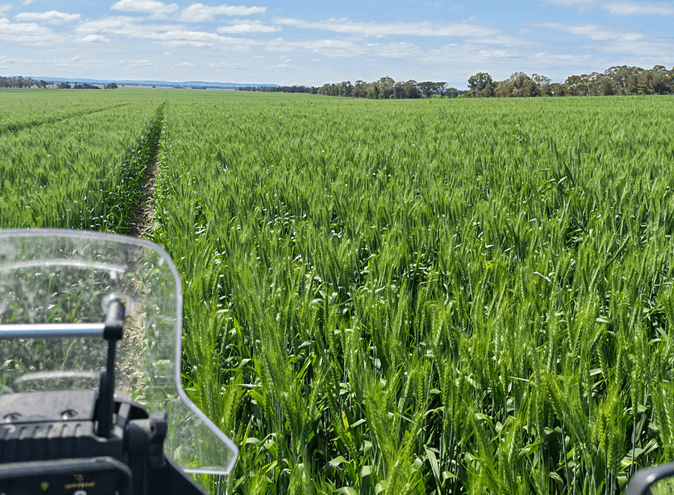
Cereal crops west of Grenfell are filling in ideal conditions. Photo: Broden Holland
BARLEY prices have dropped by up to $10 per tonne in the past week as modest new-crop volume starts to filter into the hungry northern market, and patchy rain helps to underpin yield prospects in the south.
With new-crop wheat in southern Queensland still at least a fortnight away, nearby wheat values in the north have dropped by only a dollar or two as traders report considerable volume still coming north over the border.
Export demand is helping to support wheat but not barley as growers in the south clear out storages ahead of harvest.
| Sep 24 prompt | Today prompt | Sep 24 for Jan | Today for Jan | |
| Downs barley | $420 | $410 | $415 | $412 |
| Downs SFW | $432 | $430 | $450 | $430 |
| Downs sorghum | $380 | $380 | $380 | $380 |
| Mel barley | $310 | $302 | $318 | $308 |
| Mel ASW | $375 | $375 | $365 | $365 |
Table 1: Indicative prices in Australian dollars per tonne for prompt and January delivery.
North gets rolling
Yet more dry weather in the north has sped up the ripening of cereals crops, and the ramping up of the barley harvest in the Maranoa and pockets of the Western Downs.
In the Maranoa, up to three quarters of some barley crops has been harvested.
Quality appears to be good, with testweights well over the minimum 62.5kg/hectolitre required for BAR1, and yields around 2.5-3 tonnes per hectare.
Some Maranoa growers have been selling barley off the header at around $370/t on farm, which equates to around $420/t delivered Downs, given the currently high diesel prices which have jacked up freight rates.
Northern growers with old-crop wheat to sell are hanging on to it and hoping for prices to kick by at least $10/t to get them back to levels seen last month.
“Barley’s got a good drawing arc, and growers have been selling it,” one trader said.
The epicentre of Australia’s feedgrain demand in southern Qld is looking at a limited supply of new-crop wheat, which is jostling in buyers’ minds against softer world pricing for wheat.
The local reality is a number of northern wheat and barley crops grown with grain in mind have been cut for hay or silage, or grazed out.
“Our feeling is there is a higher proportion of barley and…the $20 premium for wheat over barley…is expected to be sustained because of less wheat being around,” Narrabri-based AgVantage Commodities broker Brendon Warnock said.
After a dry September, Mr Warnock said cereal crops are turning, and the NSW barley harvest looks set to start in earnest by the third week of October.
Mr Warnock said grower selling was “a bit of a mixed bag”.
“We’re doing little trades here and there…to get the last out of silos,” Mr Warnock said, saying that the limited volume coming forward is mostly from farms east of the Newell Highway.
“Out west, they’re sitting on old-crop chickpeas, and they don’t have new-crop coming.”
Mr Warnock said consumers were aware the northern harvest was going to be a short and sharp one before headers moved into higher-yielding crops in the south.
“Feedlot consumers are looking to get November supply from further afield.
“We have seen a fair bit of inquiry from the trade wanting to buy November pick-up from northern NSW.”
West of the Newell in northern and north-central NSW, many cereal crops ran out of moisture, and Mr Warnock said he has heard of barley crops which were seen as having potential for 5t/ha now ratcheted back to 3t/ha.
However, pockets of long fallow on the north-west plains could well yield 4t/ha of barley.
Wheat up to H2 specs has been trading into the domestic feedgrain market, primarily feedlots.
“That’s the main show in town.”
Welcome rain buffers south
Crops in parts of South Australia and Victoria have had 5-15mm of rain in the past day or two, and more is on the forecast.
“This’ll finish it off for us,” Horsham-based Mygrain managing director Andy Brown said.
While SA had some unusually hot weather in the past week, with temperatures of around 35 degrees Celsius recorded in some districts, Vic has had mild weather to ease the crops into a gentle finish.
Mr Brown said finding local homes for Vic barley has become a challenge and, despite expensive diesel, some is making its way to Qld consumers.
Sources report ex farm Mallee prices of around $260/t.
“Wheat’s been good; we’ve shifted some of that.”
On top of domestic consumer demand and container business, wheat for bulk export out of Vic is still being accumulated to roll the market into new-crop.
“Consumers are looking at how big this crop is going to be and they’re not in a rush.”
Barley yields could nudge 10t/ha in the Wimmera, and 6-7t/ha in the Mallee, with Vic’s harvest expected to start on canola in about three weeks in the Mallee.
Grain Central: Get our free news straight to your inbox – Click here
HAVE YOUR SAY